Table of Contents
Fluted vs Reeded: Why the Confusion?
The terms “fluted” and “reeded” are used interchangeably by many retailers — which causes genuine confusion when you’re trying to make a specific design decision. They are actually distinct profiles with different visual characteristics, different historical origins, and subtly different effects in a room. Here’s a clear breakdown.
What Are Fluted Panels?
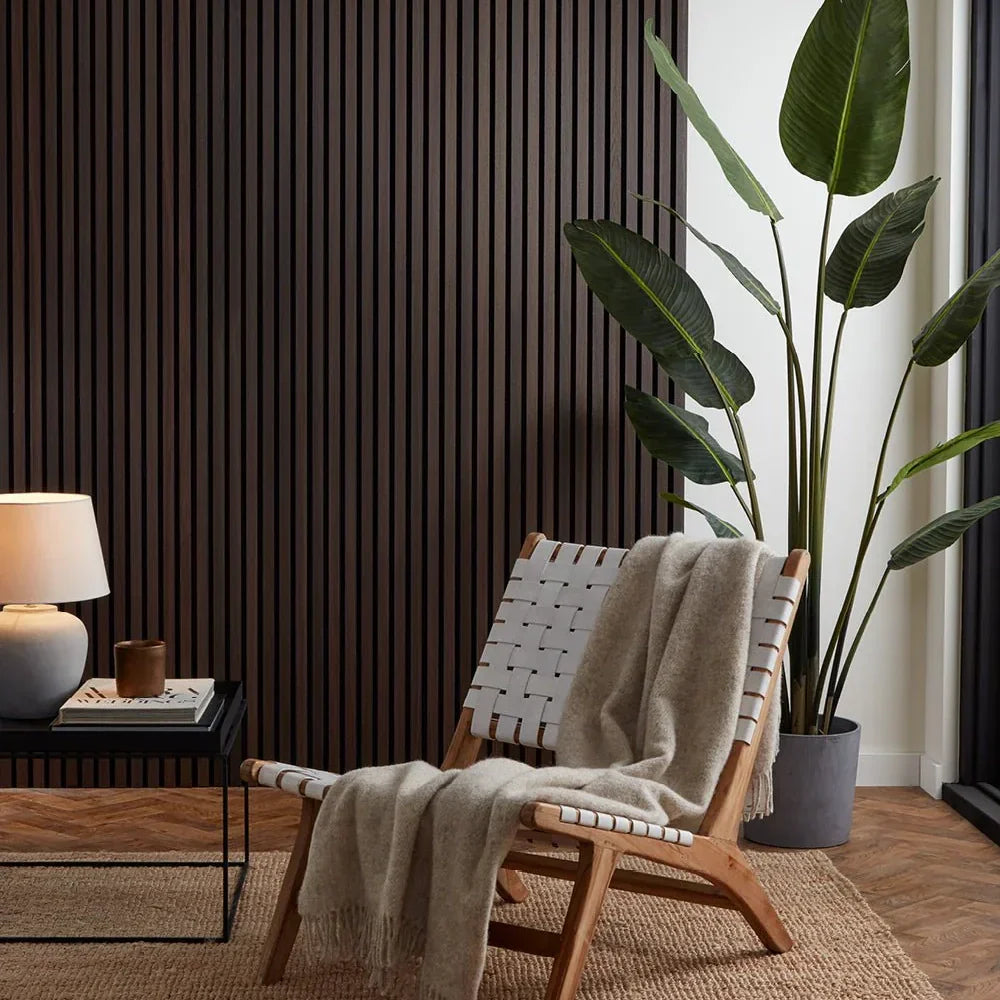
Fluted panels feature a series of parallel concave channels (grooves that curve inward) cut or moulded into the panel surface. When you look at a fluted panel in cross-section, the ridges between channels have a sharp or flat top, and the grooves cut into the material.
Fluting has its roots in classical architecture — specifically the vertical grooves carved into Greek and Roman columns. In modern interiors, this translates to wall panels with a series of parallel vertical grooves that create strong, directional shadow lines across the surface.
Visual Characteristics of Fluted Panels
- Sharp, clean shadow lines
- Crisp, architectural feel
- Light reflects off the flat or slightly curved ridges; shadows fall into the grooves
- More graphic and defined than reeded profiles
Best Applications for Fluted Panels
- Feature walls in contemporary and minimalist interiors
- Kitchen island cladding and cabinetry fronts
- Hallways where strong directional lines elongate the space
- Furniture fronts — wardrobes, drawer fronts, cabinet doors
What Are Reeded Panels?
Reeded panels are essentially the reverse of fluted — they feature parallel convex ridges that protrude from the surface rather than cutting into it. In cross-section, reeded profiles look like a row of rounded bumps or half-cylinders sitting on the panel face.
Reeding is historically associated with furniture — particularly the legs of Regency and Federal-style pieces — and has a softer, more organic character than fluting.
Visual Characteristics of Reeded Panels
- Soft, rounded shadow lines
- Warmer, more tactile feel than fluted profiles
- Light wraps around the convex ridges, creating a gentler play of light and shadow
- More organic and sculptural than fluted profiles
Best Applications for Reeded Panels
- Bedroom feature walls — the soft profile suits restful, warm spaces
- Living room walls in Japandi and organic modern interiors
- Bathroom walls where a tactile, spa-like quality is desired
- Curved wall installations — reeded profiles follow curves more naturally than sharp-groove fluting
Side-by-Side Comparison
| Feature | Fluted Panels | Reeded Panels |
|---|---|---|
| Profile shape | Concave channels (inward grooves) | Convex ridges (outward bumps) |
| Shadow quality | Sharp, defined lines | Soft, curved shadows |
| Aesthetic feel | Architectural, graphic, modern | Organic, soft, tactile |
| Historical reference | Classical columns | Regency furniture |
| Best room type | Contemporary, minimalist, commercial | Bedroom, living room, spa-like bathrooms |
| Curved surfaces | More difficult | Handles curves better |
Which Is More Popular Right Now?
In the 2025–2026 interior design landscape, both profiles are trending — but for slightly different reasons:
- Fluted panels are driving the “architectural feature wall” trend in contemporary apartments, kitchen renovations, and home offices. Their graphic clarity suits the clean lines of modern Scandi and minimalist interiors.
- Reeded panels are associated with the organic modern and Japandi movements — warmer, less severe, and increasingly popular in bedrooms and living spaces where tactility and comfort are prioritised over architectural clarity.
How to Choose Between Them
Ask yourself two questions:
- Is the room contemporary and angular, or warm and organic? Contemporary → fluted. Organic → reeded.
- Do you want the wall to make a statement or create atmosphere? Statement → fluted. Atmosphere → reeded.
If you genuinely can’t decide, order samples of both. The difference in person, under your room’s actual lighting, is usually immediately apparent — one profile will suit the space and the other won’t.
Final Word
Fluted and reeded panels are both beautiful, both on-trend, and both available in real wood veneer for premium wall applications. The choice ultimately comes down to the room’s existing character and the effect you want to create. Neither is objectively better — they’re just right for different spaces.
Mixing Fluted and Reeded Panels in the Same Space
Using both profiles in a single interior is possible — and can look intentional — but it requires a clear design logic. Random mixing reads as indecision; deliberate contrasting reads as sophistication.
The logic that works: Use one profile as the dominant surface treatment and the other as an accent or detail. For example: fluted panels on the main feature wall with reeded panels used as furniture cladding on a built-in unit, kitchen island, or bath panel. The profiles are related enough to feel cohesive, distinct enough to have purpose.
Material and finish consistency: When mixing profiles, keep the timber species and finish identical across both. The same oak stain on fluted and reeded panels in the same room creates a material family. Changing species as well as profile creates visual noise rather than layered texture.
Scale separation: Mixing profiles works best when the applications are physically separated — different walls, different furniture pieces, different zones. Adjacent panels in alternating profiles on the same wall surface rarely work unless the spacing and scale have been designed very precisely.
When to stick to one profile: In rooms with under 2.4m ceiling height, a limited floor area, or existing strong architectural features, one profile executed well is almost always better than two profiles competing for attention.
FAQs: Fluted vs Reeded Panels
What is the main difference between fluted and reeded panels?
Fluted panels have concave channels — the grooves go inward into the surface. Reeded panels have convex ridges that project outward from the surface. Both create a parallel shadow-line effect, but the cross-sectional profiles are geometrically opposite.
Which profile is more durable?
Both profiles are equally durable when made from the same base material. The ridges and grooves don’t create structural weakness. Reeded profiles may accumulate slightly more dust in the convex ridges, but this is a cleaning consideration rather than a durability one.
Can I use fluted or reeded panels on a ceiling?
Yes. Both profiles work on ceilings, particularly in rooms with high ceilings or in compact spaces where a ceiling feature wall adds visual interest without consuming floor area. Ensure the panels are mechanically fixed (not adhesive-only) for overhead applications.
Are fluted and reeded panels available in acoustic versions?
Acoustic backing can be added to many slat and fluted profiles. The acoustic performance comes from the backing material (typically felt), not the face profile. If sound absorption is a requirement alongside the decorative finish, specify panels with an acoustic backing when ordering.
Shop Fluted and Reeded Panels
Compare both profiles side by side in the full wood wall panel collection at The Panel Hub — and order samples before committing. For broader design inspiration showing how different panel profiles look in finished rooms, our interior slat wall ideas guide covers 50+ real-room applications. If acoustic performance is also part of your decision — slat panels with felt backing absorb sound in a way that solid-face fluted and reeded panels don’t — the acoustic panel buyer’s guide explains the difference clearly. For those drawn to geometric pattern over a linear profile, the GroovePanel® geometric wood wall panel range offers 100% solid wood mosaic, concentric square, and 3D relief formats as a distinct alternative to both fluted and reeded.