Tag: Solid Wood

  • MDF Wall Panels vs Solid Wood: Which Is Worth the Investment?

    MDF Wall Panels vs Solid Wood: Which Is Worth the Investment?

    MDF (Medium Density Fibreboard) and solid wood are the two primary substrate options for wood wall panels. Both can deliver excellent results. Both have genuine weaknesses. The choice between them matters — not just for budget, but for durability, appearance, environmental impact, and long-term performance in your specific application.

    What Is MDF and What Is Solid Wood?

    MDF Wall Panels

    MDF is an engineered wood product made from wood fibres, resin, and wax compressed under high pressure and heat. It’s dimensionally stable — it doesn’t expand, contract, or warp the way solid timber does — and has a smooth, consistent surface that takes paint, veneer, and surface finishes well. Most painted or foil-wrapped wall panels use MDF cores.

    Solid Wood Panels

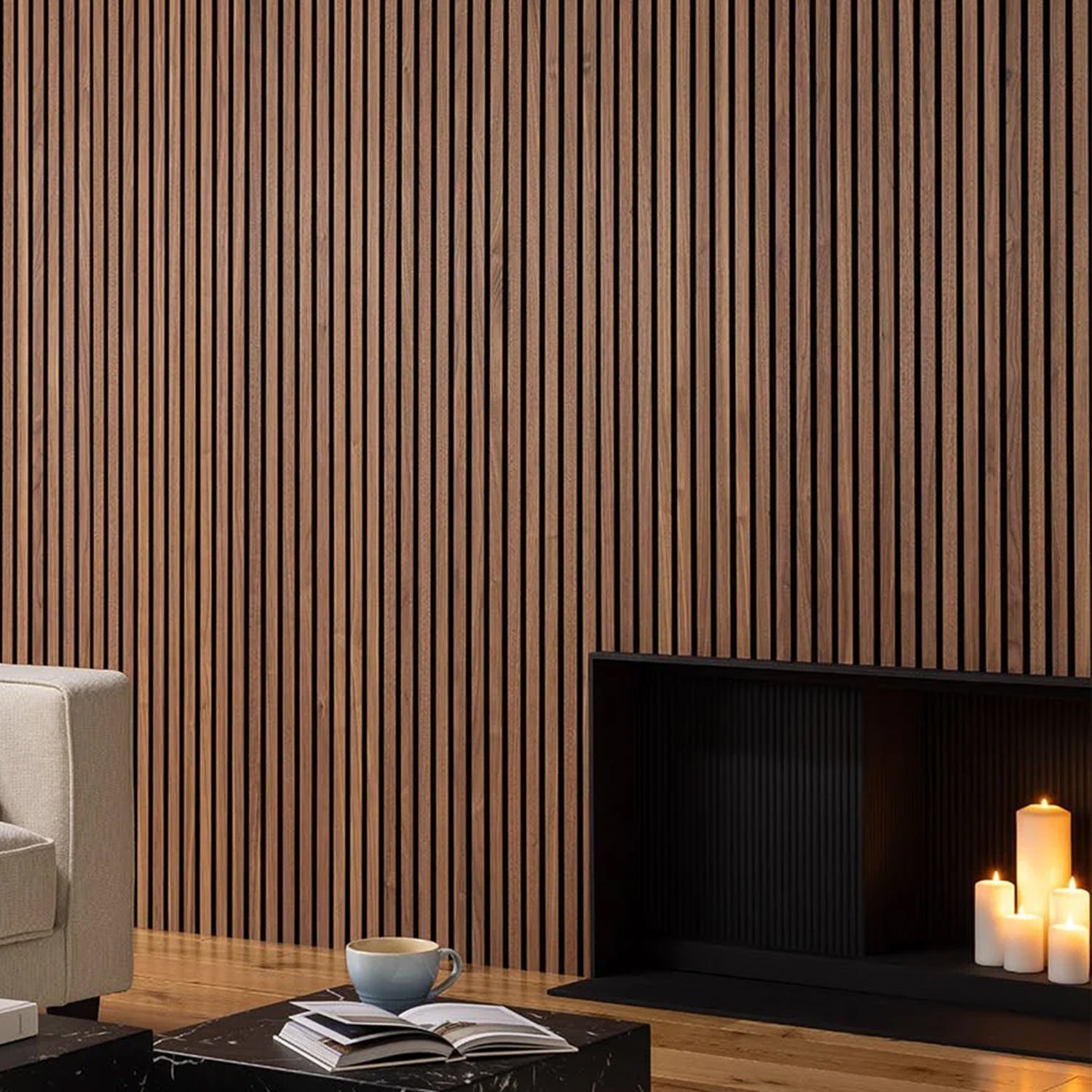
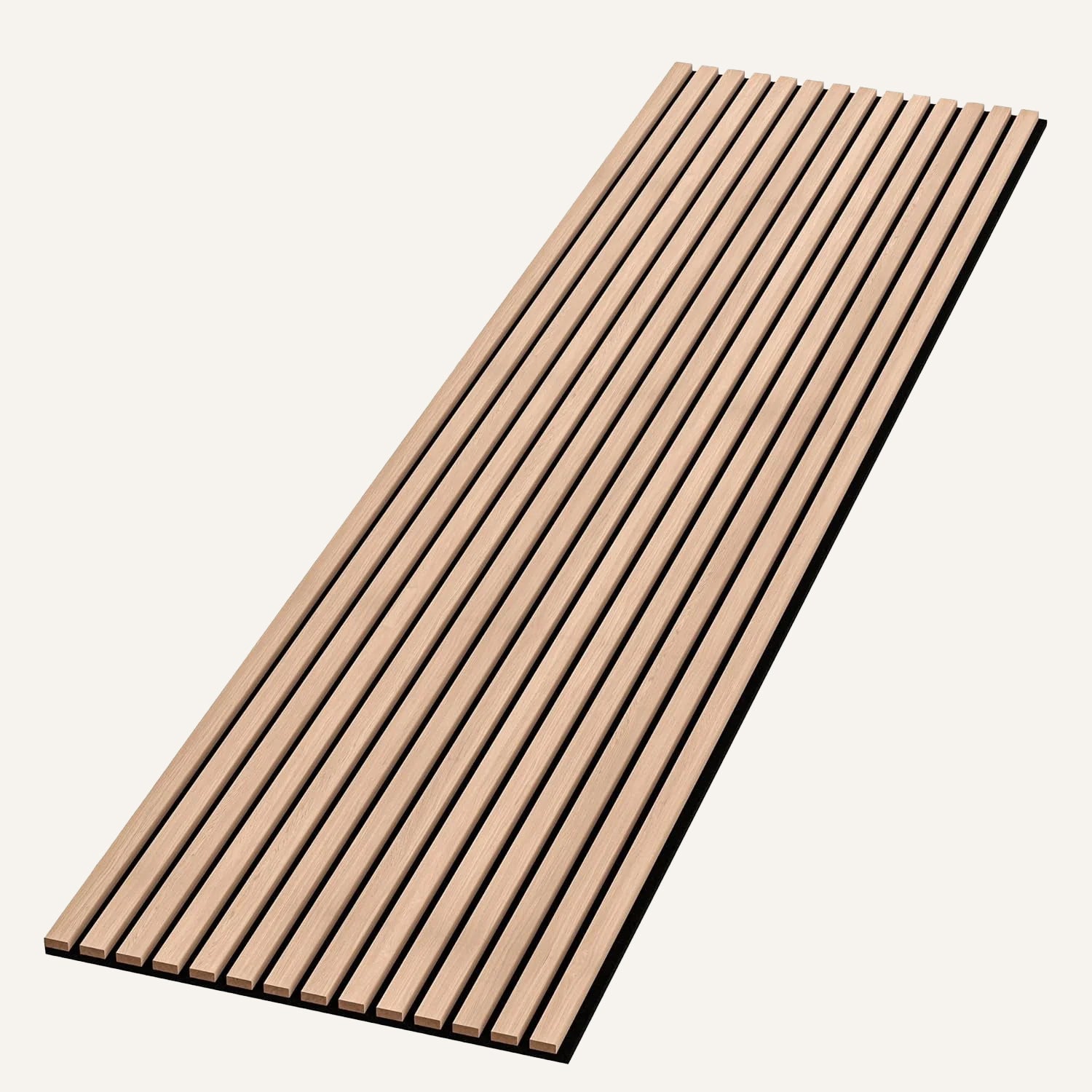
    Solid wood panels use real timber — often oak, pine, walnut, or other hardwoods — as the primary material. The GroovePanel® and SoundPanel™ ranges from The Panel Hub use solid wood construction. Real wood brings visible grain, natural colour variation, and authentic warmth that engineered materials cannot replicate.

    Appearance and Finish

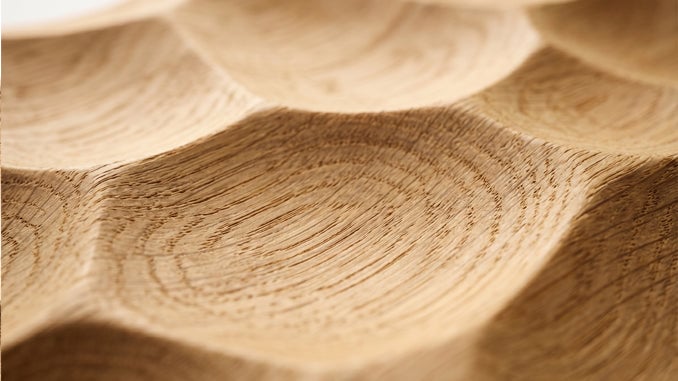
    Solid wood has the advantage for visible grain and natural authenticity. The grain, knots, colour shifts, and texture of real timber create a surface that looks and feels genuinely organic. In slat and fluted profiles, the grain of real wood creates visual depth that printed or foil-wrapped MDF cannot match.

    MDF has the advantage for painted finishes. Its smooth, consistent surface provides a flawless base for paint — no grain telegraphing through the finish. For painted panel applications, MDF is often the better material choice.

    Durability

    Solid wood is more durable in general use. It’s harder to dent, holds fixings well, and can be sanded and refinished if damaged. Solid wood panels, with appropriate maintenance, can last decades.

    MDF is less impact-resistant and has a critical weakness: moisture. MDF swells and disintegrates when exposed to sustained moisture. For bathroom or kitchen applications, only moisture-resistant (MR) MDF cores should be specified, and even then direct water exposure should be avoided.

    Cost

    MDF panels are generally less expensive than solid wood panels of equivalent dimensions. For painted applications where the material character isn’t visible in the final finish, MDF offers good value. For applications where the natural wood surface is part of the design — stained, oiled, or natural finishes — solid wood delivers an appearance that MDF cannot replicate.

    Environmental Considerations

    Solid wood from certified sustainable sources (FSC or PEFC) is renewable and stores carbon. MDF uses wood waste fibres but the resin binders are synthetic and typically non-recyclable. Look for certification claims when evaluating any wood panel product.

    Which Should You Choose?

    • Choose solid wood if natural grain and material character are important, if long-term durability is a priority, or if the application is in a dry environment where solid wood’s properties are best preserved.
    • Choose MDF if you’re painting the panels, if cost is the primary constraint, or if the application is in a dry interior environment where MDF’s moisture weakness is not a factor.

    For solid wood wall panels that deliver genuine material quality, explore the GroovePanel® and SoundPanel™ collections at The Panel Hub.
  • 3D Geometric Wood Panels: How Shadow and Depth Transform a Room

    3D Geometric Wood Panels: How Shadow and Depth Transform a Room

    There’s a difference between a patterned wall and a three-dimensional wall. A printed or painted geometric pattern adds visual interest. A 3D geometric wood panel adds physical depth — the shadows it casts are real, and they change as the light in the room changes. This is what separates a truly dynamic feature wall from one that looks impressive in photos but flat in person.

    This guide covers how 3D geometric wood panels work, what makes them effective, and how to use them to transform a room.

    What Makes a Panel “3D”?

    A 3D wood panel has relief — the surface isn’t flat. Individual elements are raised, recessed, or angled relative to each other, creating physical depth. In the 3D Geometric Pattern Wooden Panel from our GroovePanel® range, the geometric elements are routed and shaped from solid timber, creating distinct planes that produce shadow lines across the surface.

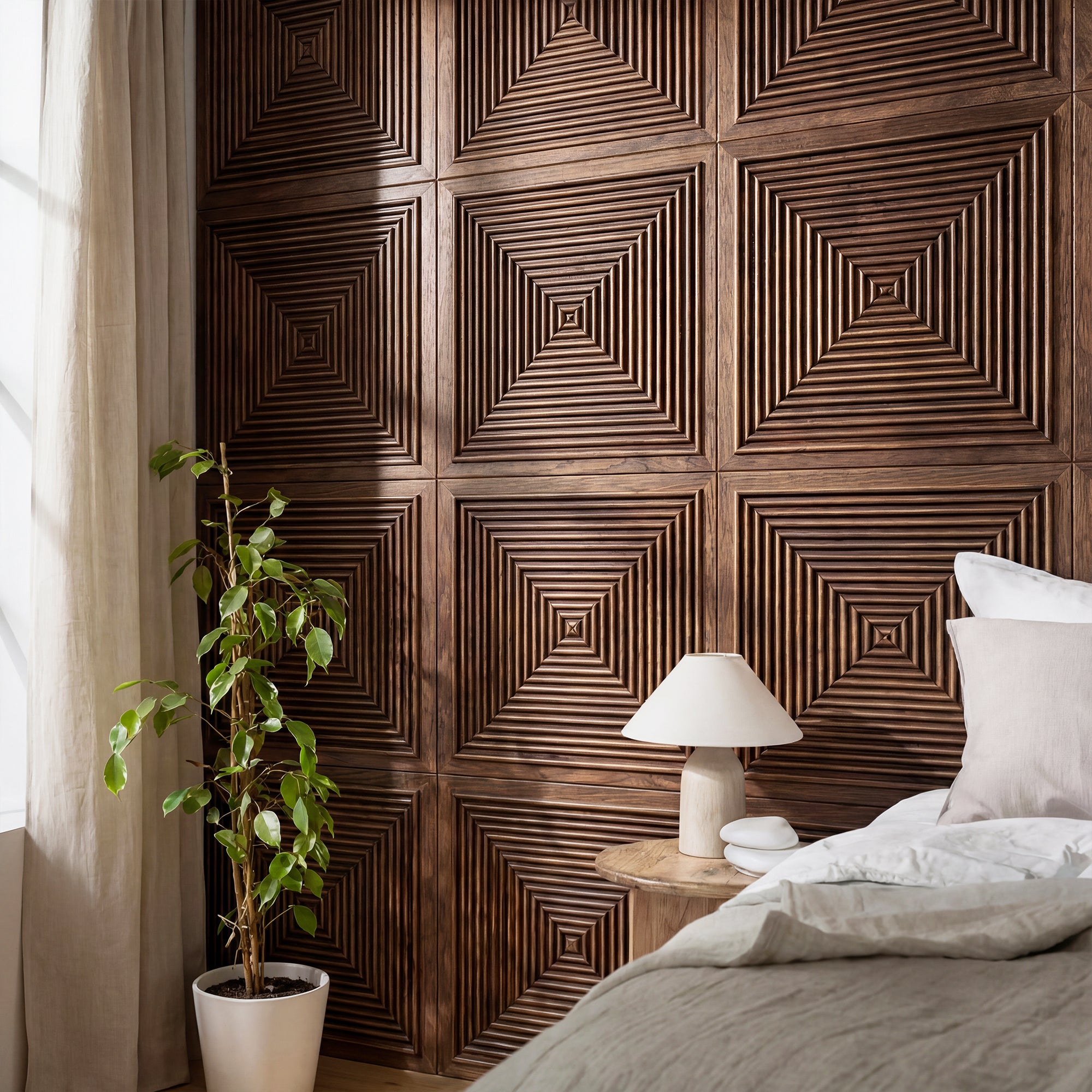
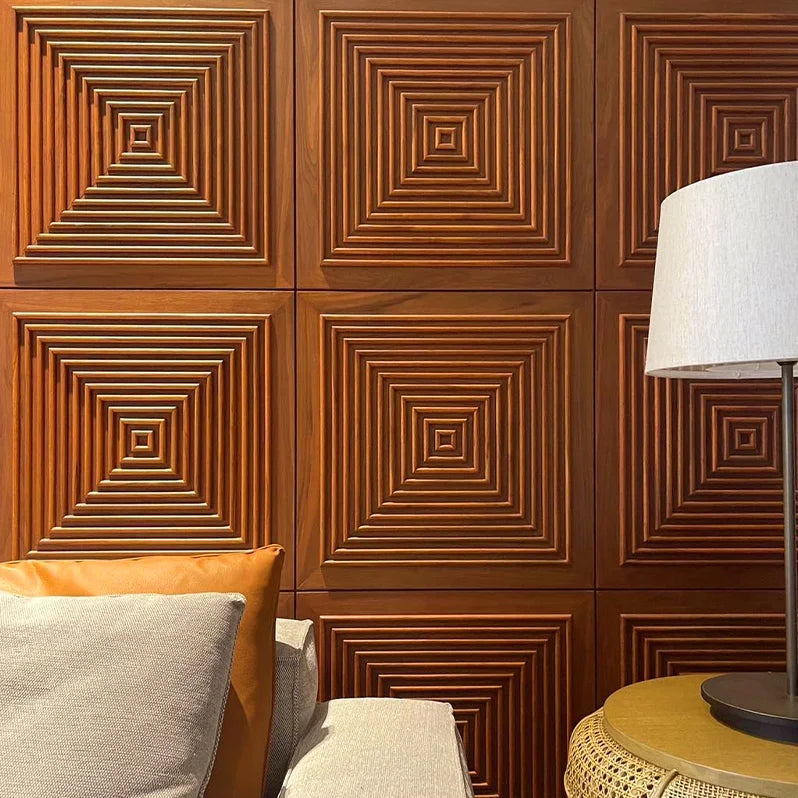
    The 3D Concentric Square Panel takes this further: the nested squares are stepped at different heights, so the innermost square is the highest point and the outer ring is the lowest. The result is a panel that looks like a topographic map or an architectural model — and it casts different shadows at different times of day as the sun angle changes.

    This is fundamentally different from a flat mosaic panel with surface pattern. The depth is structural, not visual — it exists in the physical object, not as a trick of print or finish.

    How Shadow Works on a 3D Panel

    Shadow is what gives 3D panels their character. Without directional light, a 3D panel loses most of its impact. This has direct implications for where you install one:

    • Walls receiving natural side-lighting (windows to one side of the wall) are ideal — morning and afternoon light rakes across the surface and maximises shadow definition.
    • Walls with directional artificial lighting — a wall sconce or track light at an angle — maintain the 3D effect in the evening.
    • Avoid flat, overhead-only lighting for a 3D panel wall. Overhead light fills in shadow and flattens the effect. If you have only overhead lights, add a wall sconce or an angled floor lamp to create directional light across the panel surface.

    Room-by-Room: Where 3D Geometric Panels Have the Most Impact

    Living rooms

    A chimney breast or the wall behind a sofa are the most effective locations. The panel becomes a focal point that you see from across the room and appreciate up close. In a living room that has natural light entering from the side, the shadow lines on a 3D panel shift through the day — it’s effectively an installation that changes appearance without changing physically.

    Hallways and entryways

    3D panels are particularly effective in hallways where the main light source is a single pendant or wall sconce. The raking light across the panel surface creates a striking first impression at the entrance to a home.

    Behind a TV or media wall

    Mounting a 3D geometric panel on a media wall, surrounding a TV, is a contemporary alternative to built-in media units. When the TV is off, the panel reads as a decorative surface. When the TV is on, the panel adds texture and depth to a functional zone. For ideas on media wall design, see our article on how to decorate the wall behind a TV stand.

    Solid Wood vs MDF for 3D Geometric Panels

    3D geometric panels are available in solid wood and MDF. For flat panels, MDF can be an acceptable substrate. For 3D relief panels, solid wood is significantly better:

    • Routed edges in solid wood are crisp and clean; in MDF, they can chip or fray, especially at fine geometric details
    • Solid wood panel edges show natural grain; MDF shows a grey composite
    • Solid wood holds screws and mounting hardware better in high-relief areas
    • MDF is more susceptible to moisture damage in the fine channels and recesses of a 3D pattern

    All panels in the GroovePanel® range are 100% solid FSC-certified timber. For a full material comparison, read our guide to MDF vs Solid Wood Wall Panels.

    Combining 3D Panels with Lighting

    The relationship between 3D panels and lighting is worth planning in advance rather than after installation. Options include:

    • LED strip lighting mounted in a channel above or to the side of the panel — creates continuous raking light across the entire surface
    • Wall sconces with directional shades — places a pool of angled light on a section of the panel
    • Adjustable track lighting — allows you to change the light angle seasonally

    For more on integrating lighting with wall panels, see our guide to wall panels with LED lighting.

    Getting Started

    Browse the 3D geometric formats in the GroovePanel® collection. Order a sample of wood wall panels of your choice to hold the panel in your room under your actual lighting — this is the only reliable way to judge the shadow effect before buying.

    For broader context on 3D wall panels across all material types, read our pillar guide to 3D wall panels.

  • EPD Certified Wall Panels: What Environmental Product Declarations Mean for Buyers

    EPD Certified Wall Panels: What Environmental Product Declarations Mean for Buyers

    Sustainability claims in the building materials market range from substantiated and independently verified to vague and essentially meaningless. “Eco-friendly,” “natural,” and “sustainable” are marketing terms that carry no legal definition. Environmental Product Declarations (EPDs) are different. They’re a standardised, independently verified documentation format — and they’re one of the most reliable tools available to buyers and specifiers who need to substantiate environmental performance claims.

    This guide explains what an EPD is, what it measures, and why it matters when buying wall panels.

    What Is an Environmental Product Declaration?

    An EPD is a document that presents the environmental impact of a product across its full life cycle, from raw material extraction through manufacturing, transport, use, and end-of-life disposal or recycling. It’s produced according to a standardised methodology (ISO 14025 and EN 15804 for construction products) and verified by an independent third party.

    An EPD doesn’t say a product is “good” or “bad” for the environment. It says precisely how much environmental impact the product generates, measured across categories like:

    • Global warming potential (carbon footprint, measured in kg CO₂ equivalent)
    • Ozone depletion potential
    • Acidification potential
    • Eutrophication potential (impact on water quality)
    • Primary energy consumption
    • Water use

    This makes it possible to compare two similar products based on verified data rather than marketing language.

    EPD vs FSC: What’s the Difference?

    These are two different types of certification that address different aspects of environmental performance.

    FSC (Forest Stewardship Council) certification verifies that the timber used in a product comes from forests managed according to responsible forestry standards. It addresses where the wood came from and how the forest was managed — not the full life cycle of the manufactured product.

    EPD certification covers the full manufacturing process, transport, use phase, and end-of-life — not just the timber sourcing. It’s a broader, more comprehensive environmental credential.

    The most rigorous products carry both. Our GroovePanel® Geometric Wood Wall Panels are both FSC-certified (responsibly sourced timber) and EPD-verified (full life cycle environmental data). For buyers who need verified sustainability credentials — architects specifying for green building projects, developers pursuing BREEAM or LEED ratings, homeowners who want more than marketing claims — this combination is significant.

    For more on FSC certification specifically, read our guide to what FSC certified wood means and why it matters.

    Why EPDs Matter for Specifiers and Architects

    Green building rating systems — BREEAM in the UK and Europe, LEED in North America, Green Star in Australia — require or incentivise the use of products with verified environmental credentials. EPDs are accepted as supporting evidence for credits in several categories of these systems, including materials transparency and low-carbon specification.

    For an architect or interior designer specifying wall panelling for a client pursuing a green building certification, a product without an EPD simply cannot contribute to those credits. A product with an EPD, like GroovePanel®, can.

    Why EPDs Matter for Homeowners

    Most homeowners aren’t pursuing BREEAM ratings. But EPDs still matter in a practical sense:

    • Indoor air quality: The EPD process involves measuring VOC emissions and other indoor air quality factors. Products that have been through EPD verification are more likely to have low emissions — relevant for bedrooms, nurseries, and rooms where you spend significant time.
    • Product transparency: A manufacturer willing to produce an EPD is demonstrating a level of transparency about their product that reflects on overall quality control.
    • Long-term value: Sustainable building materials are increasingly valued in property markets. Specifying EPD-verified products can contribute to a building’s environmental credentials and, in some markets, its assessed value.

    What to Look for When Buying Certified Wall Panels

    1. Check the FSC certificate number — it should be verifiable on the FSC website
    2. Ask for the EPD document number — legitimate EPDs are published in programme registries and can be looked up
    3. Check the scope of the EPD — it should cover the full life cycle (A1–A3 at minimum, with C and D modules for end-of-life preferred)
    4. Confirm the independent verifier — EPDs must be verified by an accredited third party, not self-declared

    Sustainable Geometric Panels

    The GroovePanel® range combines aesthetic quality with verifiable environmental credentials. Browse the full collection of FSC + EPD certified solid wood geometric panels at GroovePanel® Geometric Wood Wall Panels. For design inspiration, see our guides to geometric wood wall panel patterns and styles and wood mosaic wall panels.

  • Geometric Wood Panels for Luxury Interiors: How to Achieve a High-End Look

    Geometric Wood Panels for Luxury Interiors: How to Achieve a High-End Look

    Luxury in interior design isn’t about price tags. It’s about precision, material honesty, and a clear sense of intention — the feeling that every decision in a room was made rather than defaulted. Geometric wood wall panels, when chosen and installed correctly, embody all three of these qualities. Here’s how to use them to achieve a high-end result regardless of your overall budget.

    What Makes a Geometric Panel Installation Look Luxury

    Walnut Triangle Solid Wood Wall Panels - View 2

    Material authenticity

    The clearest marker of quality in any interior is whether the materials are what they appear to be. A 100% solid walnut mosaic panel reads as luxury because it is genuinely solid walnut — the grain, texture, and weight are real. A printed laminate with a walnut pattern reads as imitation regardless of how it photographs, because the eye and hand detect the difference instantly.

    All panels in the GroovePanel® decorative wall panels are 100% solid FSC-certified timber. In a luxury interior context, this isn’t just an ethical consideration — it’s the material difference between a room that feels genuinely high-end and one that merely looks like it in photos.

    Pattern precision

    Luxury also resides in exactness. Mosaic tiles that are precisely cut and perfectly consistent read as quality. Tiles with irregular edges, inconsistent gaps, or variable alignment signal low manufacturing standards. The 3D Concentric Square Panel and Crossing Lines Panel require precision machining to achieve the pattern accuracy that makes them look designed rather than approximate. That precision is what separates a panel that looks premium from one that doesn’t.

    Installation quality

    Even the best panels look mediocre if the installation is poorly executed. Luxury interiors are defined by clean edges, consistent joint gaps, perfect level and plumb, and seamless transitions between surfaces. An off-the-shelf panel from a premium manufacturer, installed with professional care, will always outperform a mediocre panel installed imperfectly.

    Pattern Choices for Luxury Applications

    3D Concentric Square — the most architecturally resolved

    3D Concentric Square Wood Wall Panel - Walnut - View 2

    The 3D Concentric Square Panel has the quality of a resolved architectural detail — it could be at home in a five-star hotel or a high-end residential project. The stepped relief and precise shadow lines communicate serious manufacturing capability. In a dining room, bedroom, or lobby, it creates a focal point that guests consistently comment on.

    Walnut Triangle Mosaic — the most tactile luxury

    Walnut Triangle Solid Wood Wall Panels - View 1

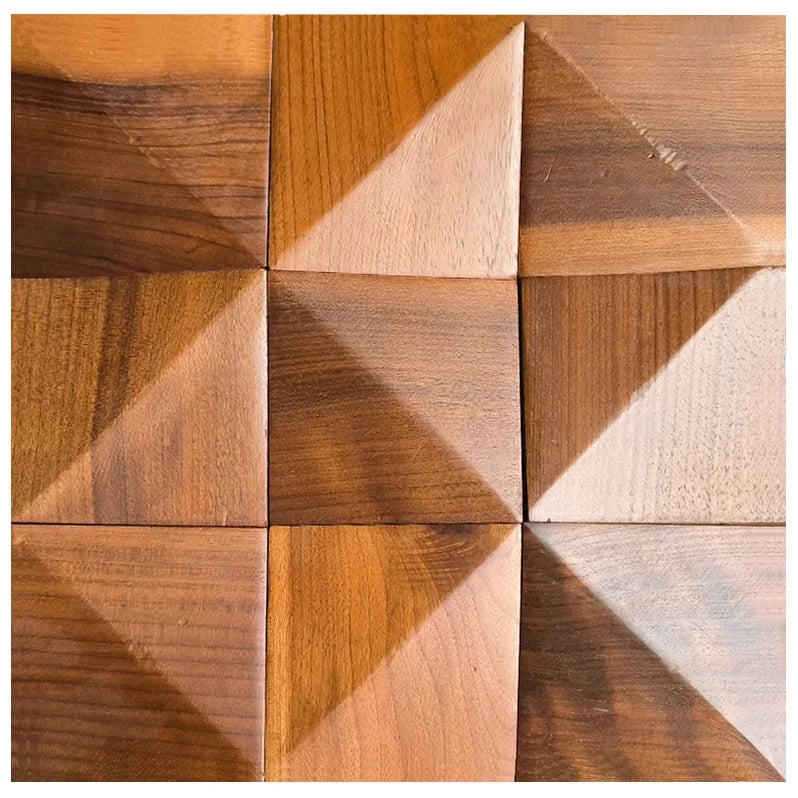
    The Walnut Triangle Panel is physically rich — the variation in grain direction across adjacent triangles creates a micro-texture that changes as you move along the wall. Run your hand across it and you feel the individual pieces. This tactile quality is one of the most direct expressions of material luxury available in a wall panel.

    Honey Mosaic — handcrafted luxury

    HoneyMosaicWoodWallPanel_2_2000x2000_9cbf2756-fb51-4962-93ca-3ac4b6131943-The Panel Hub

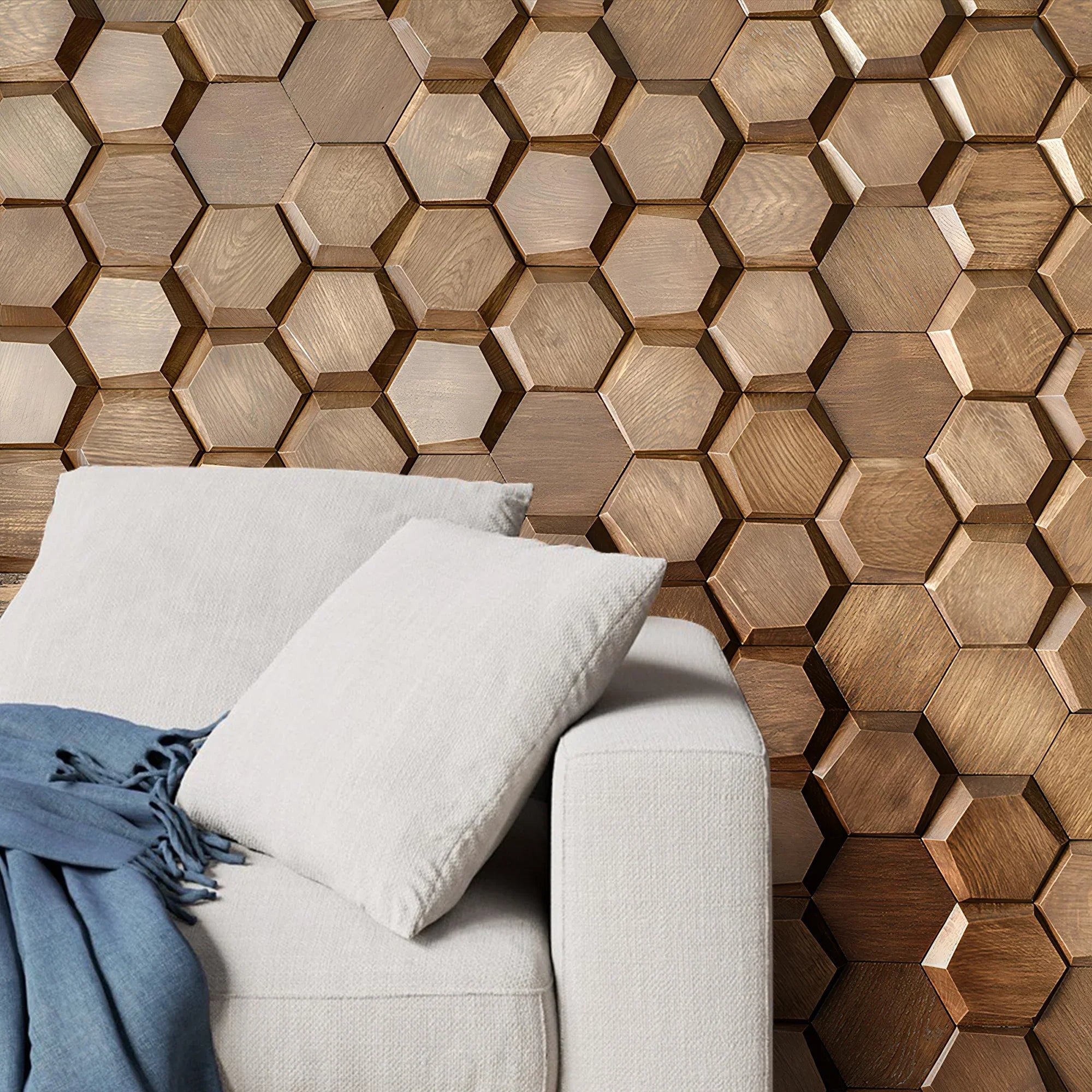
    The Honey Mosaic Panel reads as artisanal — each tile is slightly different, the pattern is irregular, and the effect is closer to a handmade mosaic than a machine-produced tile. In a high-end residential context where the brief is warm, personal luxury rather than cold hotel precision, this is often the strongest choice.

    Material Pairings That Signal Luxury

    Geometric wood panels look their best alongside materials that reinforce their quality rather than diluting it:

    • Natural stone flooring: Marble, limestone, or slate — the contrast between hard stone underfoot and timber warmth on the wall is a classic luxury pairing
    • Brass and bronze metalwork: Unlacquered brass light fittings and hardware complement dark walnut in the way gold frames complement paintings
    • Velvet and silk textiles: The contrast of soft, reflective textiles against a matte timber geometric panel creates material tension that is inherently luxurious
    • Limewash or polished plaster: On surrounding walls, these finishes have their own material presence — they read as a considered choice rather than a default, which complements the intentionality of the geometric panel wall

    The Luxury Detail: Edge Finishing

    In high-end installations, the edge where the panel meets adjacent surfaces matters as much as the panel face itself. Options:

    • Recessed reveal: A step-back between the panel and the adjacent wall, typically 10–20mm, creates a shadow line that frames the panel as a bounded element
    • Brass edge trim: A thin brass L-section at the perimeter reads as a deliberate material boundary — expensive-feeling and precise
    • Flush paint transition: Panel taken tight to adjacent surface with a clean painted edge — the simplest option, looks best when the adjacent wall is skimmed perfectly flat

    The Restraint Principle

    The most reliable marker of luxury in any interior is restraint. Using one striking geometric panel on a single wall, executed perfectly, is more impressive than covering every surface with competing materials and patterns. Choose one wall, choose the right pattern, install it immaculately, and let it be the room’s defining statement.

    Browse the full solid wood geometric range at GroovePanel® Geometric Wood Wall Panels. Order a sample to assess material quality in your space before committing. For pattern selection guidance, see our guide to geometric wood wall panel patterns and styles.

  • Solid Wood Wall Panels: Why 100% Solid Wood Is Worth the Investment

    Solid Wood Wall Panels: Why 100% Solid Wood Is Worth the Investment

    The wall panel market is full of options that sound like solid wood but aren’t. Veneer panels, MDF-core panels, HDF panels, PVC panels with wood-effect printing — all of these are sold alongside genuine solid wood products, often at similar price points. For buyers who haven’t navigated the category before, it’s genuinely confusing.

    This article explains what 100% solid wood wall panels actually are, how they differ from every engineered alternative, and why — for feature walls where quality and longevity matter — they’re consistently worth paying more for.

    What Counts as 100% Solid Wood?

    A solid wood panel is made entirely from cut timber with no composite core. Every millimetre of depth is real wood. The grain runs through the full thickness of the piece. If you cut a corner off, what you see at the cut face is identical to the front face — uniform grain, no layers, no adhesive core.

    This distinguishes solid wood from:

    • Veneer panels: A thin slice of real timber (0.6–3mm) bonded to an MDF, HDF, or plywood core
    • Laminate panels: A photographic print of wood grain under a clear protective layer, bonded to a composite core
    • Engineered wood panels: Multiple thin plies of timber bonded in alternating grain directions, similar to plywood

    All of these are legitimate products with valid applications. But they are not solid wood, and they don’t behave like solid wood over time.

    The Practical Differences That Matter

    Surface repair

    Solid wood panels can be sanded, refinished, and oiled if they’re scratched or dented. Because the material is uniform throughout, removing 0.5mm of surface restores it. Veneer panels cannot be sanded — the veneer layer is too thin. Laminate panels cannot be repaired at all; a deep scratch exposes the composite core underneath.

    Ageing

    Solid wood develops a natural patina over years. Walnut lightens slightly; oak deepens. The character of the wood increases with time. Veneer panels fade more uniformly, and laminates can yellow or delaminate with age and UV exposure.

    Edge quality

    In geometric mosaic panels, the cut edges are highly visible — they form the boundary lines between pieces. Solid wood shows clean grain at every edge. MDF-core veneer panels show the grey composite core at cut edges, which requires painting or masking.

    Environmental credentials

    Solid wood wall panels can be genuinely FSC-certified, meaning the timber supply chain is verified. Some composite panels carry partial certifications, but the adhesive binders and composite fillers complicate the environmental picture. Solid wood is simpler: it’s timber, and it came from a tree.

    Where Solid Wood Panels Make the Most Difference

    Not every application requires solid wood. For utility spaces or short-term installations, engineered alternatives may be the pragmatic choice. But for:

    • Geometric mosaic panels where cut edges are visible
    • Feature walls in main living areas or master bedrooms
    • Long-term installations where refinishing is a realistic expectation
    • Design projects where material authenticity matters to the brief

    …solid wood is the right answer.

    GroovePanel®: Solid Wood Geometric Panels

    Our GroovePanel® Geometric Wood Wall Panels are 100% solid timber throughout. The range includes triangle mosaics, concentric square patterns, crossing lines, and honey mosaic formats — all cut from FSC-certified solid wood with EPD verification.

    The 3D Geometric Pattern Wooden Panel is one of the clearest demonstrations of why solid wood matters for this product type. The three-dimensional relief is formed by routing and carving actual timber — the depth and shadow lines that give the pattern its visual impact come from physical material, not printed effect. You can’t replicate that with veneer.

    Similarly, the Walnut Triangle Panel shows rich end grain at every triangle boundary — something only possible with full-depth solid timber.

    Solid Wood vs MDF: The Full Comparison

    For a detailed breakdown of how solid wood and MDF compare across strength, moisture resistance, workability, and cost, read our guide to MDF vs Solid Wood Wall Panels.

    What to Look for When Buying

    When a product claims to be solid wood, check:

    1. Species specification: Genuine solid wood panels specify the timber species (oak, walnut, pine, etc.), not just “wood”
    2. FSC certification: Look for a verifiable FSC licence number on the product listing
    3. Edge photos: Ask for photos of the panel edge — MDF core shows as a different colour and texture
    4. Weight: Solid wood panels are heavier per square metre than composite alternatives
    5. Country of manufacture: Solid wood milling requires more skilled production than composite lamination

    Styling Solid Wood Geometric Panels

    The warmth and grain variation of solid timber means it works across a wide range of interior styles. For contemporary and Japandi aesthetics, the natural grain is left unfinished. For a more dramatic or Art Deco-influenced space, a dark walnut stain deepens the contrast between pattern elements.

    For styling inspiration, see our guide to geometric wood wall panel patterns and styles, which covers placement, pattern selection, and room-by-room recommendations.

    Browse the full solid wood collection at GroovePanel® Geometric Wood Wall Panels, or order a sample to check grain and colour in your own space before ordering.

  • Triangle Wood Wall Panels: The Geometric Shape Designers Are Using Everywhere

    Triangle Wood Wall Panels: The Geometric Shape Designers Are Using Everywhere

    Of all the geometric shapes used in interior design, the triangle is the most dynamic. Where squares suggest order and hexagons suggest nature, triangles carry direction and energy. A wall covered in precision-cut solid wood triangles doesn’t just add texture — it commands the room.

    Triangle wood wall panels have appeared in high-end hotel lobbies, Scandinavian-influenced residential projects, and contemporary living rooms for the past several years. They’re now accessible enough to be a realistic choice for any home renovation, and the right product makes installation straightforward.

    Why Triangles Work So Well on Walls

    The triangle is the most structurally stable shape, and that stability translates visually. A mosaic of triangles feels intentional and precise without being cold. The grain of each individual timber piece runs in a different direction relative to its neighbours, creating subtle micro-contrast even within a single colour species.

    Triangles also respond to light differently than squares or linear slats. As daylight tracks across a triangle-tiled wall, the shadow lines shift, giving the installation a quality that changes through the day.

    The Walnut Triangle Panel: A Closer Look

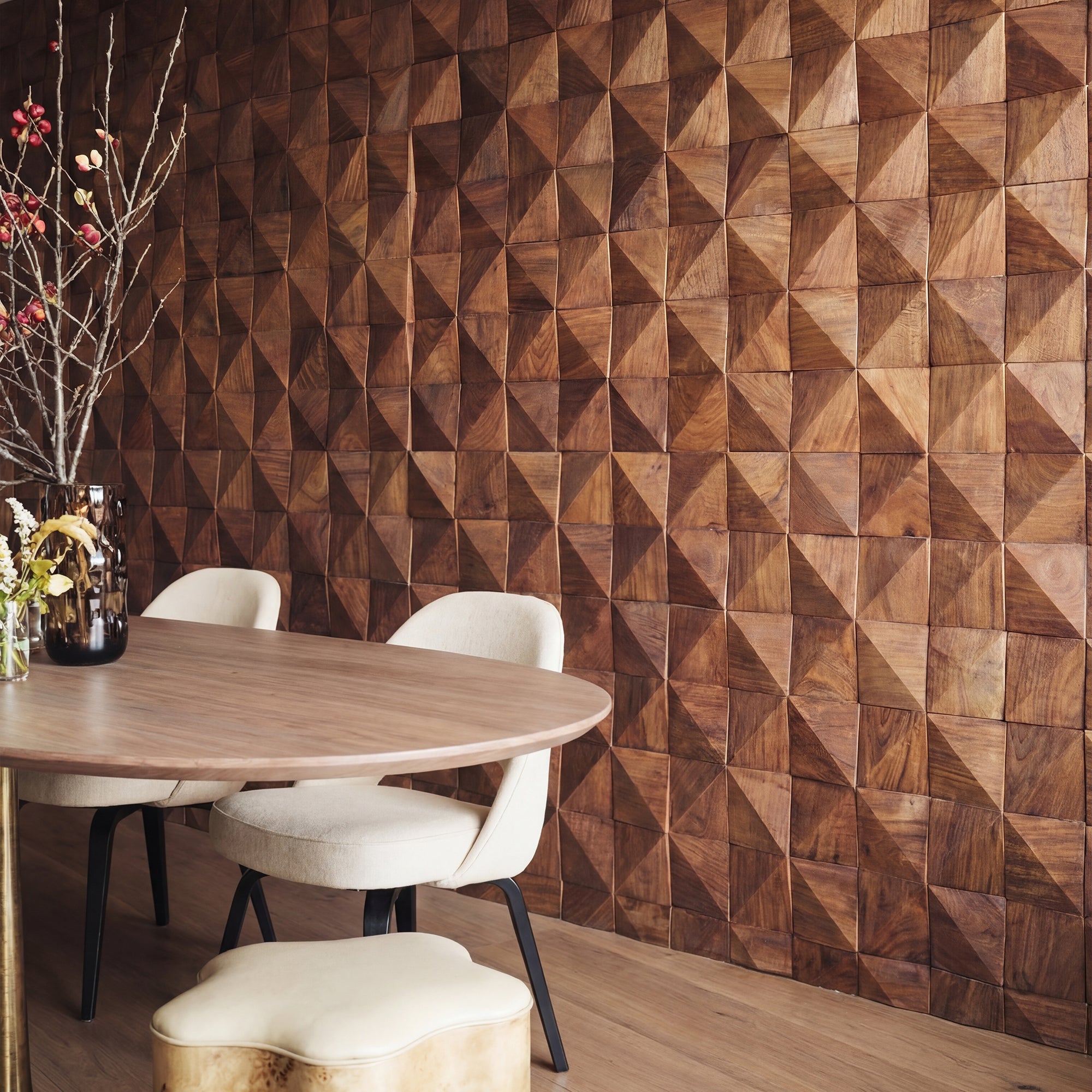
    Our Walnut Triangle Solid Wood Wall Panel is part of the GroovePanel® Geometric range. Each panel is composed of solid walnut triangles — not veneer, not laminate, but full-depth solid timber. The walnut species gives a naturally dark, rich brown tone with the irregular grain figuring characteristic of the species.

    Because the panels are 100% solid wood, the grain pattern at the edge of each cut triangle is visible, adding depth to the tile boundary. This is something engineered panels cannot replicate — their edges show the composite core.

    The panels are FSC-certified, meaning the timber is sourced from responsibly managed forests, and they carry an Environmental Product Declaration (EPD) for buyers who need verified sustainability credentials.

    Design Ideas: How to Use Triangle Wall Panels

    The full feature wall

    The most impactful use. Cover an entire wall — behind a bed, sofa, or dining table — in triangle panels from floor to ceiling. Keep the rest of the room minimal: white or off-white on the remaining walls, furniture in complementary tones. The walnut triangle wall becomes the artwork.

    Half-wall or dado treatment

    Apply triangle panels to the lower half of a wall, terminating at a timber batten or picture rail. This works particularly well in hallways and dining rooms, where floor-to-ceiling pattern can feel oppressive in a narrow space.

    Recessed alcoves and chimney breasts

    Panel the inside of a recess or the face of a chimney breast. The contained geometry of the triangle pattern is perfectly suited to a bounded surface — the edges of the alcove act as a natural frame.

    Ceiling panels

    Triangle mosaic panels work on ceilings too, particularly in rooms with lower ceiling heights where a striking overhead surface creates drama without the visual weight of a dark paint colour.

    Mixing Triangle Panels with Other Materials

    Walnut triangle panels pair naturally with:

    • Brushed brass hardware — the warm metal tone complements walnut’s dark brown without competing
    • Concrete and plaster finishes — rough industrial texture next to precision-cut timber creates contrast
    • White oak furniture — light wood furniture against a dark walnut triangle wall is a classic high-contrast pairing
    • Stone and faux stone panels — use triangle wood panels on one wall and a RockSurface® stone panel on the adjacent surface for a layered material palette

    Triangle Panels vs Other Geometric Formats

    The triangle is one of several geometric formats in the GroovePanel range. Here’s how it compares:

    • Triangle vs concentric square: Triangles create directional energy; concentric squares create depth and a hypnotic focal point. Concentric square panels tend to work better as a single centred feature; triangle mosaics cover a full wall more comfortably.
    • Triangle vs crossing lines: The Crossing Lines panel is more architectural and graphic — better for rooms where you want pattern without strong directional movement.
    • Triangle vs honey mosaic: The Honey Mosaic panel is warmer and more organic. Triangles are sharper and more contemporary.

    For a broader comparison of geometric panel types, see our guide to geometric wood wall panel patterns and styles.

    Installation Notes

    Triangle mosaic panels are installed tile by tile using panel adhesive on a flat, clean wall surface. The key is establishing a true horizontal datum before you start — because triangles form directional rows, a single misaligned tile propagates the error across the full installation.

    Allow the wall to dry fully before starting if you’ve recently plastered or skimmed. For walls with slight undulation, our guide on installing wall panels on uneven surfaces covers preparation methods that ensure a flat result.

    Order a Sample First

    Walnut varies naturally in tone from piece to piece. Before ordering a full quantity, it’s worth seeing the actual timber colour in your own space. Order a sample from our sample collection and live with it for a day or two under your room’s lighting conditions — artificial light changes warm wood tones significantly.

    Browse the full triangle and geometric range in the GroovePanel® collection.

  • Wood Mosaic Wall Panels: Patterns, Styles, and How to Choose the Right Design

    Wood Mosaic Wall Panels: Patterns, Styles, and How to Choose the Right Design

    Wood mosaic wall panels bring something that flat timber boards simply cannot: visual rhythm. Each panel is a composition of small individual pieces — triangles, squares, hexagons, or diamonds — arranged into a repeating geometry that catches light differently depending on the angle you stand at. If you’ve been staring at a blank wall wondering how to add character without committing to wallpaper or paint, a wood mosaic panel is one of the most effective answers available.

    This guide walks through what wood mosaic wall panels are, which patterns work best in which rooms, how to choose between solid wood and engineered options, and what to look for before buying.

    What Are Wood Mosaic Wall Panels?

    A wood mosaic wall panel is a modular tile made from individual pieces of real or engineered wood, glued or fitted onto a backing sheet. Unlike a continuous plank or slat panel, the mosaic format breaks the surface into a repeated geometric unit — creating texture, pattern, and depth from a single flat installation.

    The individual pieces can be cut from solid timber, engineered veneer, or MDF. The quality difference between these materials is significant, which we’ll cover in detail below.

    At The Panel Hub, our GroovePanel® Geometric Wood Wall Panels are made entirely from 100% solid FSC-certified timber. That means no MDF core hidden under a veneer — every piece you see is real wood, end grain and all. The result is panels that age naturally, resist warping better than engineered alternatives, and carry a texture you can feel as well as see.

    Pattern choice matters more than most buyers realise. The geometry you pick changes not only the look but how the wall behaves in different lighting conditions.

    Triangle mosaics

    Triangle-based mosaics create strong directional energy. Arranged in opposing pairs, triangles form diamond or chevron effects. Arranged concentrically, they build a radial focal point. The Walnut Triangle Solid Wood Panel is a favourite for headboard walls and living room feature walls where you want a clear visual anchor.

    Concentric square mosaics

    Concentric squares are among the most hypnotic patterns in interior design right now. Each panel contains a series of nested squares receding toward a central point, creating a sense of depth on an otherwise flat wall. Our 3D Concentric Square Wood Wall Panel achieves this with precision-cut solid wood — the shadow lines between layers change throughout the day as natural light shifts.

    Honey mosaic patterns

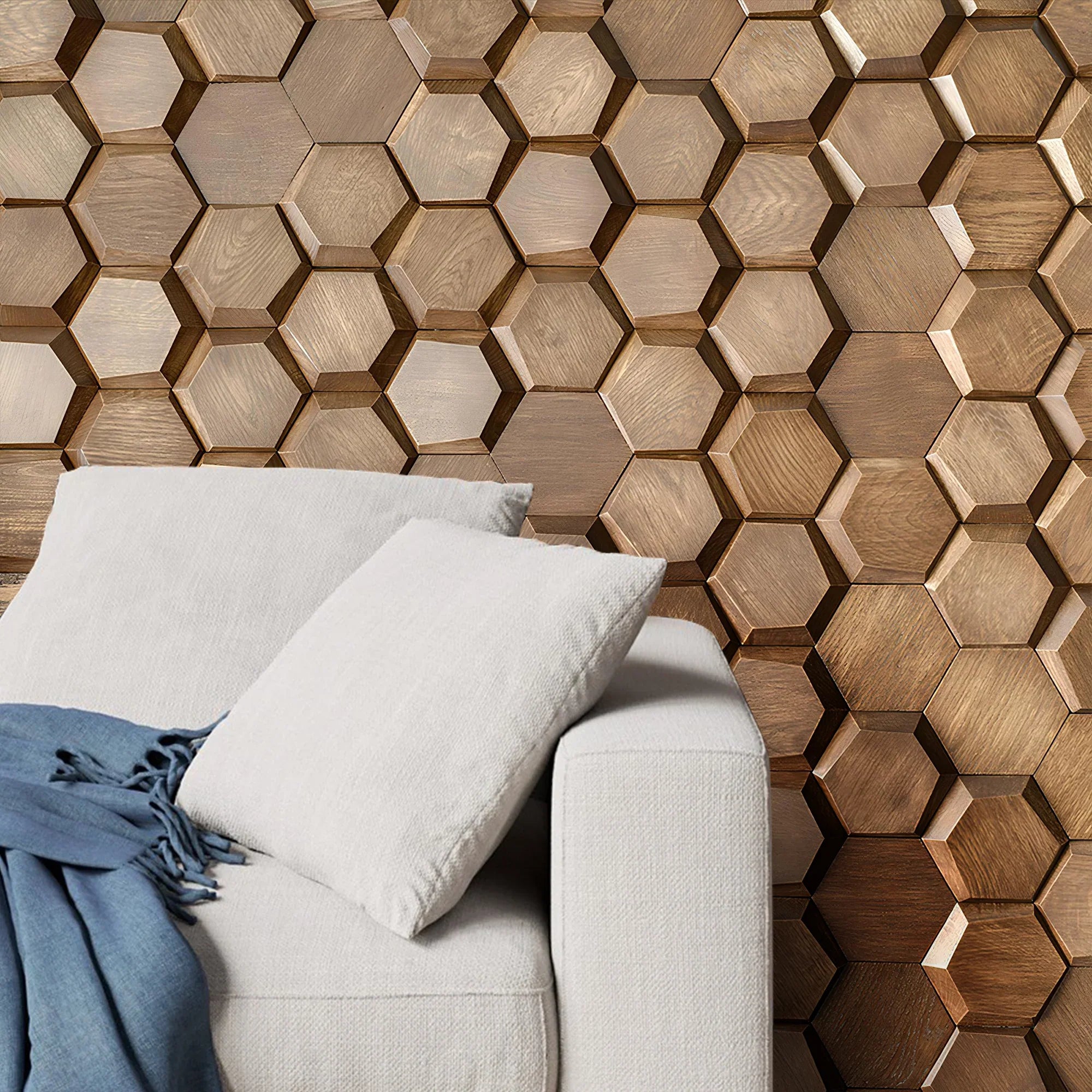
    Honeycomb-adjacent patterns built from stacked hexagonal or irregular pieces produce a warmer, more organic mosaic. Our Honey Mosaic Solid Walnut Panel uses walnut’s natural grain variation to ensure no two tiles look identical, giving large installations a handcrafted feel at scale.

    Crossing lines and grid mosaics

    Linear crossing patterns break the surface into a grid of negative space and solid wood. The Crossing Lines Solid Wood Panel is a cleaner, more architectural look — less traditional mosaic, more graphic composition.

    Solid Wood vs Engineered Wood Mosaic Panels: What’s the Difference?

    This is the question that most affects long-term satisfaction. Engineered mosaic panels — where a thin veneer is laminated to an MDF or HDF core — are cheaper upfront. But because the visible surface is only 0.6–2mm thick, they cannot be sanded or refinished if they scratch. The edges, if visible, reveal the composite core.

    Solid wood panels cost more but behave like real timber. Surface scratches can be sanded out. The colour and grain run through the full depth of each piece. And because solid wood has mass, panels feel substantial on the wall rather than thin.

    For a full breakdown of the material trade-offs, read our guide to MDF vs Solid Wood Wall Panels.

    Which Rooms Work Best for Wood Mosaic Panels?

    Mosaic patterns work in almost any room, but the scale and grain direction of the pattern should match the proportions of the wall.

    • Living rooms: Large-scale mosaics like concentric squares work well on chimney breasts or walls behind sofas. The pattern creates enough visual complexity to make art optional.
    • Bedrooms: A full headboard wall in triangle or honey mosaic pattern transforms a bedroom from functional to genuinely designed. Keep bedding and furniture in neutral tones so the pattern breathes.
    • Hallways and entryways: Smaller panels work well in tighter spaces. A single accent wall of crossing lines or triangle mosaics greets visitors without overwhelming a narrow corridor.
    • Home offices: The texture of a wood mosaic panel behind a desk is far more interesting on video calls than painted plasterboard — and it absorbs a small amount of mid-frequency sound as a bonus.

    How Many Panels Do You Need?

    Calculate your wall area in square metres (width × height), then check the individual panel coverage listed on the product page. Most of our wood mosaic panels cover between 0.09 m² and 0.25 m² per tile. Add 10% to your total to account for cuts at edges and corners.

    For help planning your layout, our guide to creating a geometric feature wall covers grid planning, centring your pattern, and avoiding the most common layout mistakes.

    Finish and Colour: Natural, Stained, or Painted?

    Most wood mosaic panels are supplied unfinished or with a light factory oil. This gives you flexibility to:

    • Leave natural for a warm, pale timber look
    • Apply a dark walnut stain for contrast and drama
    • Use a white or grey wash for a Scandinavian or coastal aesthetic
    • Paint in a flat or matte finish if you want the pattern without the wood tone

    Natural walnut panels — like those in our GroovePanel range — arrive with the species’ characteristic dark brown warmth already built in, which reduces the need for staining.

    Installation: What to Know Before You Start

    Wood mosaic panels are installed tile by tile onto a flat, primed wall. The key preparation steps are:

    1. Ensure the wall is flat — high spots cause gaps between tiles
    2. Mark a level horizontal datum line before starting
    3. Begin from the centre of the wall, working outward
    4. Use a suitable panel adhesive and allow full cure time before grouting or finishing joints

    For uneven walls, read our guide on how to install wall panels on an uneven wall before you begin.

    Where to Buy Wood Mosaic Wall Panels

    Browse the full GroovePanel® Geometric Wood Wall Panel collection for solid wood mosaic options in walnut, oak, and mixed-species finishes. All panels are FSC-certified and EPD-verified. Samples are available through our wall panel sample service if you want to check colour and texture in your own lighting before committing to a full order.