Tag: Wood Wall Panels

  • Contemporary Wall Panel Trends 2026: What’s Popular Right Now

    Contemporary Wall Panel Trends 2026: What’s Popular Right Now

    Wall panels have moved from niche to mainstream in the past five years. What began as a boutique interior design trend — acoustic slat panels on media walls, stone effect panels on fireplace breasts — has expanded into a design language used across residential, commercial, and hospitality environments at every price point.

    In 2026, the trends within wall panelling are maturing. Early adopters have moved on from the obvious applications; the mainstream has arrived and is doing more sophisticated things with the format. Here’s what’s defining the category right now.

    Fluted and Ribbed Profiles: Still Dominant, More Refined

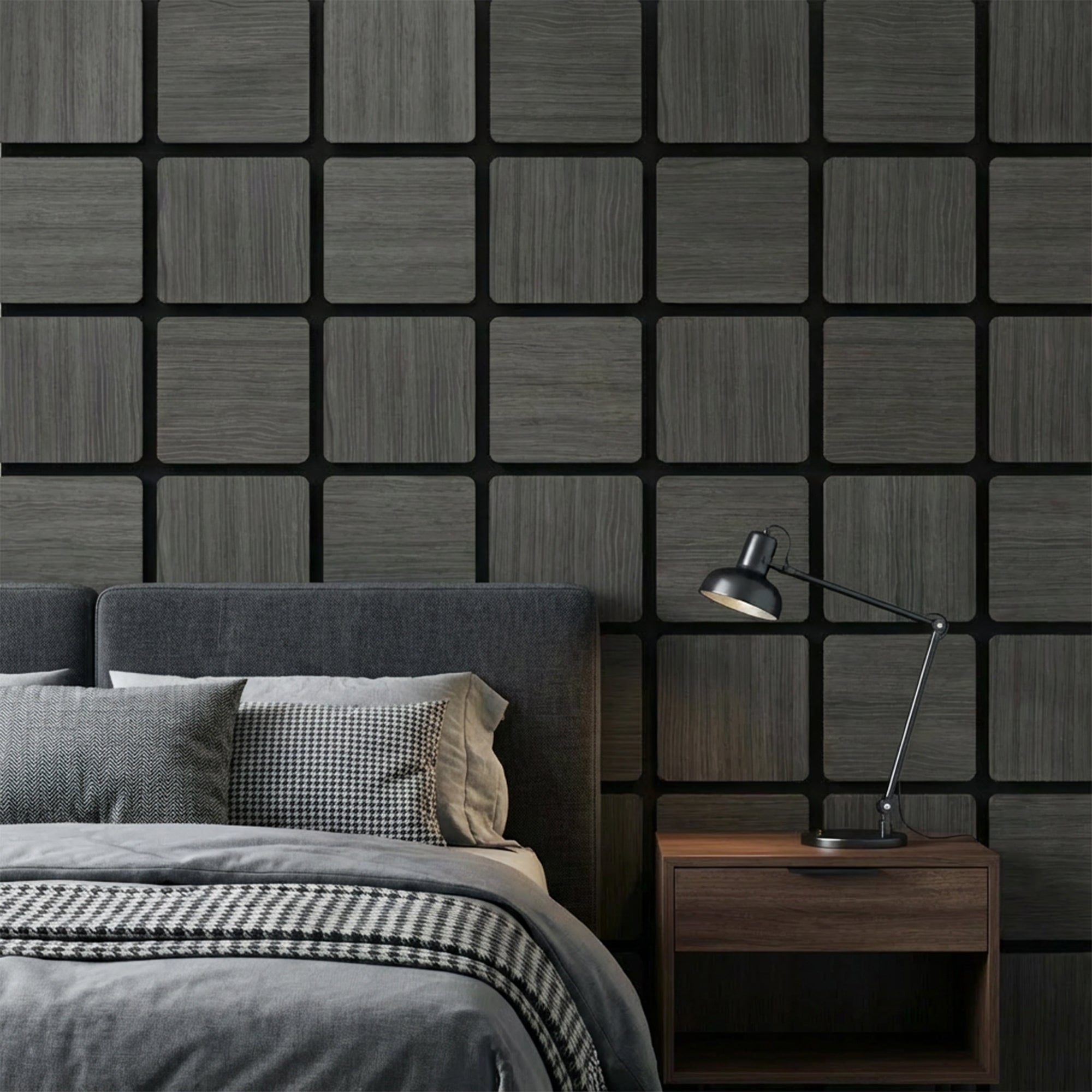
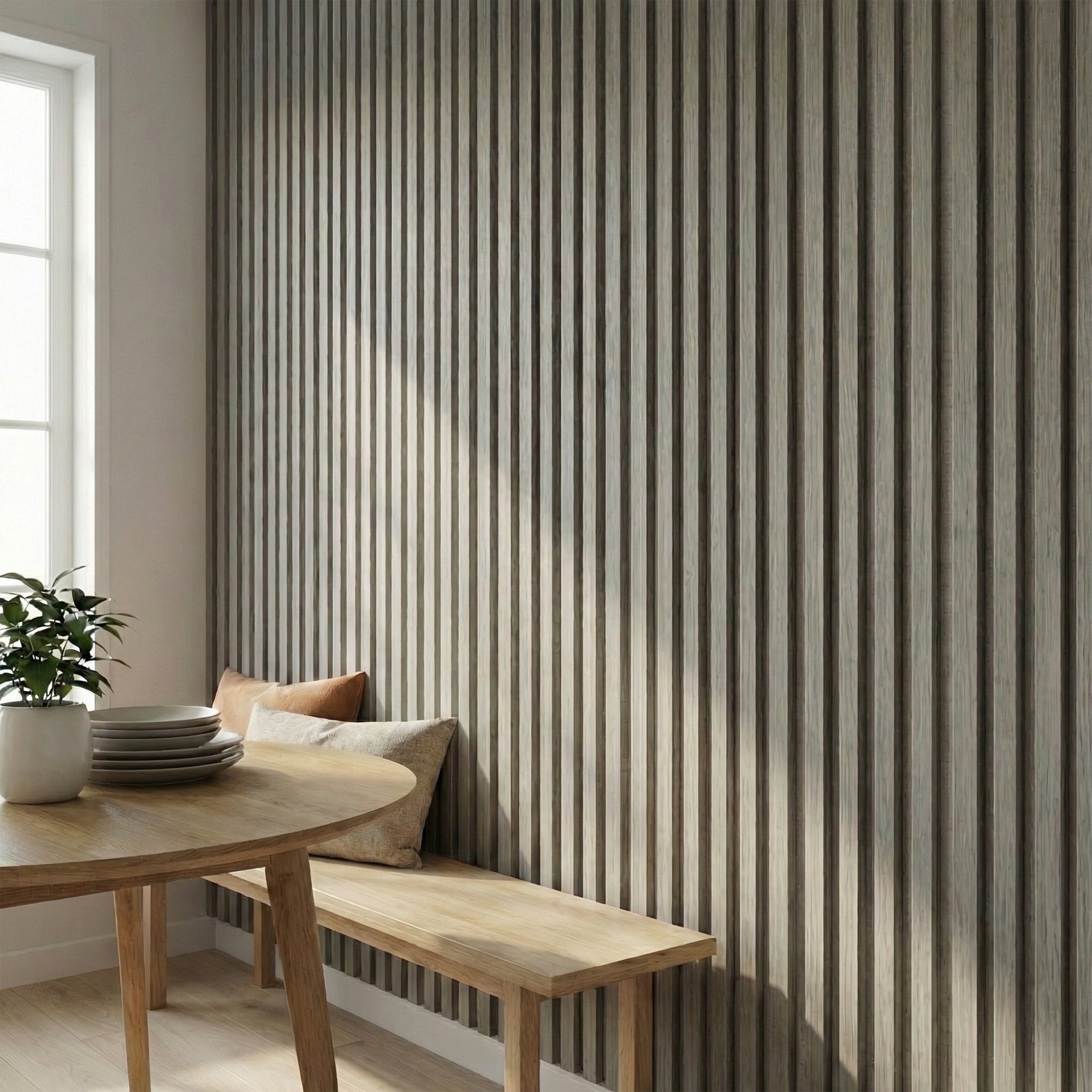
    Fluted and ribbed panels were the defining aesthetic of 2022–2024. In 2026, they’re mainstream — which means the interesting design moves have become more sophisticated. Fine-pitch fluting (narrower ridges, tighter spacing) has overtaken the bold wide-flute profiles of the early trend. The result is more refined — a surface that reads as textured at a distance but resolves into precise detail up close.

    The GroovePanel® range includes multiple flute profiles from fine pitch to bold relief — the direction of travel in 2026 is toward the finer end of the spectrum.

    Stone Effect Surfaces: From Niche to Mainstream

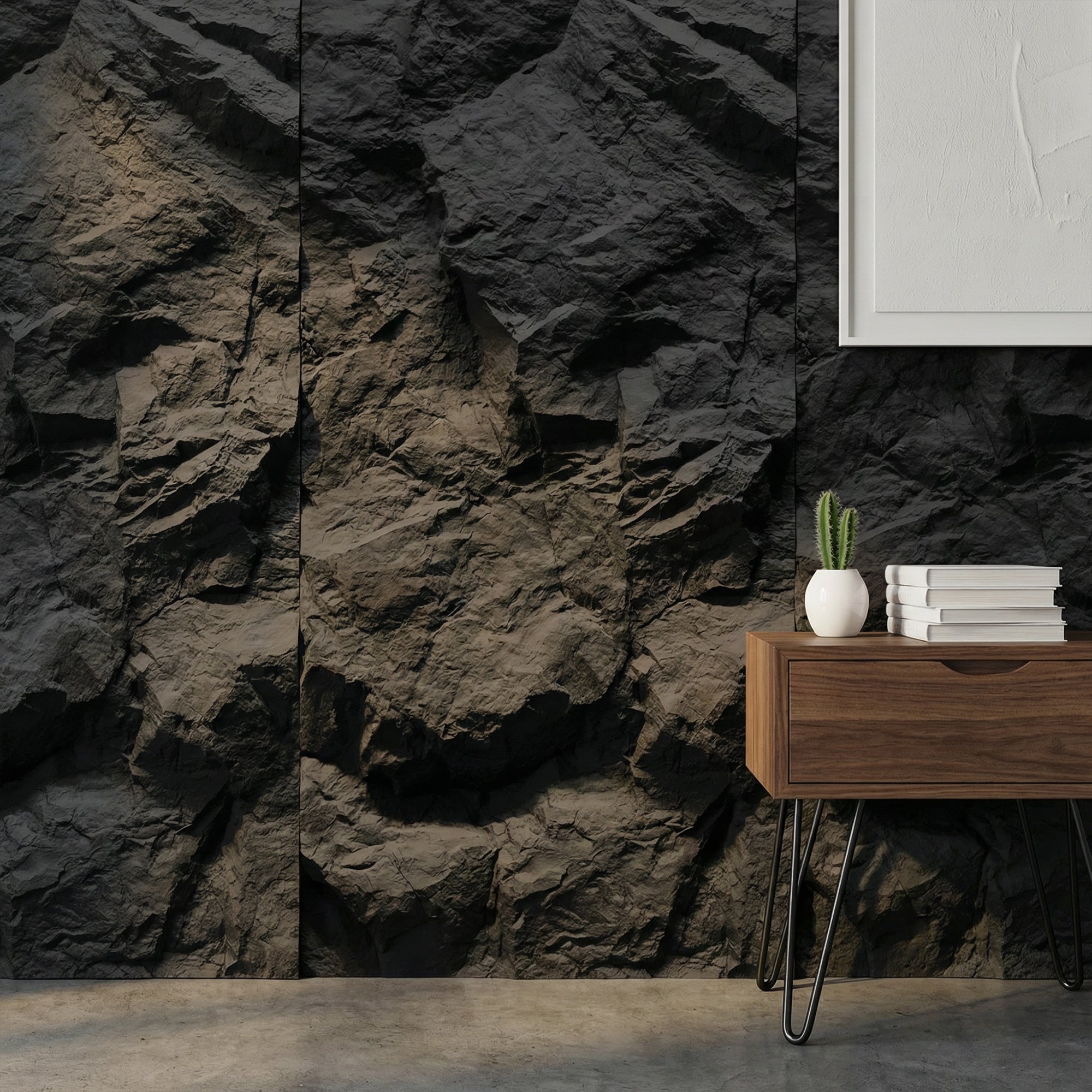
    Three-dimensional stone effect panels have followed a similar trajectory to wood panels, but about three years behind. In 2026, stone effect panels are appearing in residential applications that would previously have used painted walls or tile. The combination of realistic texture, lightweight installation, and significantly lower cost than real stone is proving compelling.

    The standout trend within stone panels is the move toward larger-format relief — bigger individual stone faces, deeper shadow lines, and more dramatic three-dimensional geometry.

    Mixing Materials: Wood Plus Stone

    One of the most interesting developments in 2026 is designers combining wood slat panels and stone effect panels in the same space. A horizontal band of stone effect panel at lower wall height, transitioning to wood slat above, creates a layered material story that neither material could tell alone. In commercial environments, this mixing approach creates spaces that feel designed at a different level of ambition than monolithic single-material feature walls.

    Acoustic Panels as Visual Features

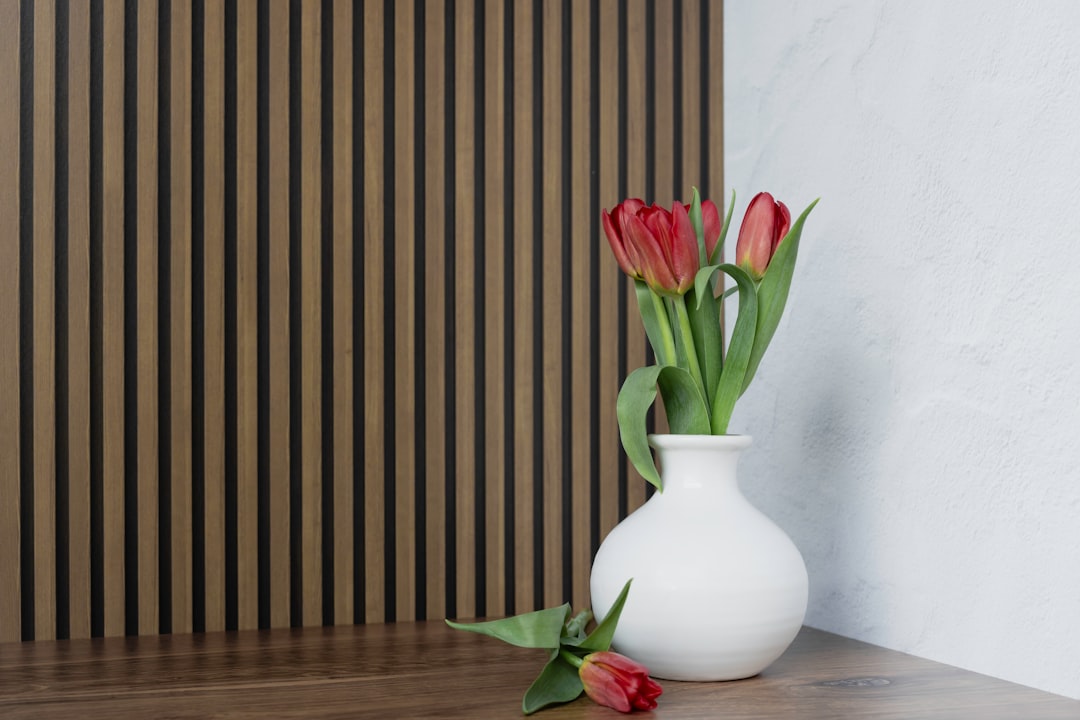
    Acoustic slat panels began as a functional specification in recording studios and broadcast environments. In 2026, they’re a mainstream residential feature, specified for their appearance as much as their acoustic performance. The SoundPanel™ range sits at this intersection of acoustic function and visual quality — a combination that’s proving increasingly relevant as open-plan living creates rooms with genuinely poor acoustic performance.

    What’s Fading Out

    • All-wall panel applications: Covering every wall in a room with the same panel product is becoming dated. Feature wall applications — one or two walls — remain strong.
    • Very dark wood tones: Deep espresso and near-black wood finishes that dominated hospitality design in 2021–2023 are giving way to warmer, lighter, more natural tones.
    • Peel-and-stick alternatives: The entry-level end of the market is separating from genuine panel products. Buyers who started with temporary solutions are upgrading to permanent installations.

    What’s Ahead

    The direction of travel for wall panels points toward more material experimentation — mixing profiles, tones, and surface textures within a single space. Browse the full range at The Panel Hub to explore both wood and stone effect options across the current collection.

  • MDF Wall Panels vs Solid Wood: Which Is Worth the Investment?

    MDF Wall Panels vs Solid Wood: Which Is Worth the Investment?

    MDF (Medium Density Fibreboard) and solid wood are the two primary substrate options for wood wall panels. Both can deliver excellent results. Both have genuine weaknesses. The choice between them matters — not just for budget, but for durability, appearance, environmental impact, and long-term performance in your specific application.

    What Is MDF and What Is Solid Wood?

    MDF Wall Panels

    MDF is an engineered wood product made from wood fibres, resin, and wax compressed under high pressure and heat. It’s dimensionally stable — it doesn’t expand, contract, or warp the way solid timber does — and has a smooth, consistent surface that takes paint, veneer, and surface finishes well. Most painted or foil-wrapped wall panels use MDF cores.

    Solid Wood Panels

    Solid wood panels use real timber — often oak, pine, walnut, or other hardwoods — as the primary material. The GroovePanel® and SoundPanel™ ranges from The Panel Hub use solid wood construction. Real wood brings visible grain, natural colour variation, and authentic warmth that engineered materials cannot replicate.

    Appearance and Finish

    Solid wood has the advantage for visible grain and natural authenticity. The grain, knots, colour shifts, and texture of real timber create a surface that looks and feels genuinely organic. In slat and fluted profiles, the grain of real wood creates visual depth that printed or foil-wrapped MDF cannot match.

    MDF has the advantage for painted finishes. Its smooth, consistent surface provides a flawless base for paint — no grain telegraphing through the finish. For painted panel applications, MDF is often the better material choice.

    Durability

    Solid wood is more durable in general use. It’s harder to dent, holds fixings well, and can be sanded and refinished if damaged. Solid wood panels, with appropriate maintenance, can last decades.

    MDF is less impact-resistant and has a critical weakness: moisture. MDF swells and disintegrates when exposed to sustained moisture. For bathroom or kitchen applications, only moisture-resistant (MR) MDF cores should be specified, and even then direct water exposure should be avoided.

    Cost

    MDF panels are generally less expensive than solid wood panels of equivalent dimensions. For painted applications where the material character isn’t visible in the final finish, MDF offers good value. For applications where the natural wood surface is part of the design — stained, oiled, or natural finishes — solid wood delivers an appearance that MDF cannot replicate.

    Environmental Considerations

    Solid wood from certified sustainable sources (FSC or PEFC) is renewable and stores carbon. MDF uses wood waste fibres but the resin binders are synthetic and typically non-recyclable. Look for certification claims when evaluating any wood panel product.

    Which Should You Choose?

    • Choose solid wood if natural grain and material character are important, if long-term durability is a priority, or if the application is in a dry environment where solid wood’s properties are best preserved.
    • Choose MDF if you’re painting the panels, if cost is the primary constraint, or if the application is in a dry interior environment where MDF’s moisture weakness is not a factor.

    For solid wood wall panels that deliver genuine material quality, explore the GroovePanel® and SoundPanel™ collections at The Panel Hub.

  • Wood Wall Panel Maintenance: How to Clean and Care for Your Panels

    Wood Wall Panel Maintenance: How to Clean and Care for Your Panels

    Wood wall panel maintenance is actually very handy these day. These panels have a reputation for being high-maintenance — an impression inherited from hardwood flooring, outdoor decking, and traditional painted joinery that needs regular attention. The reality for contemporary engineered wood wall panels is quite different. A quality wood panel installation requires a fraction of the maintenance of hardwood flooring and far less than tiled surfaces with grout joints.

    Routine Cleaning

    Dusting

    Wood slat and fluted panels accumulate dust in their grooves and gaps more readily than flat walls. A soft brush attachment on a vacuum cleaner, or a microfibre duster, removes surface dust without scratching the finish. In bedrooms and living rooms, monthly dusting is typically sufficient. In kitchens where airborne grease deposits are a factor, more frequent cleaning is recommended.

    Wiping Down

    A lightly damp microfibre cloth handles most surface marks on finished wood wall panels. Wipe along the grain of the wood or in the direction of the slat profile. Use minimal moisture — wood panels should never be saturated, even those with moisture-resistant surface treatments.

    Stubborn Marks

    For marks that don’t respond to a damp cloth, a mild solution of washing-up liquid in warm water applied with a soft cloth handles most household marks. Rinse with a clean damp cloth immediately and dry with a soft towel. Avoid leaving soapy residue on the surface.

    Dealing with Specific Issues

    Moisture and Humidity

    Wood is hygroscopic — it absorbs and releases moisture from the surrounding air. In spaces with variable humidity (bathrooms, kitchens), this can cause minor expansion and contraction of individual slats or panels. Quality engineered wood panels like the GroovePanel® and SoundPanel™ are designed to manage this movement, but good ventilation in moisture-prone rooms is the best mitigation.

    Scratches and Surface Marks

    Fine surface scratches in oiled or brushed wood finishes can often be addressed using a small amount of matching wood touch-up oil applied with a soft cloth, worked along the grain direction. For deeper marks, a touch-up pen matched to the panel colour can conceal damage effectively.

    Loose Panels or Slats

    If an individual slat or panel section becomes loose, re-adhere it using the same type of adhesive used in the original installation. Clean both surfaces before re-gluing and allow adequate curing time before putting the surface back in use.

    What to Avoid

    • Harsh chemical cleaners: Bleach, ammonia, and solvent-based products can strip the surface finish and cause permanent discolouration.
    • Abrasive pads or brushes: Steel wool, scouring pads, and stiff brushes scratch wood surfaces.
    • Excess moisture: Wet cloths, steam cleaners, and standing water are all harmful to wood panels regardless of surface treatment.
    • Direct sunlight without UV protection: Prolonged direct sun causes wood finishes to fade. UV-filtering window film or window treatments help protect panels in south-facing rooms.

    Long-Term Care Schedule

    • Monthly: Light dust with microfibre cloth or soft brush
    • Quarterly: Wipe down with damp cloth; check for any loose slats or panels
    • Annually: Apply maintenance oil or wax if the surface finish requires it — check manufacturer guidance

    For specific care guidance for your panels, contact The Panel Hub directly or read our care & maintenance guide — maintenance requirements vary by panel type and surface finish.

  • Wood Wall Panels vs Stone Wall Panels: Which Is Right for Your Space?

    Wood Wall Panels vs Stone Wall Panels: Which Is Right for Your Space?

    Wood and stone are the two dominant materials in natural feature wall design. Both have been used in interior and exterior architecture for centuries. Both are now available in panel form — engineered, lightweight, and easy to install — which puts them in direct competition for the same wall space in homes, offices, and commercial environments.

    Choosing between wood wall panels and stone effect wall panels depends on the room, the aesthetic you’re creating, and the practical requirements of the installation.

    What Each Material Communicates

    Wood Panels

    Wood panels are warm. The grain, tone, and texture of timber communicate organic warmth, natural authenticity, and domesticity. Even in their most contemporary application — fine slat panels with precise engineering and clean finishes — wood panels read as approachable and tactile. They work in bedrooms, living rooms, and home offices where warmth and comfort are design priorities.

    Stone Panels

    Stone panels are cool. Even in warm stone tones, the material communicates solidity, permanence, and weight. Stone feature walls make a bolder statement than wood and sit more comfortably in rooms where drama or formality is the goal — dining rooms, bar areas, commercial environments, feature fireplaces.

    Practical Differences

    Moisture Resistance

    Stone-effect panels generally have better inherent moisture resistance than wood panels, making them more suitable for bathroom and kitchen applications. Wood panels in humid environments require appropriate surface treatment or moisture-resistant cores.

    Acoustic Performance

    Wood slat and acoustic panels from the SoundPanel™ acoustic wood wall panel range offer measurable sound absorption — a benefit stone panels don’t provide. If acoustic performance is a factor in your specification, wood acoustic panels have a clear advantage.

    Room-by-Room Guide

    • Living room: Both work — wood for warmth, stone for drama and formality
    • Bedroom: Wood panels are generally preferred for the warmth they contribute
    • Bathroom: Stone-effect panels have the moisture resistance advantage
    • Kitchen splashback: Stone-effect panels are the practical choice
    • Fireplace breast: Stone is the classic choice; wood works in contemporary settings with appropriate fire safety considerations
    • Commercial and hospitality: Both are extensively used — choice is driven by the atmosphere the space is designed to create

    Can You Use Both?

    Yes — and the combination is often more interesting than either material alone. A fireplace breast in stone panels with an adjacent media wall in wood slats creates material contrast that defines the living room as a thoughtfully designed space. In commercial environments, alternating stone and wood surfaces across different zones creates a layered, high-end finish.

    Explore Both at The Panel Hub

    The Panel Hub supplies both wood wall panels — including the GroovePanel® and SoundPanel™ collections — and the RockSurface® stone effect range. Request samples from both to compare the materials in your own space before deciding.

  • Grooved Wall Panels: What They Are, Why Designers Love Them, and How to Use Them

    Grooved Wall Panels: What They Are, Why Designers Love Them, and How to Use Them

    What Are Grooved Wall Panels?

    What Are Grooved Wall Panels?
    Photo by Heather Newsom on Unsplash

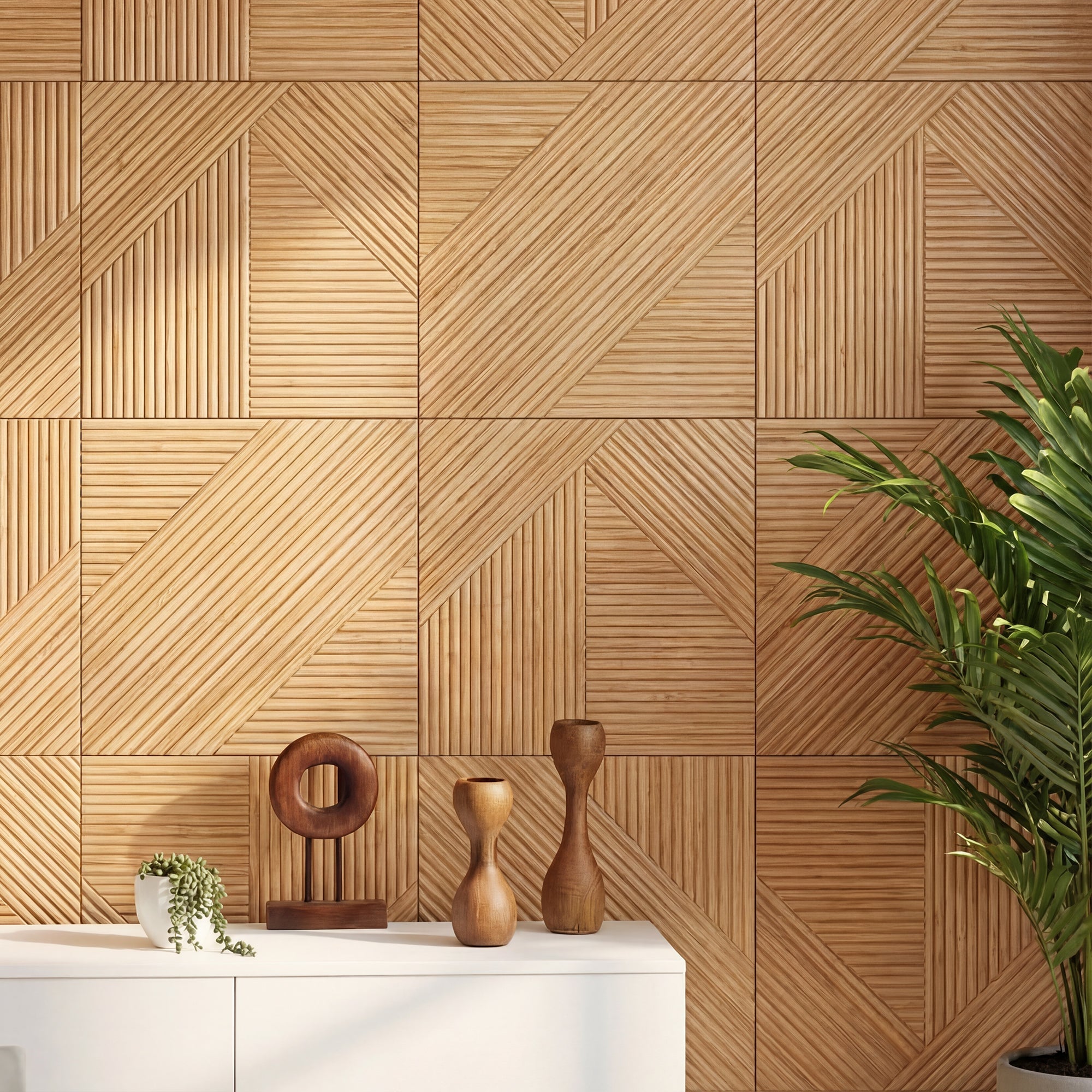
    Grooved wall panels are wood wall panels with deliberate channels — grooves — machined or routed into the panel face. The grooves can run in a single direction (vertical or horizontal), intersect in a grid, radiate outward in a concentric pattern, or form more complex geometric configurations depending on the panel design.

    The groove itself is doing two things simultaneously: creating a physical shadow line that adds depth to the wall, and defining a geometric pattern that gives the wall visual rhythm and organisation. The result is a wall surface that is more than a flat backdrop — it has its own architectural character.

    At The Panel Hub, our GroovePanel® collection is built around this principle. Every panel in the range is 100% solid wood throughout — no MDF core, no veneer face — with precision-machined grooves that hold their geometry permanently. The same grain that appears on the panel face runs through the groove edge and the panel back, because there is no veneer edge to separate or degrade over time.

    How Grooves Create Depth and Shadow

    How Grooves Create Depth and Shadow
    Photo by Heather Newsom on Unsplash

    The visual appeal of a grooved wall panel is directly tied to how light interacts with the groove geometry. A groove cut into a panel face creates a recessed shadow line — a darker band that contrasts with the lit surfaces on either side. As the light source changes through the day, the shadow depth and position shift, which means a grooved wall panel looks different in morning light, afternoon light, and under artificial evening lighting. The panel is not static.

    The depth and width of the groove determines how strong this effect is:

    • Shallow, narrow grooves (3–6mm deep): Create subtle texture — refined background detail that rewards close inspection without dominating the room from a distance. Best suited to rooms where the wall should provide warmth and interest without competing with furniture or art.
    • Deep, wide grooves (10–20mm deep): Create strong, hard shadow lines visible from across the room. These grooves read as bold architectural pattern and suit rooms where the wall is intended to be the primary visual statement.

    Groove direction adds another dimension. Vertical grooves extend the visual height of a room — the eye follows the groove lines upward. Horizontal grooves extend visual width. Intersecting grooves in a grid create even, balanced texture with no directional emphasis.

    Why Interior Designers Specify Grooved Panels

    Why Interior Designers Specify Grooved Panels
    Photo by l ch on Unsplash

    Material Authenticity

    Grooved panels in solid wood are a genuine material — real grain, real texture, real warmth. Designers working at the premium end of the residential and commercial market specify them because they introduce natural material quality that painted surfaces, wallpaper, and even most laminate finishes cannot replicate. The tactile quality of a grooved solid wood panel — the way the groove edge feels under a fingertip, the way the grain changes tone at the cut edge — is something that has to be experienced to be fully understood.

    Precision and Control

    Grooved panels give designers precise control over the visual character of a wall. The groove spacing, depth, direction, and pattern are all specified and consistent across every panel — unlike hand-finished or painted surfaces where the result depends on the skill of the tradesperson on the day. CNC-machined grooves are repeatable and exact. The panel-to-panel alignment on an installed wall reflects that precision.

    Versatility Across Design Styles

    Grooved panels sit comfortably across a wide range of interior design languages:

    • Japandi and Scandinavian: Fine-scale vertical grooves in pale oak or natural ash sit perfectly within the clean, material-honest aesthetic of Nordic-influenced interiors
    • Contemporary and minimalist: Intersecting grid grooves in a mid-tone wood create architectural texture without ornament
    • Mid-century modern: Concentric square grooves reference the geometric forms of 1950s and 60s design with a contemporary material execution
    • Transitional: Horizontal grooves in a warm walnut tone add character to transitional interiors without reading as period-specific

    Acoustic Contribution

    In rooms where sound quality matters — home offices, media rooms, dining rooms with hard floor surfaces — grooved panels contribute a small but measurable acoustic benefit. The grooves break up the flat reflective surface of the wall, introducing surface irregularity that diffuses rather than reflects sound. For more significant acoustic treatment, dedicated acoustic slat panels with felt backing are the appropriate specification — our SoundPanel® collection is designed specifically for this purpose.

    Where to Use Grooved Wall Panels

    Feature Walls and Focal Points

    The most common application — a single grooved panel wall as the primary focal point of a room. Living room sofa walls, bedroom headboard walls, and home office backdrop walls are the most frequent choices. A single well-executed grooved panel feature wall transforms the quality of a room in a way that few other interventions can achieve for equivalent cost and effort.

    Full-Room Applications

    In smaller rooms — walk-in wardrobes, studies, powder rooms — wrapping all four walls in a fine-scale grooved panel creates a cohesive, immersive material environment. The groove pattern unifies the space and eliminates the need for any other wall treatment or decoration. This approach requires precise panel-to-panel planning to ensure the groove pattern reads continuously at internal corners.

    Alcoves and Recesses

    Grooved panels used to line alcoves, recesses, or the interior of shelving units create a premium material backdrop that elevates the objects displayed against it. Books, objects, and plants all look better against a grooved wood surface than against painted plaster.

    Commercial and Hospitality Spaces

    Hotel reception walls, restaurant feature walls, office boardrooms, and boutique retail environments regularly specify grooved wood panels because the material quality and geometric precision signals investment and attention to detail. GroovePanel® FSC® and EPD certification means these panels meet sustainability requirements for LEED, BREEAM, and other commercial green building frameworks.

    Choosing Between Groove Patterns

    The GroovePanel® collection includes three primary groove configurations:

    • Crossing Lines: Horizontal and vertical grooves intersect to create a grid. Even, balanced, works at any scale. See our Crossing Lines panel guide for specific design applications.
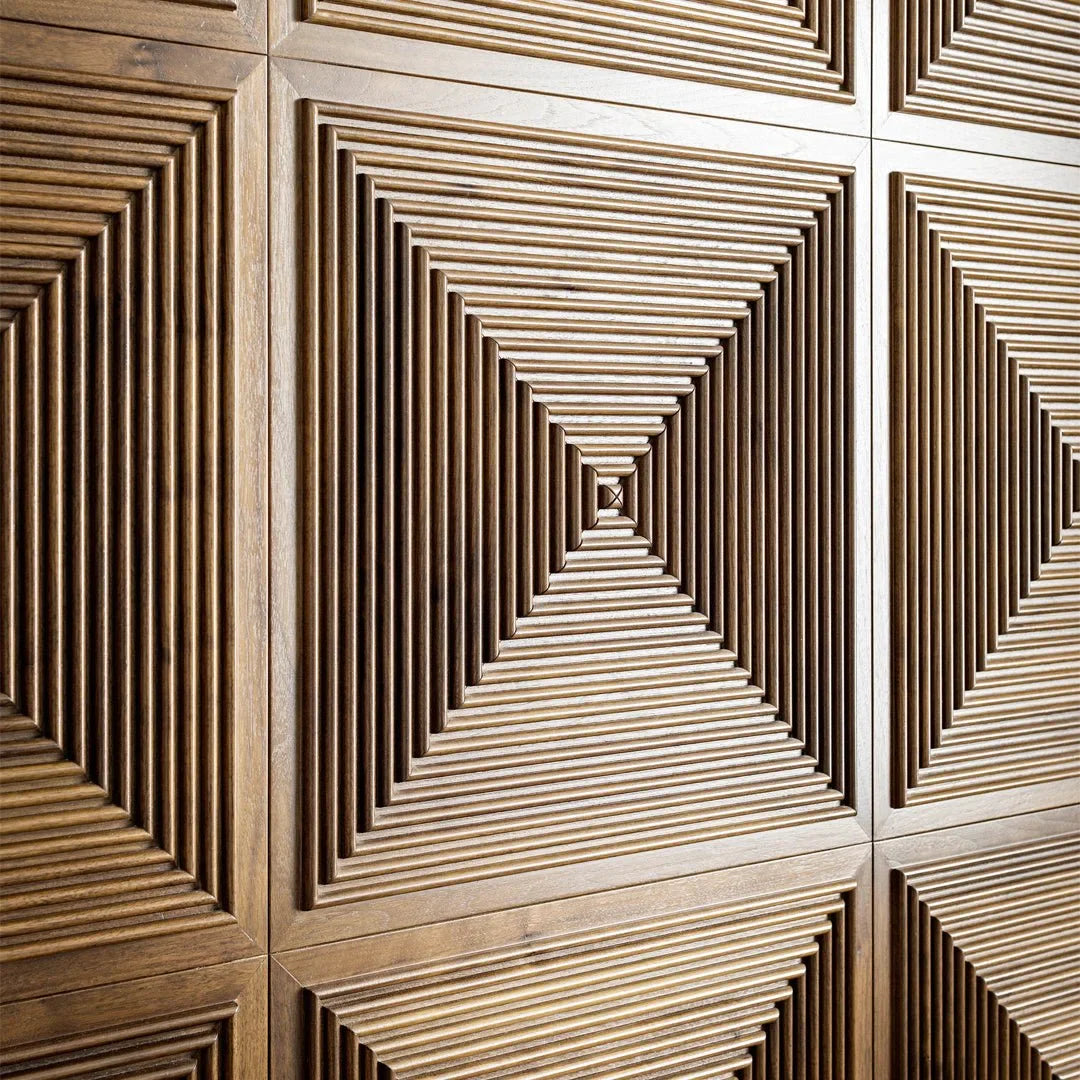
    • Concentric Squares: Nested squares machined into each panel face. Creates a radiating focal-point pattern. See our Concentric Squares guide for room-specific ideas.
    • 3D Relief: Stepped and faceted relief elements that create physical depth beyond a single groove plane. Requires directional lighting to perform at its best. The 3D Geometric Pattern panel is the most striking expression of this format in the GroovePanel® range.

    Our geometric wood panel guide covers the full range of patterns, their visual character, and which rooms suit each one.

    Browse the GroovePanel® Collection

    Explore the full GroovePanel® range at The Panel Hub — 100% solid wood, FSC® and EPD certified, with factory-direct pricing, free US shipping, a 5-year warranty, and 24/7 support. Order a sample to see the groove depth, grain quality, and shadow-play in your own space before committing to a full wall.

  • Shiplap vs Wood Wall Panels: What’s the Difference and Which Is Right for Your Home?

    Shiplap vs Wood Wall Panels: What’s the Difference and Which Is Right for Your Home?

    Shiplap vs Wood Wall Panels: The Short Answer

    Shiplap is a specific plank profile — individual boards with a rabbet cut on each edge that allows planks to overlap slightly and lie flush. Wood wall panels are a broader category: pre-engineered panel systems, typically sold in larger format sheets or modular tiles, that can include slat panels, geometric panels, acoustic panels, and more. The two products serve different design intentions and perform differently on a wall.

    What Is Shiplap?

    Shiplap originated as an exterior cladding material. The overlapping rabbet joint between boards creates a weather-resistant profile that sheds water. Used on interior walls, shiplap produces a characteristic horizontal-line aesthetic — evenly spaced parallel planks running across the wall surface.

    The modern interior shiplap trend owes much to the farmhouse and coastal interior styles popularised in the 2010s. White-painted pine shiplap became a design signature of a particular aesthetic. That association is now so strong that shiplap has become somewhat style-specific — it signals a rustic, casual, or coastal character that may or may not be what you want.

    Shiplap Characteristics

    • Profile: Individual planks, typically 100–150mm wide, with overlapping rabbet joints
    • Material: Usually pine or MDF, sometimes cedar for exterior use
    • Finish: Most often painted white; natural wood stain is less common
    • Aesthetic: Horizontal, linear, rustic, farmhouse, coastal
    • Installation: Board by board, nailed to studs; time-consuming on large walls
    • Gap consistency: Requires care to maintain even spacing and level lines across the wall

    What Are Modern Wood Wall Panels?

    Modern wood wall panel systems — like the GroovePanel® collection at The Panel Hub — are engineered as complete wall systems rather than individual boards. Panels are manufactured to precise dimensions, with pre-engineered edges that butt together cleanly and patterns that align panel-to-panel without careful on-site measurement and adjustment.

    The category is wide: geometric panels, acoustic slat panels, fluted panels, reeded panels, mosaic wood panels — each with its own visual character and performance characteristics. Unlike shiplap, which is strongly associated with a single aesthetic, wood wall panels span multiple design languages from contemporary minimalist to mid-century modern to Japandi.

    Wood Wall Panel Characteristics

    • Format: Panel sheets or tiles, typically 600mm–1200mm wide, installed in fewer pieces than individual plank systems
    • Material: Solid wood, real wood veneer on engineered core, or MDF — depending on the manufacturer
    • Finish: Natural wood tones (oak, walnut, pine), stained finishes, or paintable surfaces
    • Aesthetic: Spans contemporary, minimalist, Japandi, mid-century, traditional — depending on panel type
    • Installation: Adhesive and nails; larger format means fewer joints and faster installation
    • Pattern alignment: Engineered panel-to-panel alignment built into the product design

    Key Differences Side by Side

    Aesthetic Flexibility

    Shiplap is style-specific. Its horizontal plank profile reads as farmhouse, coastal, or rustic regardless of how it is finished. If that is the aesthetic you want, shiplap delivers it efficiently. If you want a contemporary, Japandi, minimalist, or architectural result, shiplap works against you — its associations are too strong.

    Modern wood wall panels are style-flexible. A geometric GroovePanel® with deep-cut crossing lines reads as contemporary and architectural. A fine oak slat panel reads as Japandi or Scandinavian. The panel format itself does not carry a single strong style association the way shiplap does.

    Installation Speed and Precision

    Individual shiplap planks require precise levelling of each course, particularly on longer walls where small angle errors compound over multiple boards. On a full 4m wall, keeping twenty individual planks level, spaced evenly, and terminated cleanly at corners and obstacles is a skilled job that takes time. Modern panel systems install faster because each panel covers more area and alignment is built into the panel design. Our installation guide walks through the full process.

    Material Quality

    Most shiplap available at building merchants and home improvement stores is pine or MDF — functional materials but not premium ones. At the premium end, shiplap in cedar, oak, or hardwood species is available but less common and significantly more expensive. Modern wood wall panels span a wider quality range from affordable MDF-core options through to 100% solid hardwood panels like GroovePanel® — all solid wood throughout, FSC® certified, and built for longevity. See our MDF vs solid wood comparison for detail on what the difference means in practice.

    Acoustic Performance

    Flat shiplap boards with tight joints provide no meaningful acoustic benefit. Modern acoustic wood panel systems — slat panels with felt backing, for example — do provide measurable sound absorption. If reducing echo or improving room acoustics is part of your goal, wood wall panels are the appropriate category; shiplap is not.

    Which Is Right for Your Home?

    Choose shiplap if:

    • You specifically want a farmhouse, coastal, or rustic interior aesthetic
    • You are happy with the standard painted-plank look
    • Budget is a priority and you are comfortable with the installation labour involved

    Choose modern wood wall panels if:

    • You want a contemporary, Japandi, minimalist, or architectural result
    • You want design flexibility — geometric patterns, acoustic performance, natural wood grain
    • You want a premium material (solid wood, real veneer, FSC certified)
    • You want faster, cleaner installation with engineered panel-to-panel alignment

    Where Each Approach Works Best: Room-by-Room

    The decision between shiplap and modern wood wall panels is partly about aesthetics and partly about the specific spatial context. Here’s how the two approaches tend to play out by room type.

    Hallways and entryways: Both treatments work well in hallways. Shiplap’s horizontal lines can make a narrow hallway feel slightly wider (horizontal lines optically expand a space). Vertical slat or fluted panels draw the eye upward, making a low ceiling feel taller. The choice depends on whether width or height is the more constraining dimension.

    Living rooms: Modern wood wall panels are the dominant choice for living room feature walls — the acoustic benefit in slat panel versions is particularly relevant for rooms where television and conversation compete. Shiplap in a living room reads as country-house or coastal in character, which suits some aesthetics but limits others.

    Bedrooms: Both approaches work as headboard wall treatments. Modern panels — particularly slat panels in warm timber tones — are the more common current choice for bedrooms. Shiplap in a bedroom reads as relaxed and informal, which suits a countryside or cottage aesthetic well.

    Home offices: Modern acoustic slat panels are practically significant in home offices: they address the reverberation that makes video calls uncomfortable. Shiplap provides no acoustic benefit. For a home office that also appears on screen regularly, modern panels offer both the aesthetic and the functional improvement.

    Kitchens and bathrooms: Shiplap in moisture-prone environments requires careful species selection and finishing — untreated pine shiplap will fail in high-humidity conditions. Modern composite-core panels rated for damp environments are more predictably moisture-resistant. In both rooms, the panel specification must match the environmental conditions.

    FAQs: Shiplap vs Wood Wall Panels

    Is shiplap the same as tongue-and-groove cladding?
    No. Shiplap boards have a rabbet (stepped overlap) cut into the top and bottom edges so adjacent boards overlap without a gap. Tongue-and-groove boards have a tongue on one edge and a groove on the other, creating an interlocking join. Both create a similar horizontal board look, but the join detail and shadow line are different. Tongue-and-groove creates a flat, flush surface; shiplap creates a visible shadow line at each board overlap.

    Can modern wood wall panels look like shiplap?
    Yes. Some modern wall panel products include a horizontal channel or groove profile that replicates the shadow line of shiplap boards in a single panel format. These products install more quickly than individual shiplap boards while achieving a similar visual result. The difference from genuine shiplap is visible on close inspection but not from normal room distances.

    What timber is shiplap typically made from?
    Traditionally, shiplap uses pine, cedar, or spruce — softwoods that are relatively easy to mill, paint, and maintain. For interior applications, MDF shiplap is available in primed and paint-ready formats. For exterior shiplap cladding, durable species like cedar, larch, or Siberian spruce are standard choices. Hardwood shiplap is less common due to cost and milling difficulty.

    How long does shiplap last compared to modern wall panels?
    Both can last 20+ years in appropriate conditions. Shiplap’s longevity depends on regular painting or staining (exterior shiplap every 5–7 years; interior every 7–10 years). Modern wood wall panels with factory-applied hard-wax oil or lacquer finishes require less frequent maintenance. In exterior applications, both require ongoing maintenance; modern composite panels are generally lower-maintenance than natural timber shiplap.

    Browse Wood Wall Panel Collections

    Explore the full range at The Panel Hub: the GroovePanel® geometric collection for contemporary and architectural interiors, the SoundPanel® acoustic slat collection for rooms where sound quality matters, and the full wood wall panel range for every style and budget. Order a sample to compare materials in your own space before deciding.

  • Wainscoting vs Wall Panels: Which Is Right for Your Home?

    Wainscoting vs Wall Panels: Which Is Right for Your Home?

    What Is Wainscoting?

    What Is Wainscoting?
    Photo by Franco Debartolo on Unsplash

    Wainscoting is a wall treatment applied to the lower section of an interior wall — traditionally the lower third to half — using wood panels, boards, or moulding profiles. The name comes from the Dutch word “wagenschot,” referring to the high-quality oak boards historically used for this purpose. In its most common form, wainscoting consists of a top rail (a horizontal moulding at waist height), vertical stiles and panels below, and a base rail at floor level.

    Traditional wainscoting styles include raised panel (panels that project above the frame), recessed panel (panels that sit below the frame surface), flat panel (simple inset panels with minimal moulding), and board and batten (vertical boards with thin strips covering the joints). Each style carries a distinct character: raised panel is formal and traditional; board and batten reads as farmhouse or coastal; flat panel sits between traditional and contemporary.

    What Are Modern Wood Wall Panels?

    What Are Modern Wood Wall Panels?
    Photo by Shoham Avisrur on Unsplash

    Modern wood wall panel systems — like the GroovePanel® geometric panels and SoundPanel® acoustic slat panels at The Panel Hub — are pre-engineered panel systems designed to cover full wall areas or specific sections of a wall. They come in modular formats that install cleanly panel-to-panel, with patterns and profiles that are machined at the factory rather than assembled on-site from separate components.

    Modern wall panels can be used at full height or as a half-wall treatment — replicating the proportional logic of wainscoting with a contemporary material and aesthetic. They span a much wider design range than traditional wainscoting: geometric patterns, deep-groove profiles, acoustic performance, natural wood tones, and FSC-certified materials are all available within a single panel system.

    How They Compare

    Aesthetic Range

    Wainscoting is aesthetically specific. Its architectural language — stiles, rails, panels, mouldings — is rooted in period interior design. Done well, it is beautiful in the right context: Georgian townhouses, Victorian terrace conversions, formal dining rooms, entrance halls with high ceilings. In a contemporary open-plan apartment or a Japandi-influenced interior, it works against the design rather than with it.

    Modern wood wall panels are not style-specific. A fine oak slat panel applied to the lower half of a wall reads as a contemporary dado — the proportional logic of wainscoting expressed in a modern material language. A geometric GroovePanel® applied at the same height reads as architectural and precise. The panel format adapts to the design intent rather than imposing its own historical character.

    Installation Complexity

    Traditional wainscoting is a joinery project. Individual components — top rails, base rails, stiles, panel inserts, corner mouldings, returns — are measured, cut, fitted, and fixed individually. Achieving crisp, even results requires skill and time. Even pre-primed wainscoting kits involve significant on-site assembly and finishing work.

    Modern panel systems install considerably faster. Larger format panels cover more wall area per piece, factory-made edges butt together cleanly, and alignment is built into the panel design rather than achieved through on-site carpentry. Our step-by-step installation guide covers the complete process. Most single-wall panel installations complete in under two hours.

    Material Quality and Certification

    Entry-level wainscoting is typically MDF — primed and painted on site. Mid-range wainscoting uses MDF or softwood. Premium wainscoting uses hardwood species (oak, American walnut) but at significant cost. Modern wood panel systems like GroovePanel® are 100% solid wood throughout, FSC® and EPD certified, and priced with factory-direct efficiency. You get premium solid hardwood at a price point that would typically buy mid-range wainscoting materials alone — before labour.

    Half-Wall vs Full-Wall Application

    Wainscoting is by definition a partial-height treatment. Modern wall panels work at any height: full floor-to-ceiling for maximum impact, half-wall for the proportional logic of a traditional dado, or as a focused panel in a single section of the room. This flexibility makes modern panels a more versatile investment — the same product system can serve as a full feature wall or a contemporary wainscoting alternative depending on how it is applied.

    Acoustic Performance

    Traditional wainscoting panels are decorative — they provide no acoustic benefit. Modern acoustic wood panel systems with felt backing do provide measurable sound absorption, which is relevant in open-plan spaces, home offices, and media rooms. If sound quality matters, modern panels offer a functional dimension that wainscoting cannot match.

    When to Choose Wainscoting

    Wainscoting remains the right choice when:

    • The room’s existing architecture is period or traditional and you want the wall treatment to match the period character
    • You are restoring a property and want historically accurate detailing
    • You specifically want the raised or recessed panel profile that is characteristic of traditional wainscoting

    When to Choose Modern Wood Wall Panels

    Modern wood wall panels are the right choice when:

    • You want a contemporary or design-forward result rather than a period look
    • You want the proportional logic of a dado treatment expressed in a modern material
    • You want acoustic performance alongside visual appeal
    • You want FSC-certified, environmentally documented materials
    • You want faster installation with less on-site carpentry skill required

    Making the Decision: A Practical Framework

    After comparing the two approaches, the decision usually comes down to a few practical factors rather than pure aesthetics. Here’s a framework that resolves most cases quickly.

    Is period character essential? If the room has original cornicing, skirting, or other period architectural features that you want to complement, traditional wainscoting is almost certainly the better choice. Modern panel systems read as contemporary additions rather than period-sympathetic treatments. In a listed building or period property, wainscoting is usually more appropriate and in some cases architecturally required.

    Is the installation permanent? If you’re renting, or if you anticipate removing the wall treatment within five years, modern wall panel systems that install with minimal fixing (adhesive, few fixings) are easier to remove without damaging the substrate. Traditional wainscoting installed with nails and filler is significantly harder to reverse.

    What is the primary effect you’re trying to achieve? Texture and depth → modern wall panels. Period character and formal elegance → wainscoting. Acoustic improvement → acoustic slat panels. Practical storage → slat wall storage panels. The desired outcome narrows the choice quickly.

    What is the budget constraint? Traditional wainscoting has a wide price range — from painted MDF rail-and-panel kits at modest cost to bespoke joinery at significant expense. Modern panel systems are similarly variable. At equivalent quality levels, the two approaches are broadly comparable in material cost; the labour difference is significant, with modern panels typically faster to install.

    FAQs: Wainscoting vs Modern Wall Panels

    Can wainscoting and modern wall panels be used in the same house?
    Yes — different rooms can take different approaches. Period-style wainscoting in a formal dining room or hallway, and modern 3D or slat panels in a home office or media room, is a coherent approach that uses each treatment where it’s most appropriate. The key is ensuring each room is internally consistent rather than mixing styles within a single space.

    Is wainscoting still in style?
    Traditional wainscoting remains a strong choice in period properties and formal rooms. Contemporary interpretations — simplified panel moulding, painted in off-white or deep tones — have seen renewed interest as part of the broader trend toward architectural interior detail. Classic wainscoting doesn’t go out of style in the same way trend-led treatments do; it’s a period reference rather than a current trend.

    How high should wainscoting be?
    Traditional wainscoting runs to one-third of the wall height — typically 900–1,100mm in a room with standard 2.4m ceilings. Chair rail height (approximately 900mm) is the classical reference point. Higher wainscoting (to half-wall height, 1,200mm+) creates a more dramatic effect and suits taller rooms proportionally. Lower wainscoting (below 750mm) tends to look undersized rather than restrained.

    What is the main maintenance difference between wainscoting and modern panels?
    Painted wainscoting requires periodic repainting — typically every 5–7 years depending on wear — as the paint chips and scuffs over time. Modern wood wall panels with oil or lacquer finishes require periodic re-oiling or lacquer refresh, but the natural timber appearance is more forgiving of minor wear marks. In high-traffic areas like hallways, both treatments will show wear; the maintenance approach differs but the effort level is broadly comparable.

    Browse Modern Wall Panel Collections

    Explore the GroovePanel® geometric collection and the full wood wall panel range at The Panel Hub. All panels are factory-direct, FSC® certified, and come with a 5-year warranty. Order a sample to compare materials and finishes before committing to a full installation.

  • Wood Panel Accent Wall Ideas: 12 Ways to Create a Stunning Feature Wall

    Wood Panel Accent Wall Ideas: 12 Ways to Create a Stunning Feature Wall

    Why Wood Panels Make the Best Accent Walls

    Why Wood Panels Make the Best Accent Walls
    Photo by Clay Banks on Unsplash

    Paint creates colour. Wallpaper adds pattern. Wood panels do something different: they add physical texture, natural warmth, and a material presence that changes how a room feels rather than just how it looks. A wood panel accent wall introduces real wood — grain, depth, shadow — into a space in a way that no flat surface treatment can replicate.

    The key is choosing the right panel type and pattern for your room. Here are twelve approaches, from the most subtle to the most dramatic.

    1. Crossing Lines Grid Panel Wall

    1. Crossing Lines Grid Panel Wall
    Photo by franci ee on Unsplash

    Crossing Lines Solid Wood Wall Panels - Oak - View 11

    A wall of precision-cut crossing lines in solid wood creates a refined, architectural texture that reads as background detail from a distance and rewards close inspection. This is the most versatile geometric option — it suits contemporary, minimalist, Japandi, and mid-century interiors. Use it behind a sofa, behind a bed, or in an entrance hall. The GroovePanel® Crossing Lines panel is 100% solid wood with precision-machined grooves that hold crisp geometry permanently.

    2. Concentric Square Relief Wall

    2. Concentric Square Relief Wall
    Photo by Callum on Unsplash

    3D Concentric Square Wood Wall Panel - Walnut - View 2

    Concentric square panels — nested squares machined into the panel face — create a radiating, focal-point pattern that suits living rooms and bedrooms. Position a single panel as a centrepiece or tile multiple panels for a repeating wall-wide pattern. The concentric geometry reads as both contemporary and timeless — it does not date the way trend-specific finishes do.

    3. Full-Height Slat Panel Wall

    Floor-to-ceiling vertical slats in natural oak or walnut create a warm, linear texture that stretches the room height visually. This is one of the most popular contemporary interior applications — used in living rooms, bedrooms, and dining rooms. The shadow gaps between slats add depth without the visual complexity of patterned panels. See our wood slat panel living room guide for detailed design ideas.

    4. Half-Wall Panel Treatment

    Panelling the lower half of a wall — from floor to roughly waist height — creates a contemporary version of the traditional dado. This approach is particularly effective in hallways and dining rooms where full-height panelling might feel overpowering. Choose a panel with a strong horizontal grain or a geometric pattern that reads well at lower viewing distances.

    5. TV Wall Panel Surround

    Panelling the entire wall behind a television gives the TV a designed context rather than leaving it as an isolated black rectangle on a plain wall. Panel from floor to ceiling for maximum impact, or create a framed panel zone that matches the width of the TV unit below. This approach is particularly effective with geometric panels — the angular precision of the panel pattern complements the rectangular form of the television and cabinetry.

    6. Fireplace Alcove Panels

    The recessed sections on either side of a chimney breast are natural candidates for wall panelling. Panelling these alcoves frames the fireplace, gives recessed shelving a material backdrop, and adds warmth to what are otherwise often plain painted surfaces. Wood-toned panels suit traditional and contemporary fireplaces equally well. For a stone look alongside the fireplace itself, see our RockSurface® faux stone panels.

    7. Bedroom Headboard Wall

    A panelled wall behind the bed functions as an architectural headboard — eliminating the need for a separate headboard piece and giving the sleeping space a strong focal point. For bedrooms, choose panels with subtle geometry or fine linear texture rather than bold 3D relief — the goal is warmth and calm rather than high visual drama. Our bedroom panel design guide covers this in detail.

    8. Home Office Backdrop Wall

    A wood wall paneling behind a desk transforms the home office experience — both for the person working and for anyone joining video calls. A single wall of geometric or slat panels reads as intentional and professional on camera without requiring art, accessories, or additional styling. The natural wood warmth also improves the room’s visual quality in a way that painted walls rarely achieve.

    9. Dining Room Focal Wall

    The wall at the head of a dining table — or the full-length wall facing the dining seats — is an underused design opportunity. A wood panel accent wall here anchors the dining space and creates the sense that meals are happening in a designed room rather than just a functional one. Deeper geometric patterns or walnut-toned panels suit the formality that dining rooms often call for. See our dining room panel ideas guide for eight specific approaches.

    10. Staircase and Landing Panels

    Staircase walls are among the longest continuous wall surfaces in most homes — and among the most overlooked. Running wood panels along a staircase wall, either full-height or as a dado, transforms a functional transitional space into a considered design statement. Linear slat panels work particularly well on staircase walls because the direction of the slats echoes the diagonal of the stair flight.

    11. Bathroom Feature Wall

    Moisture-resistant wood panel systems can be used in bathrooms — but material selection matters significantly. Some wood species and finishes handle bathroom humidity well; others do not. Our bathroom wood panel guide covers which materials work and which to avoid. For a fully waterproof option, waterproof wall panels are the safer choice in wet zones.

    12. Commercial Accent Wall

    Wood panel accent walls in offices, retail environments, hotel lobbies, and restaurants create a material quality and warmth that painted walls cannot match. The combination of natural wood grain and geometric precision in panels like GroovePanel® positions a space as design-conscious and premium. FSC® and EPD certification means these panels also meet sustainability requirements for commercial fit-outs. Our commercial wall panel guide covers specification considerations for non-residential applications.

    How to Get Started

    Before committing to a full installation, order a sample from The Panel Hub. Seeing the grain, depth, and shadow-play of a real panel in your own room — under your own lighting — is the most reliable way to make a confident decision. Browse the full GroovePanel® geometric collection and wood wall panel range to find the right style for your accent wall.

  • Wood Panel Wall: A Complete Guide to Styles, Materials & Installation

    Wood Panel Wall: A Complete Guide to Styles, Materials & Installation

    What Is a Wood Panel Wall?

    A wood panel wall is a wall surface covered in timber-based panels, either solid wood, engineered wood, or wood veneer over MDF. Unlike painted drywall, wood panel walls add texture, warmth, and depth to any interior space — and in the case of acoustic wood panels, they also reduce echo and improve sound comfort.

    Wood panel walls have been used in architecture for centuries, from traditional wainscoting in Georgian homes to modern acoustic slat walls in contemporary apartments. Today’s options are more accessible, more varied, and easier to install than ever before.

    Types of Wood Panel Walls

    Acoustic Slat Panels

    The most popular style in modern interiors. Acoustic slat panels feature vertical strips of real wood veneer mounted on a felt backing (like AcuFelt™), which absorbs sound. NRC ratings of 0.65–0.85 make them genuinely effective at reducing echo — not just decorative. Ideal for living rooms, bedrooms, home offices, and home theatres.

    Solid Wood Tiles

    Panels made from real solid wood pieces arranged in geometric patterns — mosaic, herringbone, concentric squares. These are purely decorative but offer unmatched authenticity in grain and texture. More expensive than veneer options, but premium in look and feel.

    Wood Veneer Panels

    Real wood veneer (typically 0.6–2mm thick) bonded to an engineered MDF core. The best of both worlds: genuine wood appearance and grain at a fraction of solid wood cost. Most quality wall panels on the market today use veneer construction.

    Shiplap and Tongue-and-Groove

    Traditional horizontal plank systems. Shiplap features planks with a small reveal gap; tongue-and-groove locks planks flush together. Both suit farmhouse, coastal, and transitional interiors.

    Fluted and Reeded Panels

    Panels with vertical grooves (fluted) or rounded ridges (reeded) that create a sculptural, architectural effect. Both are extremely popular in 2025–2026 interiors.

    Best Woods for Wall Panels

    • Walnut — rich chocolate tones, premium feel, suits modern and Japandi interiors
    • Oak — light, versatile grain; the most universally used wood for wall panels
    • Ash — pale and consistent grain; good for Scandinavian aesthetics
    • Pine — affordable, knotty character; suits rustic and farmhouse styles
    • Bamboo — sustainable, fine grain; increasingly popular in eco-conscious interiors

    Wood Panel Wall Installation Overview

    Most modern wood wall panel systems are designed for DIY installation:

    1. Prepare the wall — clean, level, and dry. Remove any loose paint or wallpaper.
    2. Measure and plan layout — start from a central point or corner depending on panel type.
    3. Apply adhesive — use a construction adhesive compatible with MDF/wood panels.
    4. Press panels into place — use a spirit level to keep each panel straight.
    5. Trim to size — cut with a fine-tooth saw at corners and edges.
    6. Finish edges — use matching trim strips or caulk for a clean result.

    Quality panel systems like those from The Panel Hub are designed to install in under two hours per wall, with no professional help required.

    How Much Does a Wood Panel Wall Cost?

    Costs vary widely:

    • Budget laminate panels: $20–$50 per panel
    • Mid-range veneer panels: $80–$150 per panel
    • Premium acoustic wood panels: $109–$259 per panel

    Factory-direct brands can save you up to 75% compared to retail pricing, making real wood panels accessible without the premium markup.

    Are Wood Panel Walls Worth It?

    Yes — for most spaces. Beyond the visual upgrade, acoustic wood panels genuinely improve the way a room feels by reducing echo. They’re more durable than paint, more practical than wallpaper, and — with the right system — no harder to install. For anyone looking to elevate a bedroom, living room, or office, a wood panel wall is one of the highest-impact upgrades available.

    Choosing Between Panel Styles: A Practical Decision Framework

    With so many panel types available, the choice can feel overwhelming. These four questions narrow it down quickly.

    1. What is the primary purpose — aesthetic or acoustic? If acoustic performance matters (home office, living room with hard floors, home theater), slat panels with acoustic felt backing are the practical choice. If the goal is purely visual, any panel type works and the choice is purely aesthetic.

    2. What scale is the room? Large rooms with high ceilings handle bold, three-dimensional panels well. 3D geometric panels, deep-profile fluted panels, and wide-plank systems look proportionate in generous spaces. In smaller rooms, finer profiles — narrow slats, shallow grooves, subtle relief — prevent the wall treatment from overwhelming the space.

    3. What is the budget per m²? Budget systems (£40–£80/m²) typically use printed wood-effect veneer or thin engineered surfaces. Mid-range (£80–£150/m²) gives you real wood veneer over engineered core. Premium systems (£150+/m²) offer solid wood, thick real veneer, or specialist treated finishes. The mid-range covers the vast majority of quality residential applications.

    4. How will it be installed? If you plan to DIY, adhesive-mount systems on standard plasterboard walls are the most practical. If the wall is uneven or the installation complex, factor in professional preparation costs before committing to the panel budget.

    Wood Panel Wall FAQs

    What is the most popular wood wall panel style right now?
    Acoustic slat panels — thin wood strips over a felt backing — are currently the most popular residential panel style in the UK and Europe. They combine a clean, contemporary aesthetic with genuine acoustic performance, and they work across a very wide range of interior styles from Japandi to maximalist.

    How thick are typical wood wall panels?
    Standard slat panels are 21–25 mm thick. MDF and engineered panel systems run 9–18 mm. Three-dimensional geometric panels can be 30–50 mm at their deepest relief point. The thicker the panel, the more depth it adds to the wall — which can be a design advantage or a practical consideration in tight spaces near door frames or light switches.

    Do wood wall panels add value to a home?
    Quality wood panel installations in key rooms (living room, bedroom, entrance hall) consistently add perceived value and are noted positively in property listings and valuations. Painted or poorly installed panels do not add value and can make a property harder to sell. The investment returns most reliably on real wood or high-quality engineered panels installed professionally or to a high DIY standard.

    How do I decide how much wall to panel?
    Start with one feature wall — the wall your eye is drawn to first when entering the room. A single feature wall almost always looks more intentional and designed than multiple paneled walls, and costs significantly less. Expand to additional walls only once you have seen how the first wall looks in the room.

    Browse the Full Collection

    Everything covered in this guide is available to explore and order at The Panel Hub. Browse the complete wood wall panel collection — including the SoundPanel™ acoustic slat range and GroovePanel® mosaic tiles. For room-by-room inspiration, our interior slat wall ideas guide covers 50+ applications across every style, and the acoustic panel buyer’s guide is the right next step if sound performance is part of your brief.

  • Wood Wall Panels: Everything You Need to Know (2026)

    Wood Wall Panels: Everything You Need to Know (2026)

    You’ve seen it in every room you’ve walked into this year. A warm, textured wall that immediately makes a space feel finished — like someone actually thought about it. That’s a wood wall panel. And if you’re here, you’re probably trying to figure out whether it’s right for your space, what it costs, how it goes up, and which type won’t look dated in three years.

    This guide covers all of it. No padding, no vague suggestions — just what you actually need to know before you buy.

    What Are Wood Wall Panels

    Wood wall panels are decorative surfacing installed directly onto interior walls. They come in sheets, planks, or modular tiles, and they transform blank drywall into something that has texture, depth, and character.

    The term covers a wide range of products — from solid hardwood planks to engineered wood-core slat systems to MDF panels with a real wood veneer face. What they share is this: they’re a wall treatment designed to be permanent (or at least semi-permanent), and they change how a room sounds and feels, not just how it looks.

    Worth knowing: wood wall panels are not the same as wood-look PVC or vinyl panels. This guide focuses on panels with real wood content — solid wood, HDF, MDF, or wood veneer-faced cores. If you want waterproof panels for a shower or bathroom, we cover those separately in our bathroom wall panels guide.

    Why People Are Using Them in 2026

    Wood wall panels aren’t a trend that appeared suddenly. They’ve been building momentum for years, and in 2026 the direction is clear: people want walls that do something. Not just cover a surface, but define a room — acoustically, visually, spatially.

    A few things are driving this specifically:

    Biophilic design has gone mainstream. The idea that natural materials improve how spaces feel isn’t fringe anymore. Wood grain, texture, and warmth are showing up in living rooms, bedrooms, and home offices because they work — rooms with natural surfaces feel calmer and more considered than bare painted walls.

    Remote work made people actually look at their walls. If you’ve been on video calls for three years, you’ve had a long time to stare at the wall behind your desk. Acoustic slat panels solve two problems at once — they look good on camera and absorb sound.

    The 2024–2026 aesthetic has moved past farmhouse. Shiplap and whitewashed wood had their moment. What’s happening now is richer, more architectural: walnut tones, vertical slat profiles, fluted and reeded textures, darker finishes paired with brass or matte black. It’s a more permanent, intentional direction.

    Types of Wood Wall Panels

    This is where most guides get vague. Here’s a clear breakdown of what’s actually available and who each type is for.

    Acoustic Slat Panels
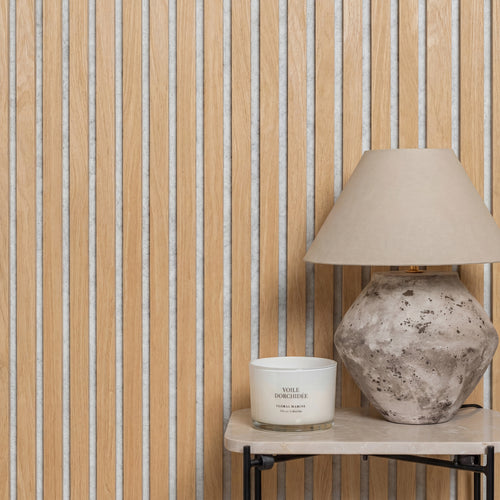
    American Acoustic Slat White Felt Wood Wall Panels - Oak - View 1

    The most popular wood wall panel in the residential market right now. These are vertical or horizontal wooden slats — typically 10–20mm wide — mounted over a felt or acoustic backing. The gaps between slats allow sound to pass through, where the felt layer absorbs it.

    TPH’s SoundPanel uses AcuFelt 1500 g/m² high-density backing and achieves an NRC (Noise Reduction Coefficient) of 0.85 — meaning it absorbs up to 85% of sound. That makes a measurable difference in home offices, home theaters, and open-plan living spaces where echo is a problem.

    Material: Real wood veneer over HDF core, with acoustic felt backing
    Best for: Living rooms, home offices, bedrooms, gaming rooms, home theaters
    NRC rating: 0.85 — Shop SoundPanel

    Decorative Slat Panels

    Same profile as acoustic, but without the felt backing. These are purely visual — the focus is on the texture and warmth of the wood rather than acoustic performance. Because they’re lighter and simpler, they’re often lower cost and easier to cut.

    Best for: Accent walls where aesthetics are the only goal
    NRC rating: None

    Solid Wood Panels
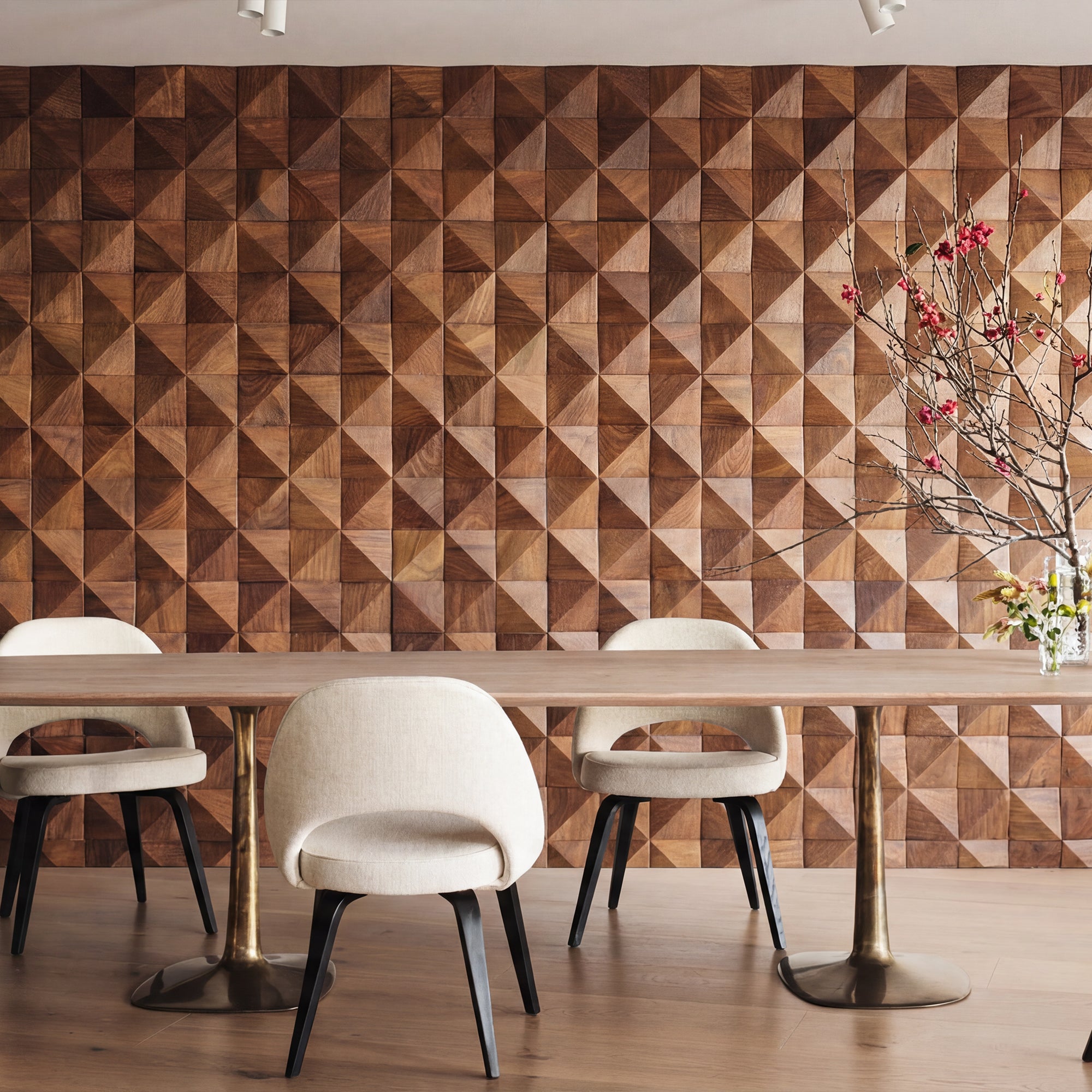
    Walnut Triangle Solid Wood Wall Panels - View 3

    Planks or sheets of real, through-and-through timber. Oak, walnut, pine, and ash are the most common species. These have genuine wood grain all the way through, take stain beautifully, and last for decades. The tradeoff: they’re heavier, more expensive, and more sensitive to humidity changes than engineered options.

    Best for: Dining rooms, hallways, statement feature walls
    Price range: Higher end — solid walnut panels can reach $15–$25/sqft in materials alone

    MDF Panels (Paintable)

    MDF panels are engineered wood — dense, stable, and smooth. They’re typically sold unfinished, ready to prime and paint. Fluted MDF and ribbed MDF are popular because they give you sculptural texture at a lower cost than real wood, and you can paint them any color you want.

    The limitation: they’re not real wood. If you want visible grain, warmth, or an honest material story, MDF isn’t it. But for a bold, painted feature wall — especially if you’re going dark — MDF is a practical and good-looking choice.

    Best for: Painted feature walls, contemporary interiors where grain isn’t the point
    Price range: $7–$11/sqft for materials — Solid wood vs MDF: full comparison

    Wood Veneer Panels
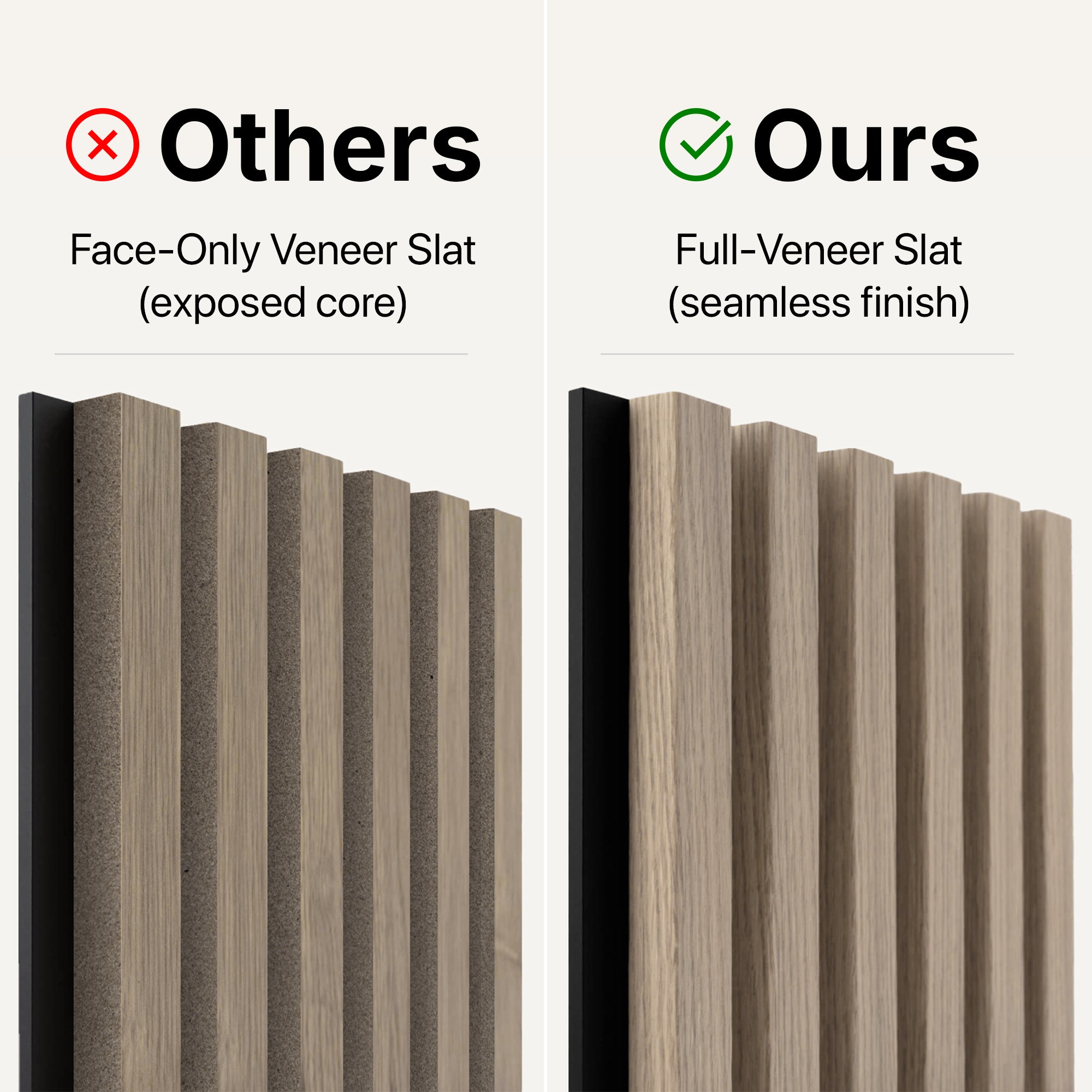
    A thin layer of real wood — typically 0.6–3mm — bonded to an engineered core (usually HDF or MDF). You get the look and feel of solid wood at a fraction of the weight and cost. The veneer is real; you can see and feel the grain. The core provides dimensional stability.

    Most of TPH’s slat panels use a wood veneer construction. It’s the sweet spot for 95% of residential applications.

    Best for: Anyone who wants real wood appearance without solid wood cost or weight
    Price range: $13–$22/sqft

    Mosaic and Geometric Panels
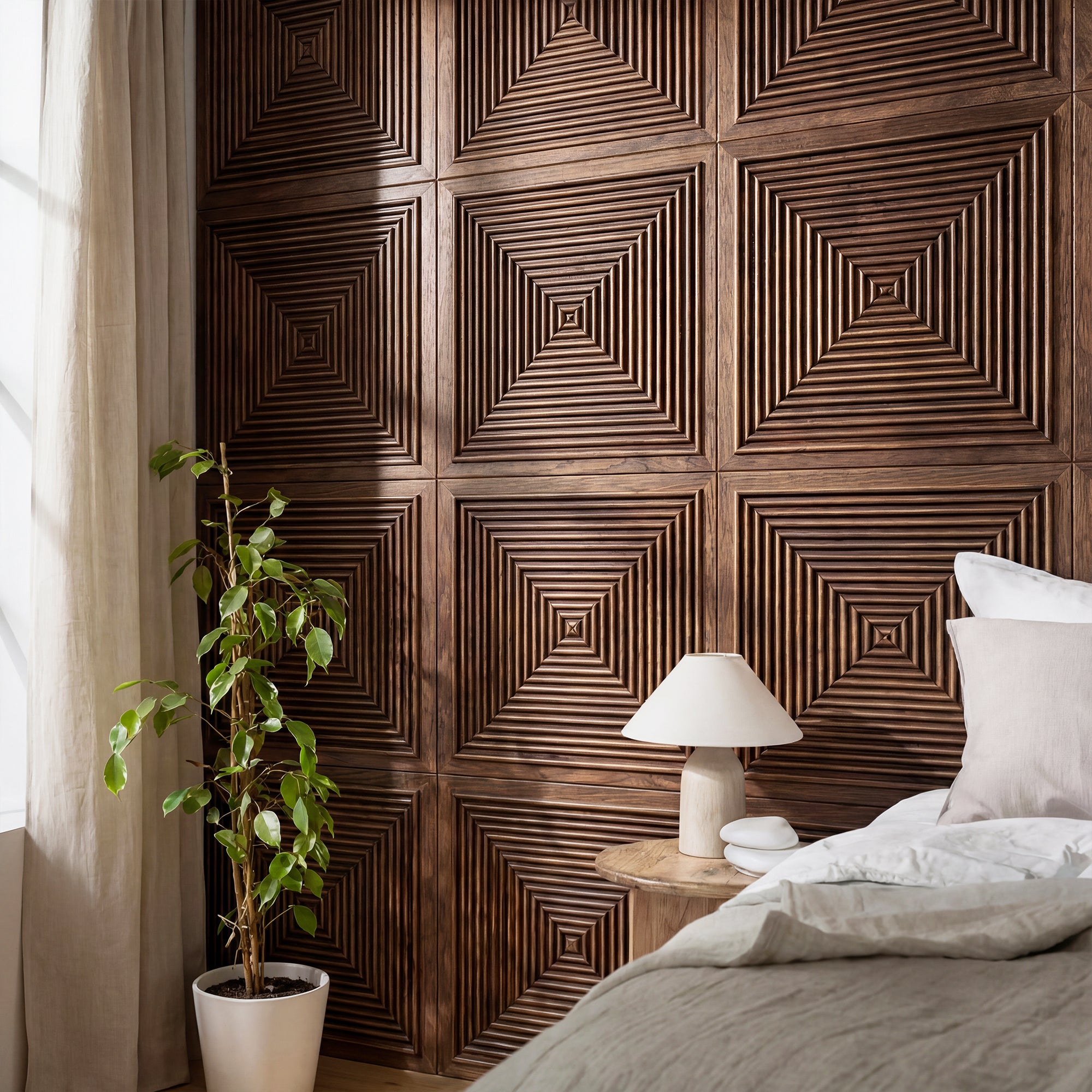
    3D Concentric Square Wood Wall Panel - Walnut - View 2

    Solid wood pieces cut into triangles, hexagons, or other geometric shapes and assembled into patterns. These create a more artistic, statement-wall effect. They take longer to install and require more planning, but the result is genuinely unique.

    Best for: Focal walls in dining rooms, entryways, or anywhere you want a conversation piece — Shop Mosaic Panels

    WPC Outdoor Panels

    Wood-plastic composite panels engineered for exterior use. Real wood fiber combined with polymer — stable, weather-resistant, and still warm-looking. If you’re cladding an exterior wall, covered patio, or garden room, WPC is the right material. Learn more about WPC outdoor panels.

    Wood Wall Panels Cost: What to Expect

    Wood panel walls typically cost between $7 and $22 per square foot for materials alone, depending on the type. Here’s how that breaks down in practice.

    Panel Type Materials (per sqft) DIY Install Time Contractor Labor (per sqft)
    Paintable MDF (fluted, ribbed) $7–$11 2–4 hrs per wall $3–$10
    Wood veneer slat (decorative) $12–$18 Under 2 hrs per wall $3–$10
    Acoustic slat (SoundPanel) $14–$22 Under 2 hrs per wall $3–$10
    Solid wood planks $15–$40+ 3–6 hrs per wall $5–$15
    Mosaic / geometric $18–$35 4–8 hrs per wall $8–$20

    Contractor labor runs $3–$10 per square foot for standard installations, with more complex layouts or solid wood work running higher.

    A realistic budget for a single accent wall (roughly 60–80 sqft):

    • Acoustic slat panels at $18/sqft = $1,080–$1,440 in materials
    • DIY install: your time + a few basic tools
    • Pro install: add $180–$800 depending on your area

    Full room coverage in a standard 12×14 bedroom (approx. 400 sqft of wall) runs $2,800–$8,800 in materials depending on the panel type. Most homeowners do one or two walls, not a full room.

    Which Wood Species Should You Choose?

    The wood species defines the color, grain character, and overall feel of your wall. Here’s what each one does:

    American Walnut — Dark chocolate brown with straight, sometimes wavy grain. The premium choice. Warm, rich, and pairs beautifully with brass hardware and natural linen. If your room has warm tones, walnut is hard to beat. See walnut wall panels.

    White Oak — Medium golden-brown, clean grain, highly versatile. Works in Scandinavian, mid-century, contemporary, and transitional rooms. The safest choice if you’re not sure — it doesn’t clash with much and ages well.

    Golden Oak — Warmer and more amber than white oak. Traditional feel. Pairs naturally with cream walls, dark floors, and warmer light sources.

    Pine — Light, pale, and knotty. Rustic and casual. Works in cottages, farmhouse interiors, and anywhere you want wood to feel natural and unpretentious rather than designed. Lower cost than hardwood species.

    Charcoal / Ebonized — Deeply stained or thermally treated wood with a near-black finish. Bold. Works in modern, industrial, and moody spaces. Increasingly popular in 2026 as darker tones replace the lighter Scandi palette of the previous decade.

    Room-by-Room: Where Wood Wall Panels Work Best

    Living Room

    The most popular application, and for good reason. A single accent wall behind a sofa or TV immediately anchors the room. Vertical slat panels draw the eye upward and make ceilings feel higher. Acoustic panels also reduce echo in open-plan spaces.

    Best types: Acoustic slat, wood veneer slat, mosaic for a statement wall
    Most popular wall: Behind the sofa, or as a TV feature wall — Living room panel ideas

    Bedroom

    The headboard wall is the natural target. A full-width panel behind the bed creates a built-in headboard effect without the cost or permanence of custom millwork. Walnut and dark oak work especially well here — they create a sense of enclosure and calm.

    Best types: Acoustic slat (for sound dampening), solid wood veneer
    Most popular wall: Behind the bed

    Home Office

    The acoustics argument is strongest here. Hard surfaces — painted drywall, glass, hard floors — create a flutter echo that makes every video call feel like you’re talking in a parking garage. One acoustic panel wall changes that completely. The NRC 0.85 rating means absorbing 85% of sound energy hitting the surface.

    Best types: Acoustic slat panels exclusively
    Most popular wall: Behind the desk, doubles as a camera backdrop — Gaming and office wall panel ideas

    Dining Room

    Panels make dining rooms feel more intimate and formal without being heavy. The trick is restraint — one wall behind a banquette or sideboard is enough. Walnut or darker tones create that restaurant-booth warmth that makes people want to stay at the table longer.

    Best types: Wood veneer slat, mosaic, solid wood
    Most popular wall: Behind a bench seat or sideboard — Dining room wall panels

    Hallway

    Hallways are narrow, high-traffic, and usually boring. A slat wall panel transforms them into something architectural. Horizontal panels make narrow hallways feel wider; vertical panels add height in low-ceiling corridors. This is also one of the easiest spaces to panel because the wall area is manageable.

    Home Theater and Gaming Room

    If you’re spending money on a projector or screen, spend proportionately on the room. Acoustic panels on the side walls and back wall reduce the flutter echo that plagues untreated rooms. Dark finishes absorb light scatter and improve perceived contrast. Home theater room ideas.

    How to Install Wood Wall Panels: The Real Timeline

    Most acoustic slat and wood veneer panels are designed for DIY installation. Here’s what’s actually involved.

    What you need:

    • Tape measure, pencil, level
    • Construction adhesive or panel-specific adhesive — adhesive guide
    • Oscillating tool or circular saw for cuts
    • Hammer and finishing nails (optional, for added security)

    The process:

    1. Prepare your wall. Clean surface, check for level. The panels won’t fix a badly out-of-plumb wall — fix large dips before you start.
    2. Mark your starting point. Find the center of the wall or use a corner. A level chalk line saves time.
    3. Cut to fit. Measure your wall height. Most panels need a top cut to fit ceiling height. Score-and-snap works for many panel types; a circular saw handles anything trickier. How to cut wall paneling.
    4. Apply adhesive. Run a zigzag bead on the back of the panel, or apply to the wall directly if the manufacturer recommends it.
    5. Press, check level, secure. Press the panel firmly to the wall. Check level. For acoustic panels, the felt backing grips the wall — the bond is strong immediately.
    6. Repeat and stagger joints. Adjacent panels should have staggered end joints for a cleaner look.

    Realistic time: A standard 8×10 ft accent wall takes most people 1.5–2.5 hours on their first installation. The second wall goes faster.

    Solid Wood vs MDF vs Wood Veneer: Which Is Right for You?

    The three materials serve different needs. Here’s how to think about the choice honestly.

    Choose solid wood if: You want panels that will last 30+ years and improve with age. You’re okay with a higher price and some sensitivity to humidity. You want a material that’s honest — it’s wood all the way through, and you can feel it.

    Choose wood veneer if: You want real wood appearance — visible grain, genuine warmth — without the weight, cost, or movement of solid wood. This is the right choice for 90% of residential walls. TPH’s veneer panels use real wood faces on stable HDF cores, so you get the look and the stability.

    Choose MDF if: You want a painted finish and don’t need grain. MDF paints beautifully and holds crisp profiles for fluted and ribbed designs. It’s also the most budget-friendly option at $7–$11/sqft. The honest limitation: it’s not wood, and it won’t look like wood.

    Full solid wood vs MDF comparison.

    Do Wood Wall Panels Actually Improve Acoustics?

    Yes — but the answer depends heavily on which panels you buy.

    Decorative wood panels with no acoustic backing do almost nothing for sound. The wood itself reflects rather than absorbs. You’ll get a small improvement from the added surface mass, but nothing measurable.

    Acoustic panels are different. The combination of slat gaps and high-density felt backing creates a mechanism for sound absorption. TPH’s SoundPanel achieves NRC 0.85 — that means 85% of sound energy hitting the panel is absorbed rather than reflected back into the room.

    For context: a fully treated recording studio typically targets NRC 0.9–1.0. A bare drywall room sits around NRC 0.05. A single acoustic panel wall takes you most of the way to a treated room without turning your house into a studio.

    Practical difference you’ll notice: fewer echoes on calls, voices that sound clearer and closer, less fatigue in rooms where you spend long periods talking or listening. More on acoustic wood panels.

    How to Choose the Right Panel for Your Space

    Five questions to narrow it down:

    1. Do you need acoustic performance? If yes, go straight to acoustic slat panels. If no, decorative options open up.

    2. What’s your wall’s moisture exposure? Bathrooms and kitchens need waterproof panels — WPC or PVC, not wood veneer. Bathroom panel options.

    3. What’s your budget? Under $10/sqft in materials: paintable MDF. $12–$18: decorative wood veneer slat. $18–$22+: acoustic slat or solid wood.

    4. What’s your room’s existing palette? Warm tones (cream, terracotta, warm grey): walnut or golden oak. Cool tones (white, charcoal, slate): white oak or charcoal finish. Industrial or modern dark rooms: ebonized wood.

    5. Are you DIYing or hiring? Both are completely viable. DIY acoustic slat panels go up in under 2 hours on a standard wall.

    Use the Room Visualizer to see how different finishes look on your actual walls before you commit. Open the Room Visualizer.

    How to Care for Wood Wall Panels

    Wood wall panels are low-maintenance. Here’s the short version:

    • Dust regularly with a dry microfiber cloth. Don’t use wet cloths on untreated or unfinished wood.
    • For marks: Damp cloth with mild soap, wiped quickly and dried immediately.
    • Avoid direct sunlight on dark-stained panels — UV fading is real, and it’s slow enough that you won’t notice until you move furniture.
    • Don’t steam clean. Heat and moisture are the enemies of any wood product.
    • Acoustic felt backing: Vacuuming the slat gaps once a year keeps the felt from accumulating dust that would reduce its performance over time.

    Full panel care guide.

    The Honest Comparison: Wood Panels vs Wallpaper vs Paint

    Each does something different. The right answer depends on what you’re trying to achieve.

    Paint is the cheapest and most reversible option. It changes color but not texture, and it does nothing for acoustics. If your walls are in good shape and you’re just after a new look, paint is fine.

    Wallpaper adds pattern and some texture, but remains a flat surface. Modern wallpapers look good, but they don’t change how a room feels spatially or acoustically. And removal is a project.

    Wood wall panels add genuine texture, warmth, and — if you choose acoustic panels — measurable sound improvement. They’re permanent in the best sense: they look better in 10 years than they do on day one, and they hold up to real use. The tradeoff is cost and installation time.

    Wall panels vs wallpaper: full comparison.

    Frequently Asked Questions

    How long do wood wall panels last?
    Wood veneer panels installed correctly last 15–25+ years under normal indoor conditions. Solid wood panels last the life of the building. MDF panels are slightly more vulnerable to moisture damage at edges — seal them properly on installation and they’ll last 10–15 years without issue.

    Can you install wood wall panels over existing wallpaper?
    Not recommended. Wallpaper creates an uneven, potentially unstable substrate. Strip the wallpaper first, skim-coat any damage, and install onto a clean flat wall.

    Do wood wall panels need to be sealed?
    Pre-finished wood veneer panels (like TPH’s SoundPanel) arrive ready to install — no sealing required. Unfinished solid wood or MDF panels need primer or sealant before or after installation.

    Are wood wall panels suitable for a bedroom?
    Yes, and the bedroom is one of the best applications. The acoustic benefit is real — people sleep better in quieter rooms — and the visual warmth of wood behind a bed transforms the space.

    Can I install wood wall panels myself?
    Yes. TPH panels are designed for DIY installation and take under 2 hours per wall for most homeowners. The main requirement is a level wall, accurate measurements, and the right adhesive.

    Where to Start

    If you know the room but not the panel, the Room Visualizer is the right first step — it lets you see any TPH panel on a wall before you order. Open the Room Visualizer.

    If you know you want acoustic performance, start with the SoundPanel collection. Shop SoundPanel.

    If you want to explore wood types and finishes across the full range, the wood wall panels collection is the place. Shop all wood wall panels.

    Sample boxes are available if you want to hold the finish in your hand before committing — which, honestly, you should. A photo on a screen tells half the story. Order a sample box.

    The Panel Hub makes real wood acoustic wall panels from FSC-certified materials, designed in the USA and shipped from North Carolina. 3-sided rounded edges. AcuFelt 1500 g/m² backing. NRC 0.85.

    Shop the Full Collection

    Everything covered in this guide is available to explore and order at The Panel Hub. Browse the complete wood wall panel collection — including the SoundPanel™ acoustic slat range, the GroovePanel® mosaic tiles, and the RockSurface® faux stone panels. For room-by-room design inspiration, our interior slat wall ideas guide covers 50+ applications across every style. For detailed guidance on acoustic panel performance and specifications, the complete acoustic panel buyer’s guide is the right next step.