Tag: Geometric

  • Geometric Wall Panels for Hallway: How to Use Pattern in a Narrow Space

    Geometric Wall Panels for Hallway: How to Use Pattern in a Narrow Space

    Hallways present a genuine design challenge. They’re transitional spaces — narrow, often dark, and constrained by architecture. Most people treat them as afterthoughts: a coat hook, a mirror, and whatever paint was left over from the last room. But the hallway is the first thing guests see when they enter your home, and the last thing they notice when they leave. Getting it right matters more than it seems.

    Geometric wood wall panels are one of the most effective tools for transforming a hallway. Here’s how to use them in a way that makes the space feel considered rather than cluttered.

    The Hallway Challenge: Narrow, Dark, and Transitional

    Most hallways have three specific constraints:

    • Narrow width: Pattern that feels bold in a living room can feel overwhelming in a space you pass through in two steps
    • Limited natural light: Windowless hallways depend entirely on artificial lighting, which changes how timber tones and shadow effects read
    • No place to sit: Without furniture to anchor the eye, the wall becomes the entire design

    Geometric panels address all three constraints effectively when chosen and installed thoughtfully.

    Which Geometric Pattern Works Best in a Hallway?

    Crossing lines — the most versatile hallway choice

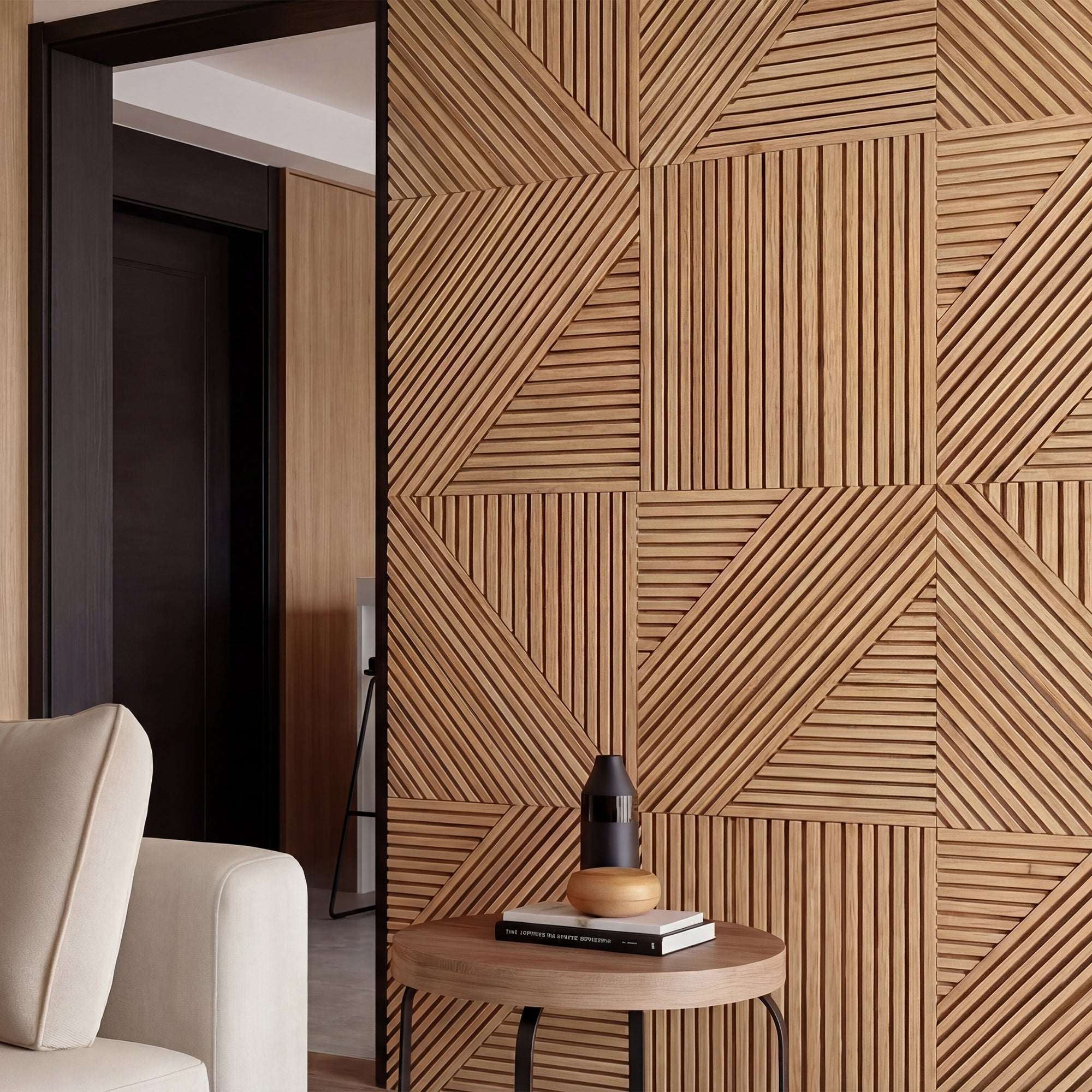
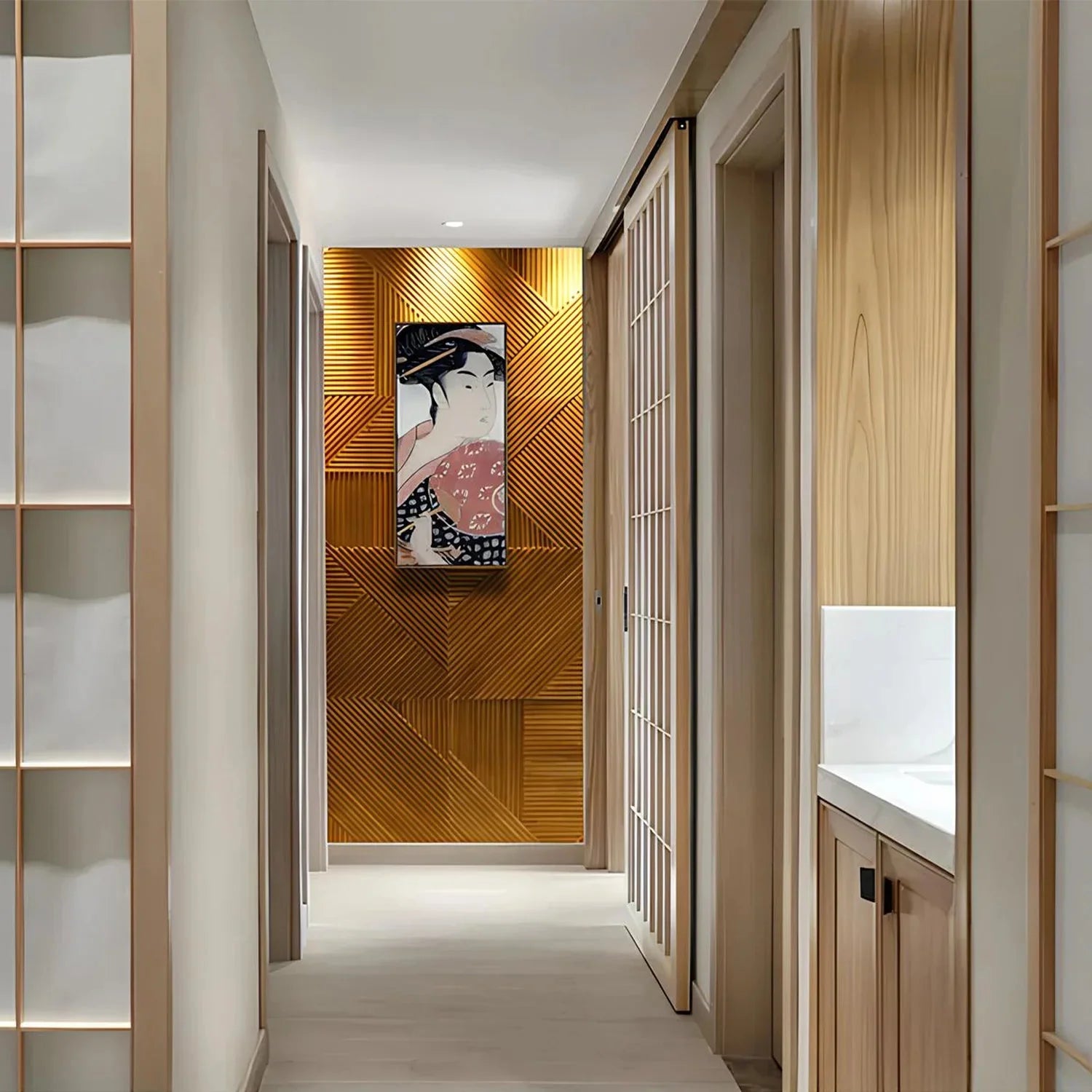
    The Crossing Lines Solid Wood Panel is the most hallway-appropriate pattern in the GroovePanel® range. Its grid-based geometry creates strong visual presence without the directional movement of a triangle mosaic or the focal-point demand of a concentric square. It reads well in narrow spaces and holds up under both overhead pendant lighting and wall-mounted sconces.

    Concentric squares — best at the end wall

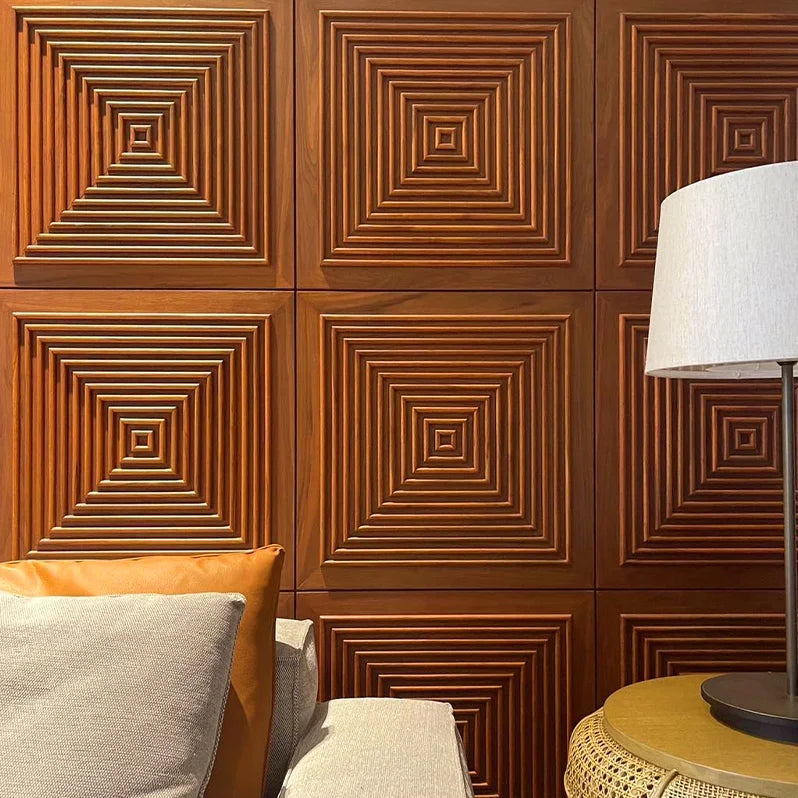
    If your hallway terminates at a visible end wall — common in T-shaped layouts or where a hallway opens to a back room — the 3D Concentric Square Panel is highly effective at this position. Viewed from the entrance, the nested square pattern draws the eye to a vanishing point, creating a sense of depth and spatial extension in what is otherwise a short, confined corridor.

    Triangle mosaic — use sparingly in hallways

    Triangle mosaics can work well in wider hallways or on a single accent wall, but their directional energy can feel restless in very narrow spaces. If you’re drawn to the triangle format, consider limiting it to one wall rather than both sides of a corridor.

    Panel Height in a Hallway

    Full floor-to-ceiling panels make a hallway feel taller. In contrast, panels applied at dado height only — up to about 1100mm — make the space feel lower and more constrained. For most hallways, ceiling-height panels are the better choice.

    A practical option for standard-height hallways (2.4m ceiling): run geometric panels from floor to ceiling on the main feature wall (opposite the front door, or the end wall), and keep the side walls plain. This creates a strong directional experience without closing in the space.

    Lighting Geometric Panels in a Hallway

    Most hallways rely on a single central ceiling pendant. This creates flat, overhead lighting — the worst condition for showing the texture and shadow of a geometric panel. To get the best out of a textured panel in a hallway:

    • Add a wall sconce on each side of the panel wall, angled toward the surface
    • Replace the central pendant with a track light that you can angle toward the panel
    • Mount an LED strip behind a reveal at the top of the panel, pointing downward

    Even a single angled light source dramatically improves how a 3D or mosaic panel reads in a hallway.

    Colour and Timber Species in a Dark Hallway

    In hallways that receive little or no natural light, very dark timber tones (deep walnut) can absorb light and make the space feel smaller. Options:

    • Choose a lighter-toned geometric panel format in an oak or natural pine finish
    • Complement dark walnut panels with pale plaster or white-painted walls on adjacent surfaces
    • Use reflective surfaces (mirror, gloss flooring) opposite a dark panel wall to bounce light back

    Hallway Panel Ideas: Quick Reference

    • End wall of a long hallway in 3D Concentric Square — creates depth and a visual destination
    • Full-height Crossing Lines panels on both sides of an entrance vestibule — architectural and welcoming
    • Triangle mosaic on the wall opposite the front door — the first thing you see when you arrive home
    • Honey Mosaic on a single hallway wall with a console table and mirror in front — warm, tactile, inviting

    Further Reading

    For broader hallway design ideas including non-geometric panels, read our guide to hallway ideas to maximise your home’s first impression. For the full geometric range, browse GroovePanel® Geometric Wood Wall Panels.
  • Wood Mosaic Wall Panels: Patterns, Styles, and How to Choose the Right Design

    Wood Mosaic Wall Panels: Patterns, Styles, and How to Choose the Right Design

    Wood mosaic wall panels bring something that flat timber boards simply cannot: visual rhythm. Each panel is a composition of small individual pieces — triangles, squares, hexagons, or diamonds — arranged into a repeating geometry that catches light differently depending on the angle you stand at. If you’ve been staring at a blank wall wondering how to add character without committing to wallpaper or paint, a wood mosaic panel is one of the most effective answers available.

    This guide walks through what wood mosaic wall panels are, which patterns work best in which rooms, how to choose between solid wood and engineered options, and what to look for before buying.

    What Are Wood Mosaic Wall Panels?

    A wood mosaic wall panel is a modular tile made from individual pieces of real or engineered wood, glued or fitted onto a backing sheet. Unlike a continuous plank or slat panel, the mosaic format breaks the surface into a repeated geometric unit — creating texture, pattern, and depth from a single flat installation.

    The individual pieces can be cut from solid timber, engineered veneer, or MDF. The quality difference between these materials is significant, which we’ll cover in detail below.

    At The Panel Hub, our GroovePanel® Geometric Wood Wall Panels are made entirely from 100% solid FSC-certified timber. That means no MDF core hidden under a veneer — every piece you see is real wood, end grain and all. The result is panels that age naturally, resist warping better than engineered alternatives, and carry a texture you can feel as well as see.

    Pattern choice matters more than most buyers realise. The geometry you pick changes not only the look but how the wall behaves in different lighting conditions.

    Triangle mosaics

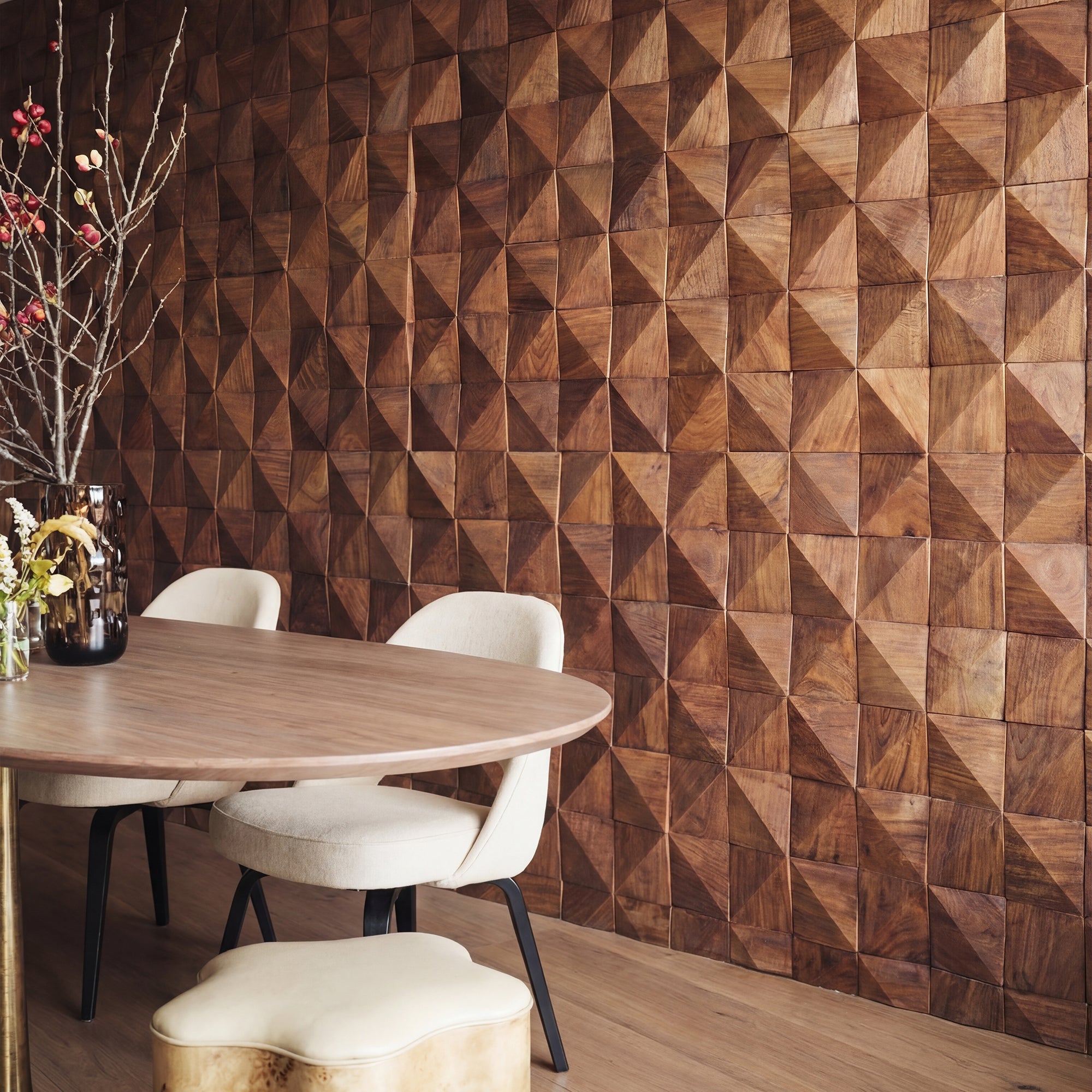
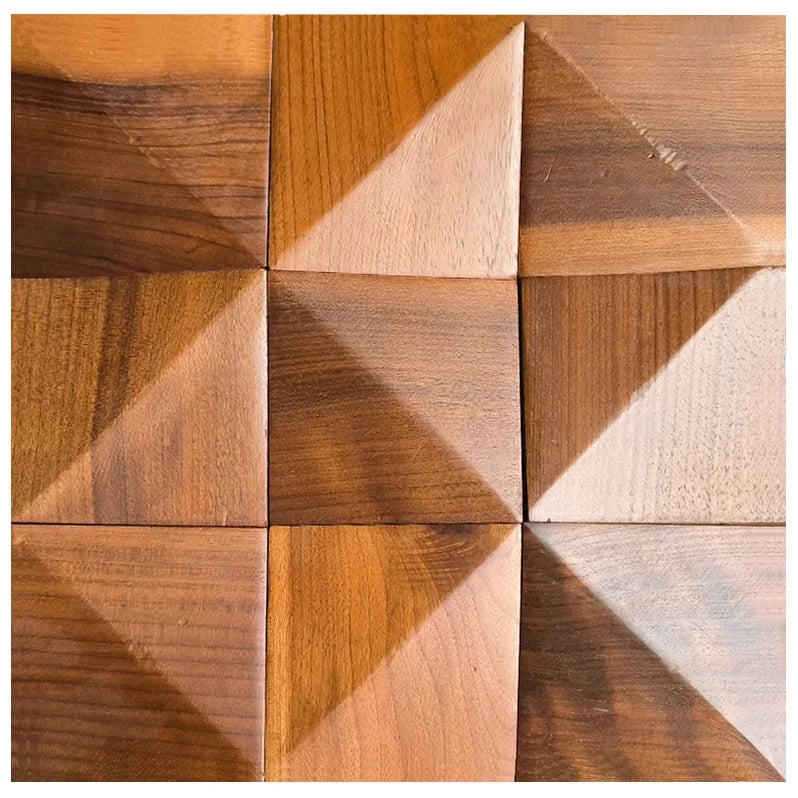
    Triangle-based mosaics create strong directional energy. Arranged in opposing pairs, triangles form diamond or chevron effects. Arranged concentrically, they build a radial focal point. The Walnut Triangle Solid Wood Panel is a favourite for headboard walls and living room feature walls where you want a clear visual anchor.

    Concentric square mosaics

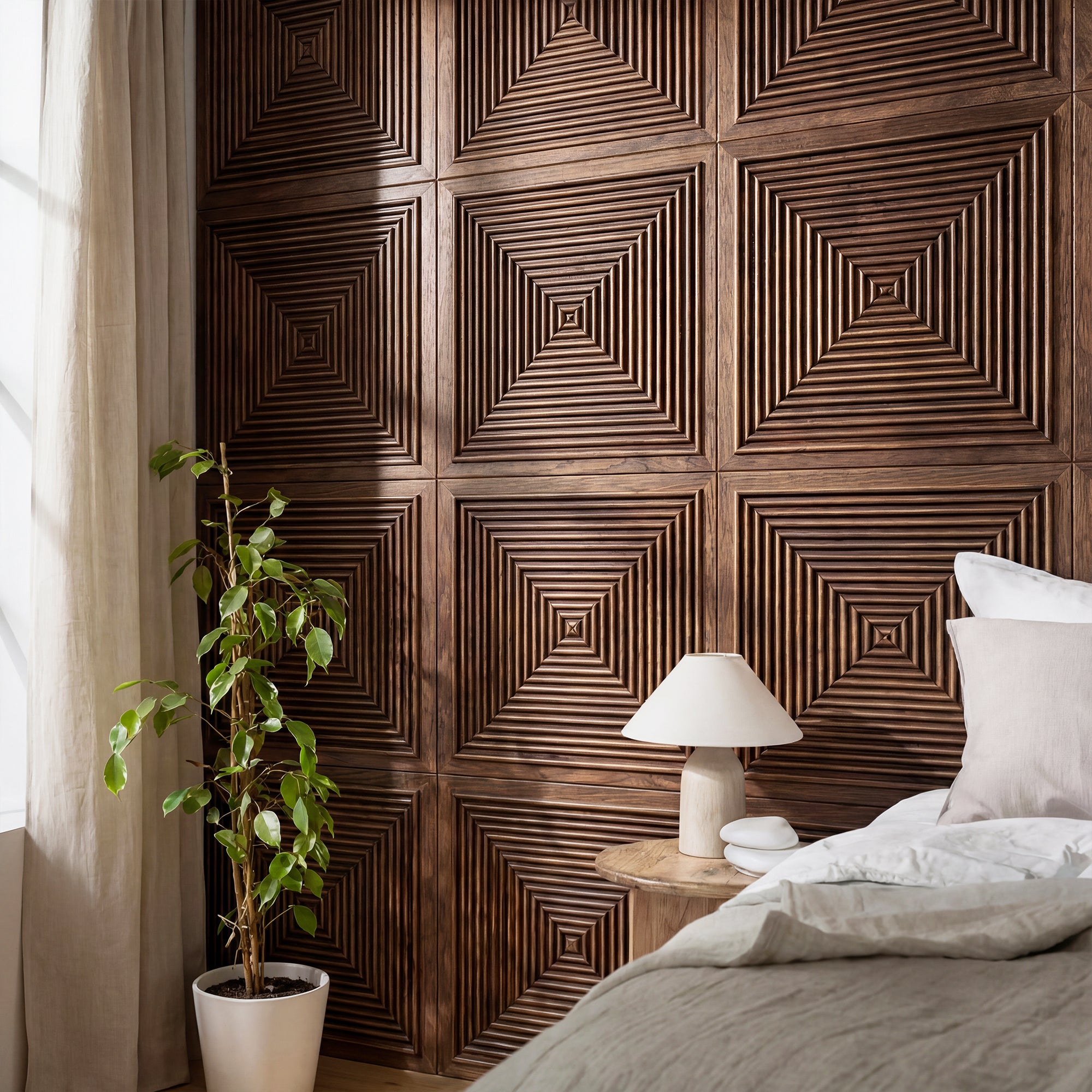
    Concentric squares are among the most hypnotic patterns in interior design right now. Each panel contains a series of nested squares receding toward a central point, creating a sense of depth on an otherwise flat wall. Our 3D Concentric Square Wood Wall Panel achieves this with precision-cut solid wood — the shadow lines between layers change throughout the day as natural light shifts.

    Honey mosaic patterns

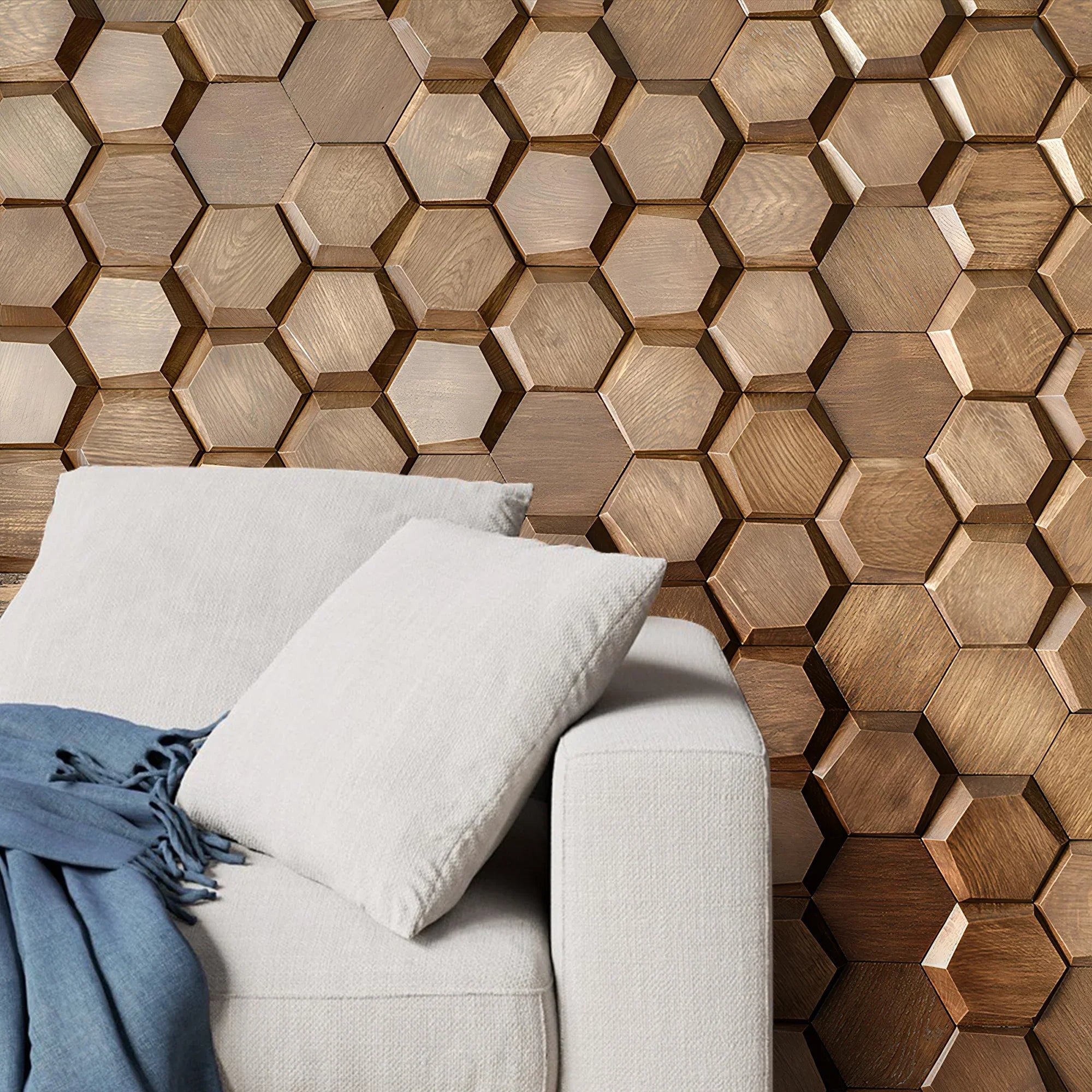
    Honeycomb-adjacent patterns built from stacked hexagonal or irregular pieces produce a warmer, more organic mosaic. Our Honey Mosaic Solid Walnut Panel uses walnut’s natural grain variation to ensure no two tiles look identical, giving large installations a handcrafted feel at scale.

    Crossing lines and grid mosaics

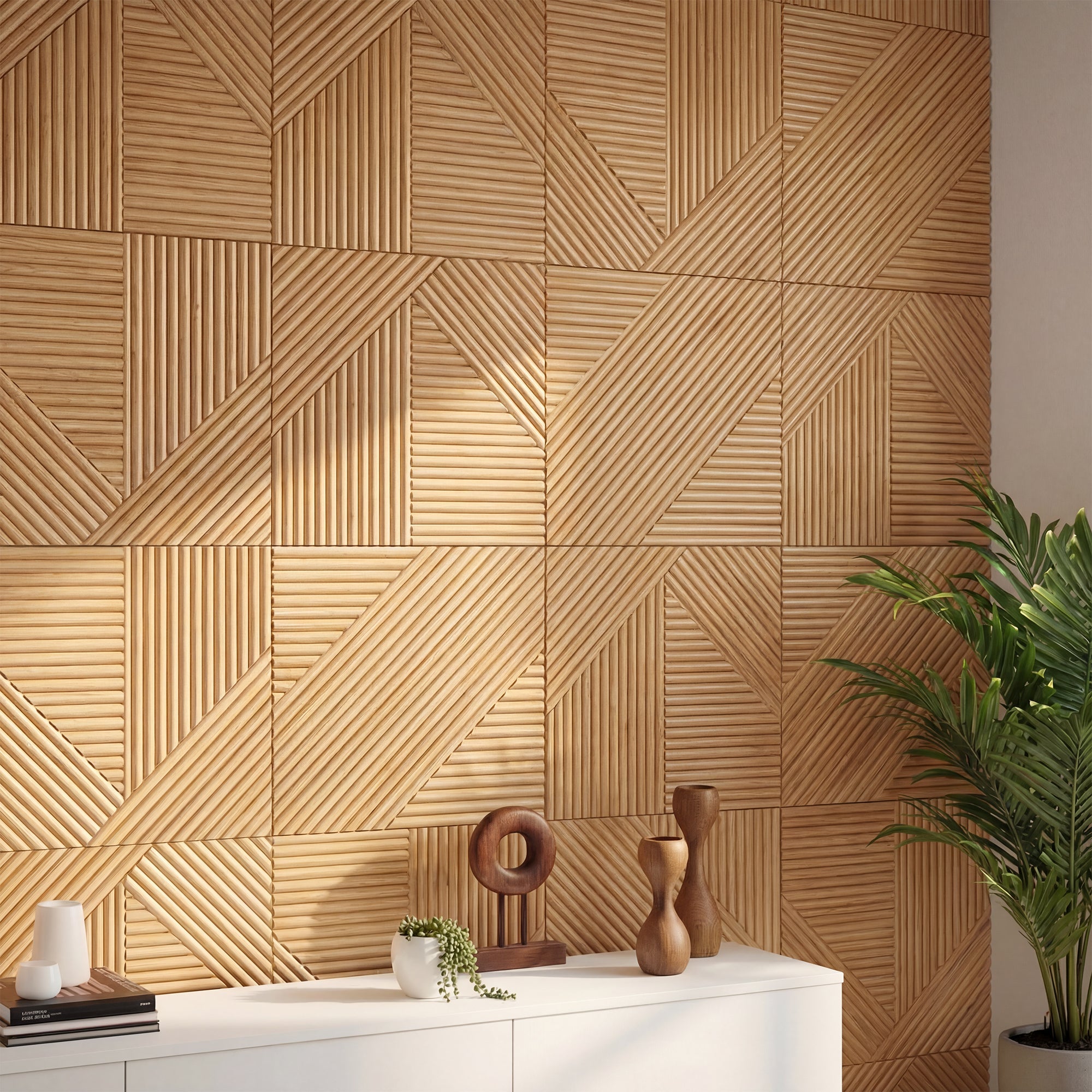
    Linear crossing patterns break the surface into a grid of negative space and solid wood. The Crossing Lines Solid Wood Panel is a cleaner, more architectural look — less traditional mosaic, more graphic composition.

    Solid Wood vs Engineered Wood Mosaic Panels: What’s the Difference?

    This is the question that most affects long-term satisfaction. Engineered mosaic panels — where a thin veneer is laminated to an MDF or HDF core — are cheaper upfront. But because the visible surface is only 0.6–2mm thick, they cannot be sanded or refinished if they scratch. The edges, if visible, reveal the composite core.

    Solid wood panels cost more but behave like real timber. Surface scratches can be sanded out. The colour and grain run through the full depth of each piece. And because solid wood has mass, panels feel substantial on the wall rather than thin.

    For a full breakdown of the material trade-offs, read our guide to MDF vs Solid Wood Wall Panels.

    Which Rooms Work Best for Wood Mosaic Panels?

    Mosaic patterns work in almost any room, but the scale and grain direction of the pattern should match the proportions of the wall.

    • Living rooms: Large-scale mosaics like concentric squares work well on chimney breasts or walls behind sofas. The pattern creates enough visual complexity to make art optional.
    • Bedrooms: A full headboard wall in triangle or honey mosaic pattern transforms a bedroom from functional to genuinely designed. Keep bedding and furniture in neutral tones so the pattern breathes.
    • Hallways and entryways: Smaller panels work well in tighter spaces. A single accent wall of crossing lines or triangle mosaics greets visitors without overwhelming a narrow corridor.
    • Home offices: The texture of a wood mosaic panel behind a desk is far more interesting on video calls than painted plasterboard — and it absorbs a small amount of mid-frequency sound as a bonus.

    How Many Panels Do You Need?

    Calculate your wall area in square metres (width × height), then check the individual panel coverage listed on the product page. Most of our wood mosaic panels cover between 0.09 m² and 0.25 m² per tile. Add 10% to your total to account for cuts at edges and corners.

    For help planning your layout, our guide to creating a geometric feature wall covers grid planning, centring your pattern, and avoiding the most common layout mistakes.

    Finish and Colour: Natural, Stained, or Painted?

    Most wood mosaic panels are supplied unfinished or with a light factory oil. This gives you flexibility to:

    • Leave natural for a warm, pale timber look
    • Apply a dark walnut stain for contrast and drama
    • Use a white or grey wash for a Scandinavian or coastal aesthetic
    • Paint in a flat or matte finish if you want the pattern without the wood tone

    Natural walnut panels — like those in our GroovePanel range — arrive with the species’ characteristic dark brown warmth already built in, which reduces the need for staining.

    Installation: What to Know Before You Start

    Wood mosaic panels are installed tile by tile onto a flat, primed wall. The key preparation steps are:

    1. Ensure the wall is flat — high spots cause gaps between tiles
    2. Mark a level horizontal datum line before starting
    3. Begin from the centre of the wall, working outward
    4. Use a suitable panel adhesive and allow full cure time before grouting or finishing joints

    For uneven walls, read our guide on how to install wall panels on an uneven wall before you begin.

    Where to Buy Wood Mosaic Wall Panels

    Browse the full GroovePanel® Geometric Wood Wall Panel collection for solid wood mosaic options in walnut, oak, and mixed-species finishes. All panels are FSC-certified and EPD-verified. Samples are available through our wall panel sample service if you want to check colour and texture in your own lighting before committing to a full order.

  • Triangle Wood Wall Panels: The Geometric Shape Designers Are Using Everywhere

    Triangle Wood Wall Panels: The Geometric Shape Designers Are Using Everywhere

    Of all the geometric shapes used in interior design, the triangle is the most dynamic. Where squares suggest order and hexagons suggest nature, triangles carry direction and energy. A wall covered in precision-cut solid wood triangles doesn’t just add texture — it commands the room.

    Triangle wood wall panels have appeared in high-end hotel lobbies, Scandinavian-influenced residential projects, and contemporary living rooms for the past several years. They’re now accessible enough to be a realistic choice for any home renovation, and the right product makes installation straightforward.

    Why Triangles Work So Well on Walls

    The triangle is the most structurally stable shape, and that stability translates visually. A mosaic of triangles feels intentional and precise without being cold. The grain of each individual timber piece runs in a different direction relative to its neighbours, creating subtle micro-contrast even within a single colour species.

    Triangles also respond to light differently than squares or linear slats. As daylight tracks across a triangle-tiled wall, the shadow lines shift, giving the installation a quality that changes through the day.

    The Walnut Triangle Panel: A Closer Look

    Our Walnut Triangle Solid Wood Wall Panel is part of the GroovePanel® Geometric range. Each panel is composed of solid walnut triangles — not veneer, not laminate, but full-depth solid timber. The walnut species gives a naturally dark, rich brown tone with the irregular grain figuring characteristic of the species.

    Because the panels are 100% solid wood, the grain pattern at the edge of each cut triangle is visible, adding depth to the tile boundary. This is something engineered panels cannot replicate — their edges show the composite core.

    The panels are FSC-certified, meaning the timber is sourced from responsibly managed forests, and they carry an Environmental Product Declaration (EPD) for buyers who need verified sustainability credentials.

    Design Ideas: How to Use Triangle Wall Panels

    The full feature wall

    The most impactful use. Cover an entire wall — behind a bed, sofa, or dining table — in triangle panels from floor to ceiling. Keep the rest of the room minimal: white or off-white on the remaining walls, furniture in complementary tones. The walnut triangle wall becomes the artwork.

    Half-wall or dado treatment

    Apply triangle panels to the lower half of a wall, terminating at a timber batten or picture rail. This works particularly well in hallways and dining rooms, where floor-to-ceiling pattern can feel oppressive in a narrow space.

    Recessed alcoves and chimney breasts

    Panel the inside of a recess or the face of a chimney breast. The contained geometry of the triangle pattern is perfectly suited to a bounded surface — the edges of the alcove act as a natural frame.

    Ceiling panels

    Triangle mosaic panels work on ceilings too, particularly in rooms with lower ceiling heights where a striking overhead surface creates drama without the visual weight of a dark paint colour.

    Mixing Triangle Panels with Other Materials

    Walnut triangle panels pair naturally with:

    • Brushed brass hardware — the warm metal tone complements walnut’s dark brown without competing
    • Concrete and plaster finishes — rough industrial texture next to precision-cut timber creates contrast
    • White oak furniture — light wood furniture against a dark walnut triangle wall is a classic high-contrast pairing
    • Stone and faux stone panels — use triangle wood panels on one wall and a RockSurface® stone panel on the adjacent surface for a layered material palette

    Triangle Panels vs Other Geometric Formats

    The triangle is one of several geometric formats in the GroovePanel range. Here’s how it compares:

    • Triangle vs concentric square: Triangles create directional energy; concentric squares create depth and a hypnotic focal point. Concentric square panels tend to work better as a single centred feature; triangle mosaics cover a full wall more comfortably.
    • Triangle vs crossing lines: The Crossing Lines panel is more architectural and graphic — better for rooms where you want pattern without strong directional movement.
    • Triangle vs honey mosaic: The Honey Mosaic panel is warmer and more organic. Triangles are sharper and more contemporary.

    For a broader comparison of geometric panel types, see our guide to geometric wood wall panel patterns and styles.

    Installation Notes

    Triangle mosaic panels are installed tile by tile using panel adhesive on a flat, clean wall surface. The key is establishing a true horizontal datum before you start — because triangles form directional rows, a single misaligned tile propagates the error across the full installation.

    Allow the wall to dry fully before starting if you’ve recently plastered or skimmed. For walls with slight undulation, our guide on installing wall panels on uneven surfaces covers preparation methods that ensure a flat result.

    Order a Sample First

    Walnut varies naturally in tone from piece to piece. Before ordering a full quantity, it’s worth seeing the actual timber colour in your own space. Order a sample from our sample collection and live with it for a day or two under your room’s lighting conditions — artificial light changes warm wood tones significantly.

    Browse the full triangle and geometric range in the GroovePanel® collection.

  • Pattern Wall Panels vs Plain Wood Panels: Which Makes a Better Feature Wall?

    Pattern Wall Panels vs Plain Wood Panels: Which Makes a Better Feature Wall?

    When planning a feature wall, one of the most fundamental decisions is whether to use a patterned panel — geometric mosaic, 3D relief, or crossing lines — or a plain, flat timber panel such as a wood slat wall or smooth veneer board. Both are legitimate choices. They produce entirely different results, and the decision should be deliberate rather than defaulted to whichever option you’ve seen most recently.

    This comparison breaks down when pattern panels win, when plain panels win, and what determines the right choice for a given room.

    What We Mean by Pattern vs Plain

    Pattern panels have a designed surface geometry — triangle mosaics, concentric squares, crossing line grids, 3D relief profiles. The visual interest comes from the pattern itself rather than purely from the wood grain. Examples: the GroovePanel® Geometric range, including the 3D Concentric Square and Crossing Lines panels.

    Plain panels have a flat or relatively flat surface where the visual interest comes from the timber grain, species colour, and material quality. Examples: wood slat panels, wide plank veneer boards, smooth MDF panels with painted finishes.

    When Pattern Panels Win

    When the room is otherwise visually quiet

    If your room has plain walls, simple furniture, and a minimal palette, a pattern panel gives the space its visual focus. A plain timber panel in the same context can read as understated to the point of being uninteresting — the grain alone doesn’t create enough differentiation from a well-painted wall.

    When you want the wall itself to be the artwork

    In rooms where you’re not planning to hang art or display objects, a geometric pattern panel fills the role of the artwork. The pattern, shadow, and texture of a solid wood mosaic or 3D panel provide the same kind of sustained visual interest as a large-format print — without requiring anything to be hung or lit.

    When the architecture is simple and needs character

    Plain rectangular rooms in new-build houses often lack inherent architectural character. A geometric panel wall creates it — the pattern becomes the room’s defining feature in the way that an ornate cornice or arched window would in an older property.

    When you’re designing for shadow and light dynamics

    3D geometric panels and mosaic patterns respond to changing light conditions in a way that flat panels don’t. If the wall receives natural side-light or has directional artificial lighting, a pattern panel becomes a different surface at different times of day. A flat panel doesn’t have this quality.

    When Plain Panels Win

    When the room is already visually complex

    In rooms with patterned upholstery, decorative rugs, multiple artworks, or strong architectural features, adding a geometric panel wall can tip the space into visual overload. A plain timber slat panel or smooth board adds material warmth and texture without competing.

    When the goal is material quality rather than graphic impact

    In rooms where the design brief is about luxury materials and quiet refinement rather than bold statements, the subtlety of a plain panel often communicates more sophistication than a strong geometric pattern. Wide oak planks or a smooth walnut veneer board can be just as high-end as a mosaic — they just make their case differently.

    When the wall is in a functional zone

    Behind a kitchen cabinet run, in a utility room, or as a splashback behind a sink (with appropriate waterproofing), a plain panel is more appropriate than a geometric one. The functional context doesn’t call for visual drama.

    The Hybrid Approach

    Pattern and plain panels can coexist in the same room — and often the combination is stronger than either alone. A common approach: geometric pattern panel on the main feature wall (behind a sofa, bed, or dining table), plain wood slat panels on the adjacent walls for material consistency without competing pattern. The variety of texture and surface within the same timber palette creates depth without conflict.

    Making the Decision

    The quickest test: hold a sample of your intended panel against the wall in question and ask whether the room needs more visual complexity or less. If it needs more — choose pattern. If it needs less — choose plain. Most rooms have a clear answer if you look honestly at what’s already there.

    Browse patterned geometric options at GroovePanel® Geometric Wood Wall Panels. For slat and acoustic panels, see the SoundPanel® acoustic panels. Order a sample of both to compare in your space before deciding. For context on how pattern types differ within the geometric category, read our guide to geometric wood wall panel patterns and styles.
  • How to Mix Geometric Wall Panels with Stone, Metal, and Other Materials

    How to Mix Geometric Wall Panels with Stone, Metal, and Other Materials

    A room that uses only one material on its walls is a safe choice that rarely produces a memorable result. The interiors that feel genuinely designed — in hotels, high-end residential projects, and professionally executed homes — almost always involve a considered mix of materials on the same surface or adjacent surfaces. Geometric wood panels are one of the most versatile anchors for a mixed-material wall composition.

    Here’s how to mix geometric wood panels with stone, metal, plaster, and other materials successfully.

    The Principle of Material Contrast

    Material mixing works on contrast. The juxtaposition of different textures, temperatures, and visual weights creates interest that no single material achieves alone. The contrasts that work best are those between opposites:

    • Warm vs cool: timber warmth against stone or concrete coolness
    • Hard vs soft: rigid wood geometry against fluid plaster or fabric
    • Rough vs smooth: raw stone texture against precision-cut timber pattern
    • Natural vs industrial: organic wood grain against metal or glass

    Geometric wood panels work well as the “warm and natural” element in most of these pairings.

    Mixing Geometric Wood Panels with Stone

    This is one of the most effective material combinations in contemporary interior design. Solid walnut geometric panels on one wall, faux stone panels on an adjacent wall — different textures, different tones, but both natural material references in the same space.

    At The Panel Hub, the GroovePanel® Geometric range and the RockSurface® Faux Stone range are designed to coexist in the same interior. A common application: stone panels on the chimney breast or fireplace surround, geometric timber panels on the flanking walls. The two materials share a natural, textured quality but offer completely different visual and tactile experiences.

    When combining timber and stone, keep the colour temperatures compatible: warm walnut works with warm stone tones (Highland Rock, sandy limestone). Lighter, cooler timber species (ash, light oak) pair better with cooler stone (slate, blue-grey basalt).

    Mixing Geometric Wood Panels with Plaster and Paint

    The simplest and most common combination. Plain painted plasterboard on surrounding walls, geometric timber panel on the feature wall. The painted surface recedes; the panelled surface advances. The key decisions are:

    • How much contrast in tone? Dark walnut panels against white walls: maximum contrast, maximum impact. Natural oak panels against warm grey walls: more integrated, more subtle.
    • What finish on the plaster? Flat matte paint is the most appropriate for rooms with textured panel walls — gloss finishes compete for attention. Limewash or polished plaster on surrounding walls creates an interesting dialogue with the panel’s structured geometry.

    Mixing Geometric Wood Panels with Metal

    Metal wall panels — perforated steel, brushed aluminium, corten steel — are increasingly used in residential interiors for their industrial, contemporary quality. Mixed with timber geometric panels, the contrast between hard metal and organic wood produces a sophisticated industrial-luxury result.

    Practical applications:

    • Corten steel (weathered orange-brown) panels alongside walnut geometric panels — warm tones that reinforce each other
    • Brushed brass inlay strips between geometric panel tiles — a detail that reads as intentional joinery rather than a gap
    • Metal framing or edge profiles around a timber panel installation — gives the panel a framed quality that emphasises it as a composed element

    Mixing Geometric Wood Panels with Tile

    In kitchens and bathrooms, the combination of ceramic or porcelain tile in functional zones (splashback, shower surround) and geometric timber panels in dry zones (dining wall, bath wall feature) is highly effective. The tile handles the water; the timber handles the aesthetic.

    For the best results, choose a tile with a large, plain format rather than a small mosaic — small-scale tile and small-scale timber mosaic compete if they’re in close proximity. A large-format limestone tile alongside a triangle timber mosaic produces clear material distinction; two competing small patterns create visual noise.

    The One Rule: Each Material Needs Space to Read

    The most common mistake in mixed-material wall design is crowding. Each material needs enough continuous surface area to establish its character before it meets the next material. A 3D geometric panel needs at least a full wall width to make its pattern legible; a stone panel needs at least 1.2m of surface to establish its texture.

    Browse geometric panel options at GroovePanel® Geometric Wood Wall Panels and stone panel options at RockSurface® panels. For styling the geometric panel formats themselves, see our guide to geometric wood wall panel patterns and styles. Order a sample of both materials to trial the combination in your space.

  • Honeycomb Wood Wall Panels: Design Ideas and How to Use the Honey Mosaic Pattern

    Honeycomb Wood Wall Panels: Design Ideas and How to Use the Honey Mosaic Pattern

    The honeycomb is one of the most efficient structures in nature. Hexagonal cells tessellate perfectly, cover a surface with no gaps, and distribute structural load evenly — which is why bees figured it out millions of years ago. In interior design, honeycomb-inspired wall patterns carry that same sense of natural order: organic, textured, and satisfying in a way that purely geometric shapes sometimes aren’t.

    At The Panel Hub, the Honey Mosaic Solid Walnut Panel is our closest expression of this aesthetic — a mosaic of irregular, closely fitted solid walnut pieces that create an all-over surface texture reminiscent of natural cellular structures. Here’s how to use it, and what to consider when planning a honey mosaic installation.

    What Is the Honey Mosaic Pattern?

    The honey mosaic is a solid walnut panel composed of small, irregularly shaped pieces arranged in a close-fitted mosaic. Unlike a regular geometric tile where every unit is identical, the honey mosaic has slight variation between pieces — in grain direction, cut angle, and natural colour — that gives the overall surface a handcrafted, organic quality.

    This distinguishes it from our sharper geometric formats like the concentric square or crossing lines panels, which are more architectural and precise. The honey mosaic reads as warmer and more natural — closer to a craftsman’s work than a technical drawing.

    Which Rooms Suit the Honey Mosaic Pattern?

    Living rooms seeking warmth

    A honey mosaic wall behind a sofa adds rich timber texture without the hard-edged geometry of a concentric square or triangle pattern. If your living room is contemporary but you want warmth and tactile interest rather than graphic impact, the honey mosaic is the better choice.

    Bedrooms with earthy or biophilic interiors

    The irregular, nature-derived quality of the honey mosaic pattern suits bedrooms with earthy tones — terracotta, warm white, sage green. For biophilic interior design (bringing natural materials and textures indoors), it’s one of the most appropriate panel formats because it mimics the cellular structure of organic materials rather than imposing a human-made geometry.

    Spa bathrooms and wellness spaces

    Wellness-oriented bathrooms — where the aesthetic goal is calm, warmth, and natural materials — benefit from honey mosaic panels on a feature wall behind a freestanding bath or vanity. The walnut tone reads as luxurious in contrast to white marble or concrete floor tiles. Note: ensure panels are not in direct water contact zones; oil or wax the surface for moisture protection.

    Home offices and reading rooms

    A honey mosaic wall behind a desk brings warmth to a workspace without the visual distraction of a strongly directional pattern. It’s present enough to improve the aesthetic but not so graphic that it competes for attention during video calls.

    Styling the Honey Mosaic Pattern

    Complementary colours

    Walnut’s natural colour ranges from medium brown to a deep reddish-brown. It pairs well with:

    • Warm white walls (not cool, blue-tinted white)
    • Terracotta and burnt orange accents
    • Deep green upholstery
    • Sand and camel tones in textiles and flooring

    Material combinations

    The organic quality of the honey mosaic works particularly well alongside other natural materials: linen upholstery, jute rugs, unglazed ceramic vessels. Avoid combining it with high-gloss synthetic finishes, which create a jarring contrast with the raw, natural quality of the walnut.

    Honey Mosaic vs Other GroovePanel Formats

    If you’re deciding between the honey mosaic and other patterns in the GroovePanel® range, here’s the key distinction: the honey mosaic prioritises warmth and organic texture over graphic impact. If you want a wall that makes a bold pattern statement, choose the concentric square or walnut triangle. If you want a wall that reads as warm, handcrafted, and natural, choose the honey mosaic.

    For a full comparison of panel patterns and when to use each, read our guide to wood mosaic wall panels.

    Installation

    Honey mosaic panels are installed using adhesive onto a flat, prepared wall. Because the pattern is irregular, there’s no strict directional requirement — you don’t need to align rows as precisely as you do with triangles or squares. Start from the centre of your planned installation area and work outward, maintaining consistent joint spacing between tiles.

    For all installation preparation guidance, read our article on how to install wall panels on an uneven wall — the surface prep steps are the same regardless of panel format.

    Browse the full range at GroovePanel® Geometric Wood Wall Panels or order a honey mosaic sample to see the walnut tone in your own lighting.

  • Geometric Wood Panels for Luxury Interiors: How to Achieve a High-End Look

    Geometric Wood Panels for Luxury Interiors: How to Achieve a High-End Look

    Luxury in interior design isn’t about price tags. It’s about precision, material honesty, and a clear sense of intention — the feeling that every decision in a room was made rather than defaulted. Geometric wood wall panels, when chosen and installed correctly, embody all three of these qualities. Here’s how to use them to achieve a high-end result regardless of your overall budget.

    What Makes a Geometric Panel Installation Look Luxury

    Walnut Triangle Solid Wood Wall Panels - View 2

    Material authenticity

    The clearest marker of quality in any interior is whether the materials are what they appear to be. A 100% solid walnut mosaic panel reads as luxury because it is genuinely solid walnut — the grain, texture, and weight are real. A printed laminate with a walnut pattern reads as imitation regardless of how it photographs, because the eye and hand detect the difference instantly.

    All panels in the GroovePanel® decorative wall panels are 100% solid FSC-certified timber. In a luxury interior context, this isn’t just an ethical consideration — it’s the material difference between a room that feels genuinely high-end and one that merely looks like it in photos.

    Pattern precision

    Luxury also resides in exactness. Mosaic tiles that are precisely cut and perfectly consistent read as quality. Tiles with irregular edges, inconsistent gaps, or variable alignment signal low manufacturing standards. The 3D Concentric Square Panel and Crossing Lines Panel require precision machining to achieve the pattern accuracy that makes them look designed rather than approximate. That precision is what separates a panel that looks premium from one that doesn’t.

    Installation quality

    Even the best panels look mediocre if the installation is poorly executed. Luxury interiors are defined by clean edges, consistent joint gaps, perfect level and plumb, and seamless transitions between surfaces. An off-the-shelf panel from a premium manufacturer, installed with professional care, will always outperform a mediocre panel installed imperfectly.

    Pattern Choices for Luxury Applications

    3D Concentric Square — the most architecturally resolved

    3D Concentric Square Wood Wall Panel - Walnut - View 2

    The 3D Concentric Square Panel has the quality of a resolved architectural detail — it could be at home in a five-star hotel or a high-end residential project. The stepped relief and precise shadow lines communicate serious manufacturing capability. In a dining room, bedroom, or lobby, it creates a focal point that guests consistently comment on.

    Walnut Triangle Mosaic — the most tactile luxury

    Walnut Triangle Solid Wood Wall Panels - View 1

    The Walnut Triangle Panel is physically rich — the variation in grain direction across adjacent triangles creates a micro-texture that changes as you move along the wall. Run your hand across it and you feel the individual pieces. This tactile quality is one of the most direct expressions of material luxury available in a wall panel.

    Honey Mosaic — handcrafted luxury

    HoneyMosaicWoodWallPanel_2_2000x2000_9cbf2756-fb51-4962-93ca-3ac4b6131943-The Panel Hub

    The Honey Mosaic Panel reads as artisanal — each tile is slightly different, the pattern is irregular, and the effect is closer to a handmade mosaic than a machine-produced tile. In a high-end residential context where the brief is warm, personal luxury rather than cold hotel precision, this is often the strongest choice.

    Material Pairings That Signal Luxury

    Geometric wood panels look their best alongside materials that reinforce their quality rather than diluting it:

    • Natural stone flooring: Marble, limestone, or slate — the contrast between hard stone underfoot and timber warmth on the wall is a classic luxury pairing
    • Brass and bronze metalwork: Unlacquered brass light fittings and hardware complement dark walnut in the way gold frames complement paintings
    • Velvet and silk textiles: The contrast of soft, reflective textiles against a matte timber geometric panel creates material tension that is inherently luxurious
    • Limewash or polished plaster: On surrounding walls, these finishes have their own material presence — they read as a considered choice rather than a default, which complements the intentionality of the geometric panel wall

    The Luxury Detail: Edge Finishing

    In high-end installations, the edge where the panel meets adjacent surfaces matters as much as the panel face itself. Options:

    • Recessed reveal: A step-back between the panel and the adjacent wall, typically 10–20mm, creates a shadow line that frames the panel as a bounded element
    • Brass edge trim: A thin brass L-section at the perimeter reads as a deliberate material boundary — expensive-feeling and precise
    • Flush paint transition: Panel taken tight to adjacent surface with a clean painted edge — the simplest option, looks best when the adjacent wall is skimmed perfectly flat

    The Restraint Principle

    The most reliable marker of luxury in any interior is restraint. Using one striking geometric panel on a single wall, executed perfectly, is more impressive than covering every surface with competing materials and patterns. Choose one wall, choose the right pattern, install it immaculately, and let it be the room’s defining statement.

    Browse the full solid wood geometric range at GroovePanel® Geometric Wood Wall Panels. Order a sample to assess material quality in your space before committing. For pattern selection guidance, see our guide to geometric wood wall panel patterns and styles.
  • Geometric Wall Panels for Nursery and Kids’ Rooms: Safe, Bold, and Beautiful

    Geometric Wall Panels for Nursery and Kids’ Rooms: Safe, Bold, and Beautiful

    Children’s rooms present a specific interior design challenge. The brief is usually something like: stimulating, cheerful, safe, durable, and ideally not something you’ll desperately want to rip out in three years. Geometric wood wall panels navigate this unusually well — they’re bold enough to define a space, natural enough to age gracefully, and made from materials that meet the safety standards relevant for rooms where children sleep and play.

    Here’s how to use geometric panels in a nursery or children’s bedroom effectively.

    Material Safety: What Matters in a Children’s Room

    In a room where a child spends eight to twelve hours a day, the materials on the walls are worth scrutinising. Key concerns are:

    VOC emissions

    Volatile organic compounds (VOCs) off-gas from many building materials — adhesives, paints, laminates, and engineered wood products with formaldehyde-based binders. In a child’s bedroom where ventilation is often limited, low-VOC materials matter.

    All panels in the GroovePanel® solid wood panels are made from 100% solid timber with no MDF or HDF binders. Solid wood has significantly lower inherent VOC emissions than composite panel products. The panels also carry Environmental Product Declaration (EPD) verification, which includes indoor air quality data — giving parents documented evidence of what they’re putting on their child’s wall rather than just marketing claims.

    Physical robustness

    Children’s rooms are harder on surfaces than adult rooms. Solid wood panels withstand bumps and contact significantly better than veneer panels or painted surfaces. Minor surface damage in solid wood can often be sanded and refinished; the same damage in a veneer panel is permanent.

    Certifications

    FSC certification verifies that the timber was sourced from responsibly managed forests — relevant for parents who want the environmental credentials of the materials in their child’s room to be verified. For more detail on what FSC certification means, see our guide to FSC certified wood and why it matters.

    Geometric Patterns for Children’s Rooms

    The appeal of geometric patterns for children’s rooms goes beyond aesthetics. There’s genuine educational value in an environment that presents mathematical shapes and spatial relationships as a natural part of daily life.

    Triangle mosaics — dynamic and stimulating

    Triangle patterns are excellent for older children’s rooms and teenagers’ bedrooms where the brief shifts from gentle and soothing to bold and expressive. The directional energy of the Walnut Triangle Panel suits a room that’s meant to feel active and interesting.

    Concentric squares — best for nurseries

    For babies and very young children, the 3D Concentric Square Panel offers an interesting visual environment without being overwhelming. Research suggests concentric pattern shapes are among those that catch infant attention — the nesting structure is instinctively engaging for developing visual systems.

    Honey mosaic — warmest and most organic

    The Honey Mosaic Panel is the most tactile and naturalistic option — appropriate for rooms designed around a biophilic, nature-connecting aesthetic. It works well in rooms where you’re pairing the panel with natural textiles, rattan furniture, and botanical prints.

    Colour Considerations

    Walnut’s natural dark tone can make a small nursery feel heavy if used on all four walls. Options for lighter-toned rooms:

    • Use geometric panels on one wall only (the feature wall behind the cot or bed), keep remaining walls in a light, warm paint
    • Choose the natural, unfinished finish of lighter wood species if available
    • Pair dark walnut panels with very pale walls — the contrast actually reads as energetic and modern rather than heavy

    Installation Safety

    Ensure panels are fully secured to the wall — not just adhesive-bonded but mechanically fixed if they are large enough to pose a risk if they detach. Use the appropriate wall anchor for your wall construction (plasterboard fixings for stud walls, masonry plugs for solid walls). For mosaic tiles under 300mm square, adhesive alone is typically sufficient if applied correctly to a properly prepared surface.

    For installation guidance, see our article on wood wall panel installation tools and our guide to wood accent walls for nurseries and safe materials.

    Get Started

    Browse the full FSC-certified, EPD-verified range at GroovePanel® Geometric Wood Wall Panels. Order a sample to assess timber tone in your child’s room lighting before committing.
  • Geometric Wall Panels for Home Office: How Pattern Influences Focus and Creativity

    Geometric Wall Panels for Home Office: How Pattern Influences Focus and Creativity

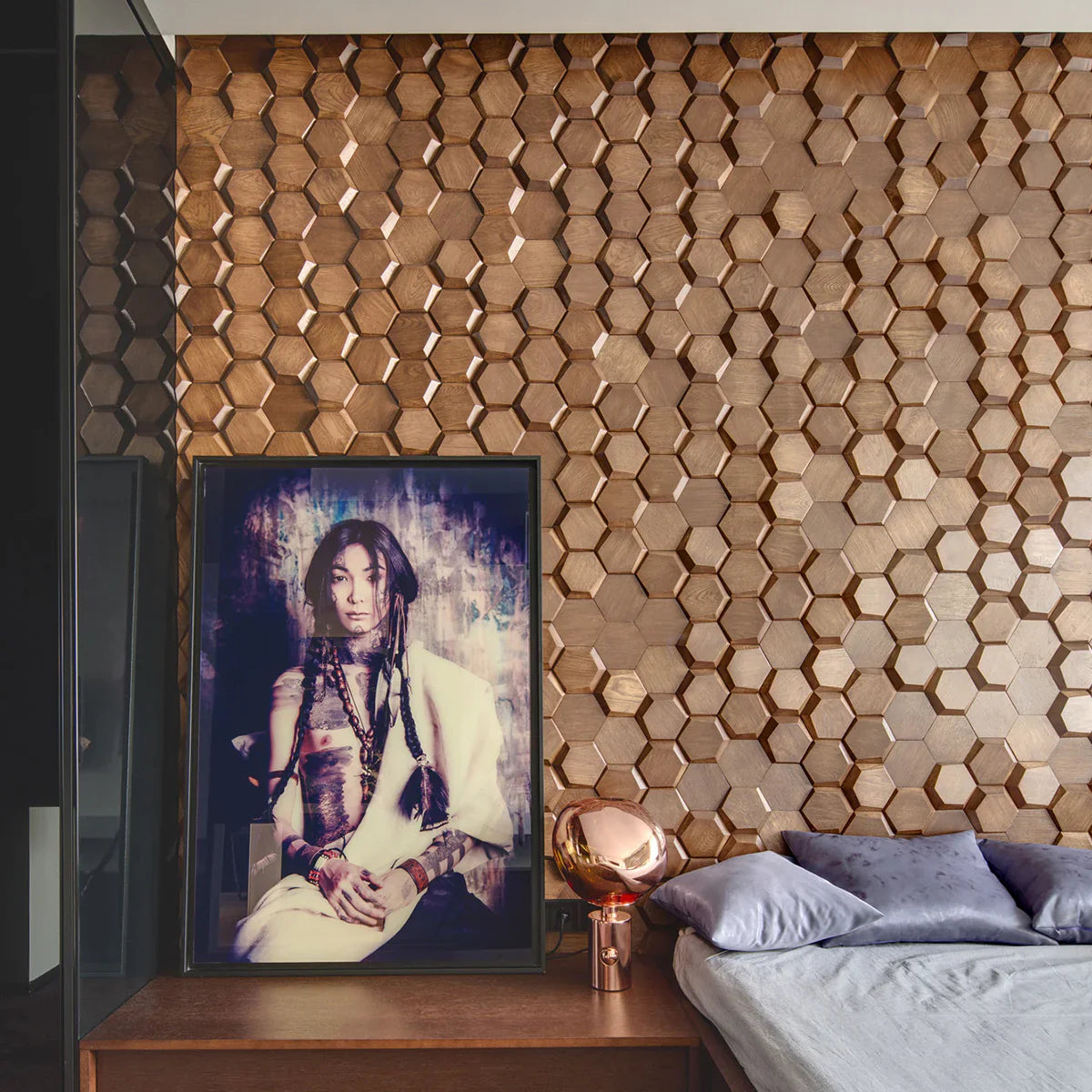
    The home office got a lot of attention after 2020, but most of the upgrades focused on ergonomics and technology rather than design. The wall behind your desk — the surface that fills your field of vision for eight hours a day, and backgrounds every video call you make — usually gets painted white and forgotten. That’s a missed opportunity.

    Geometric wood wall panels are one of the most effective upgrades for a home office. Here’s why they work, what patterns suit a workspace, and how to install them without disrupting the room’s function.

    What Your Office Wall Is Actually Doing

    The wall behind your desk serves two simultaneous purposes: it’s the visual environment you spend most of your working day looking at, and it’s the background visible to everyone on your video calls. A blank white wall doesn’t do either job particularly well — it’s visually inert for you and professionally anonymous for your colleagues.

    A geometric wood panel wall changes both. For you, it adds visual interest that is complex enough to be engaging at a glance but not so busy that it competes for attention while you’re working. For video calls, it immediately signals that your workspace is designed and intentional.

    Which Patterns Work Best in a Home Office?

    Crossing lines — the cleanest option for focus

    The Crossing Lines Solid Wood Panel is the most appropriate pattern for a workspace. Its regular grid structure is calm and architectural — it reads as background rather than foreground, adding texture and warmth without demanding attention. It’s the least distracting of the geometric formats, which matters in a room where you need to concentrate.

    Concentric square — best for a creative office

    If your work is creative — design, writing, strategy, anything that benefits from visual stimulation — the 3D Concentric Square Panel is a more interesting choice. Its depth and shadow create a meditative focal point that can be genuinely useful when you’re thinking hard about something. It’s more demanding visually than crossing lines, but in a creative context that’s a feature rather than a bug.

    Honey mosaic — best for reducing screen fatigue

    The organic, irregular quality of the Honey Mosaic Panel is a good counterpoint to the hard geometry of screens and monitors. Opposite from a desk, a honey mosaic wall gives the eye a natural, restorative surface to rest on during breaks from screen work — which is linked to reduced eye fatigue over a working day.

    Scale: How Much of the Wall to Panel

    Full wall behind the desk: the most impactful and the best background for video calls. A full wall is also the most efficient use of panels if you’re buying a single quantity — partial installations require more cutting and waste more material.

    Partial wall (the section visible above the monitor): a smaller installation that focuses the panelled area on what is visible on video rather than the full wall. This works in offices with limited wall space or where other walls have windows.

    Alcove or recess: if your desk is set into an alcove, panel the three interior walls for an immersive, designed workspace.

    Acoustic Benefits of Geometric Wood Panels in an Office

    Solid wood wall panels add a small amount of diffusion to a room’s acoustics — the irregular surfaces of a mosaic pattern scatter sound rather than reflecting it directly. This is a marginal improvement compared to purpose-built acoustic treatment, but it’s not nothing. In home offices that double as podcast recording spaces or video call studios, the timber surface behind the desk reduces the flat, reflective acoustic quality of bare plasterboard walls.

    For more significant acoustic treatment in a home office, read our guide to acoustic panels for home offices. Geometric wood panels and acoustic slat panels — such as the SoundPanel® American Acoustic Slat panel — can be combined in the same room.

    Colour Temperature and Timber Species

    Home offices often have strong artificial lighting — LED desk lamps and overhead lights that render cool-toned surfaces accurately but can make warm timber tones look orange. Before committing to a timber species, hold a sample under your office’s specific lighting. Walnut — the species in most of our GroovePanel® products — tends to read richer and warmer under daylight and more red-brown under LED light.

    Order a sample panel and hold it behind your monitor position under your actual working light before ordering.

    Setting Up Your Office Around the Geometric Panel

    Once you have a geometric panel wall, the rest of the office design should support it rather than compete with it:

    • Keep other walls plain — white or pale grey is fine
    • Choose desk and shelving in metal or light-toned timber to contrast with dark walnut panels
    • Add a directional desk lamp or wall sconce angled at the panel to create shadow definition
    • Keep the desk surface clear and uncluttered — the panel wall is the room’s visual interest; the desk is the work surface

    Browse the full range at GroovePanel® Geometric Wood Wall Panels. For the full 3D wall panel category, see our guide to 3D wall panels.
  • 3D Geometric Wood Panels: How Shadow and Depth Transform a Room

    3D Geometric Wood Panels: How Shadow and Depth Transform a Room

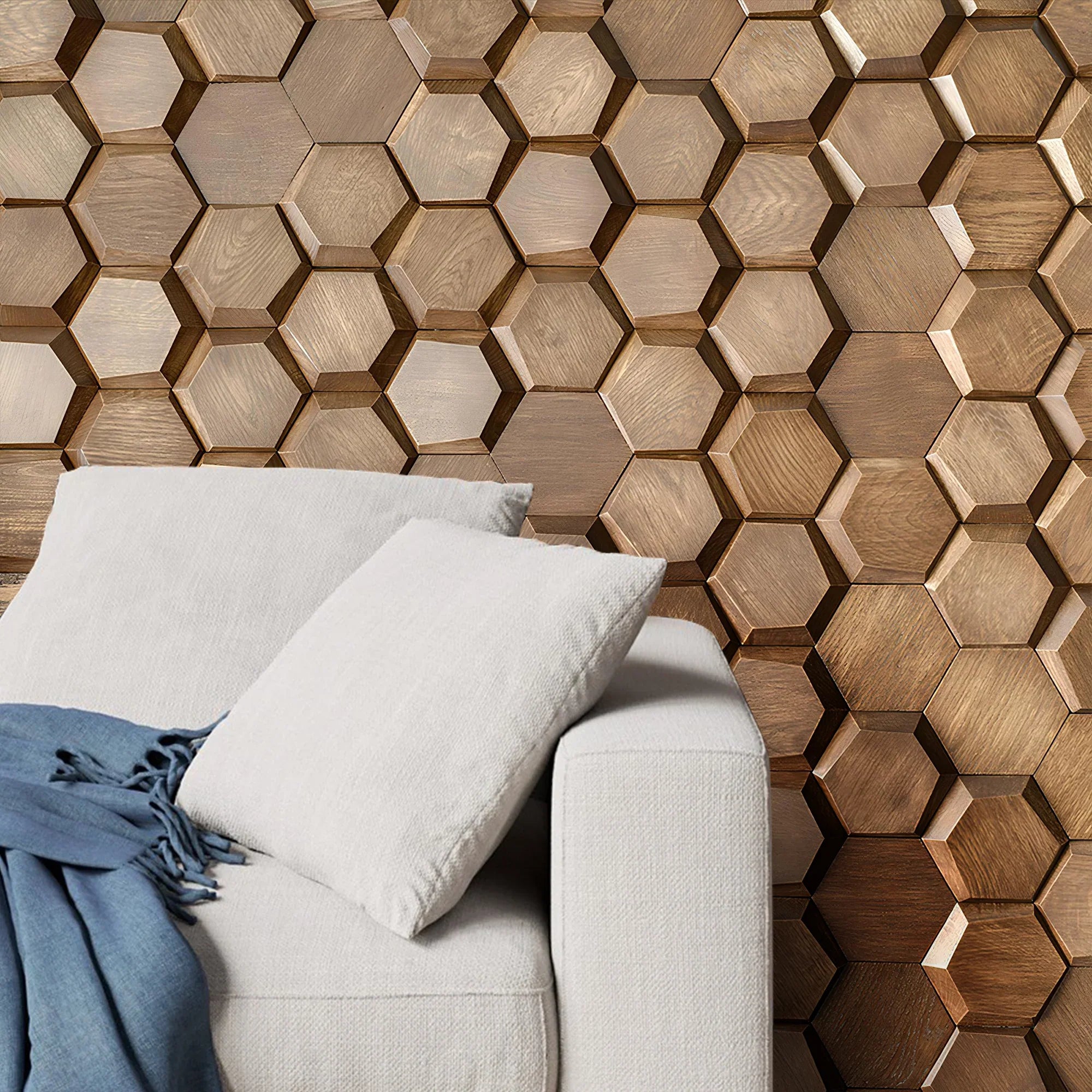
    There’s a difference between a patterned wall and a three-dimensional wall. A printed or painted geometric pattern adds visual interest. A 3D geometric wood panel adds physical depth — the shadows it casts are real, and they change as the light in the room changes. This is what separates a truly dynamic feature wall from one that looks impressive in photos but flat in person.

    This guide covers how 3D geometric wood panels work, what makes them effective, and how to use them to transform a room.

    What Makes a Panel “3D”?

    A 3D wood panel has relief — the surface isn’t flat. Individual elements are raised, recessed, or angled relative to each other, creating physical depth. In the 3D Geometric Pattern Wooden Panel from our GroovePanel® range, the geometric elements are routed and shaped from solid timber, creating distinct planes that produce shadow lines across the surface.

    The 3D Concentric Square Panel takes this further: the nested squares are stepped at different heights, so the innermost square is the highest point and the outer ring is the lowest. The result is a panel that looks like a topographic map or an architectural model — and it casts different shadows at different times of day as the sun angle changes.

    This is fundamentally different from a flat mosaic panel with surface pattern. The depth is structural, not visual — it exists in the physical object, not as a trick of print or finish.

    How Shadow Works on a 3D Panel

    Shadow is what gives 3D panels their character. Without directional light, a 3D panel loses most of its impact. This has direct implications for where you install one:

    • Walls receiving natural side-lighting (windows to one side of the wall) are ideal — morning and afternoon light rakes across the surface and maximises shadow definition.
    • Walls with directional artificial lighting — a wall sconce or track light at an angle — maintain the 3D effect in the evening.
    • Avoid flat, overhead-only lighting for a 3D panel wall. Overhead light fills in shadow and flattens the effect. If you have only overhead lights, add a wall sconce or an angled floor lamp to create directional light across the panel surface.

    Room-by-Room: Where 3D Geometric Panels Have the Most Impact

    Living rooms

    A chimney breast or the wall behind a sofa are the most effective locations. The panel becomes a focal point that you see from across the room and appreciate up close. In a living room that has natural light entering from the side, the shadow lines on a 3D panel shift through the day — it’s effectively an installation that changes appearance without changing physically.

    Hallways and entryways

    3D panels are particularly effective in hallways where the main light source is a single pendant or wall sconce. The raking light across the panel surface creates a striking first impression at the entrance to a home.

    Behind a TV or media wall

    Mounting a 3D geometric panel on a media wall, surrounding a TV, is a contemporary alternative to built-in media units. When the TV is off, the panel reads as a decorative surface. When the TV is on, the panel adds texture and depth to a functional zone. For ideas on media wall design, see our article on how to decorate the wall behind a TV stand.

    Solid Wood vs MDF for 3D Geometric Panels

    3D geometric panels are available in solid wood and MDF. For flat panels, MDF can be an acceptable substrate. For 3D relief panels, solid wood is significantly better:

    • Routed edges in solid wood are crisp and clean; in MDF, they can chip or fray, especially at fine geometric details
    • Solid wood panel edges show natural grain; MDF shows a grey composite
    • Solid wood holds screws and mounting hardware better in high-relief areas
    • MDF is more susceptible to moisture damage in the fine channels and recesses of a 3D pattern

    All panels in the GroovePanel® range are 100% solid FSC-certified timber. For a full material comparison, read our guide to MDF vs Solid Wood Wall Panels.

    Combining 3D Panels with Lighting

    The relationship between 3D panels and lighting is worth planning in advance rather than after installation. Options include:

    • LED strip lighting mounted in a channel above or to the side of the panel — creates continuous raking light across the entire surface
    • Wall sconces with directional shades — places a pool of angled light on a section of the panel
    • Adjustable track lighting — allows you to change the light angle seasonally

    For more on integrating lighting with wall panels, see our guide to wall panels with LED lighting.

    Getting Started

    Browse the 3D geometric formats in the GroovePanel® collection. Order a sample of wood wall panels of your choice to hold the panel in your room under your actual lighting — this is the only reliable way to judge the shadow effect before buying.

    For broader context on 3D wall panels across all material types, read our pillar guide to 3D wall panels.