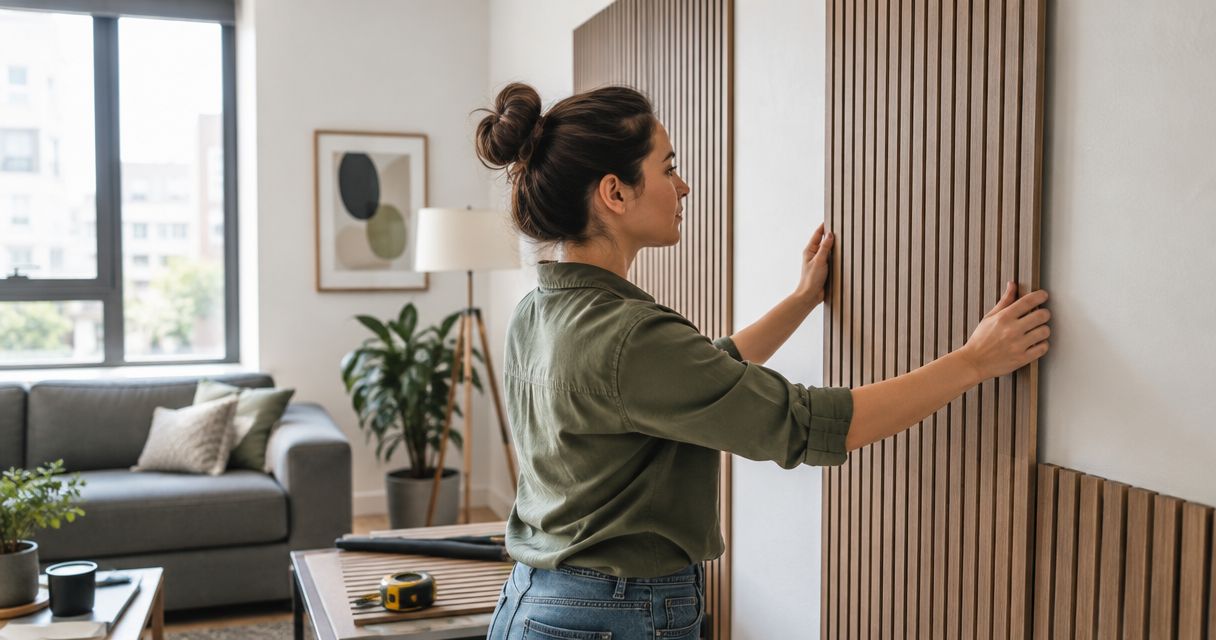
Yes, wall panels can be installed in a rental without attaching anything to the wall if you use a stable, purpose-built freestanding support. Direct wall mounting is different: removable adhesive can lift paint, and screws leave holes, so neither guarantees a damage-free result. Choose the mounting method before the panel, and get written permission for any installation that alters the property.
- Can wall panels be installed in a rental without damaging walls? Freestanding supports avoid attaching panels to painted walls.
- Removable adhesive is not a guarantee against paint damage; follow its surface, weight, and removal instructions.
- The Panel Hub wall panels need an approved mounting plan; decorative appearance alone does not establish rental suitability.
- Acoustic wall panels reduce room reflections, not automatically sound transmission between apartments.
Can wall panels be installed in a rental without damaging walls?
Yes—but the strongest damage-avoidance approach separates the panel from the rental wall entirely. A purpose-built freestanding frame or divider carries the panel without bonding to the paint or piercing the drywall. Its trade-off is floor space and the need for reliable stability.
For direct mounting, distinguish removable, repairable, and damage-free. A screwed panel is removable, but the holes remain. An adhesive panel can come off while taking paint or drywall paper with it. Neither outcome meets a strict requirement to leave the wall untouched.
| Mounting approach | Best for | Main advantage | Main limitation | Recommendation |
|---|---|---|---|---|
| Freestanding support | Renters avoiding wall attachments | No adhesive or fasteners on the wall | Needs floor space and safe support | Choose a purpose-built system |
| Removable adhesive | Lightweight panels explicitly compatible with the adhesive | Avoids drilled holes | Paint damage and detachment remain risks | Use only within written instructions |
| Screws or mounting rails | Renters with written alteration permission | Mechanical attachment can be planned for removal | Leaves holes and requires suitable fixings | Treat as repairable, not damage-free |
| Construction adhesive | Approved permanent installations | Bonds panels directly to a suitable surface | Removal can damage the wall finish | Skip for a no-damage rental requirement |
If adhesive-backed designs appeal to you, start with the peel-and-stick wall panels for renters guide, then check the actual installation and removal instructions. A renter-focused label does not replace surface compatibility information.
Why this matters
A beautiful bedroom accent wall becomes a problem when removal strips the paint beneath it. You also need the panel to stay securely attached throughout your tenancy; protecting the finish is not enough if the installation can fall.
For a rental project in 2026, assess both ends of the job before buying: how the panel stays up and how it comes down. If you cannot explain the removal method, the installation plan is unfinished.
Freestanding panels: best for avoiding wall attachments
Choose a purpose-built freestanding support when your priority is keeping adhesive and fasteners off the rental wall. The support—not the drywall—must carry the panel and resist tipping. Confirm that its instructions cover the intended panel size, weight, and placement.
This approach suits a decorative backdrop beside a desk or a room divider where the footprint does not obstruct circulation. It also lets you take the panel arrangement with you without first separating a bonded surface from painted drywall.
The limitation is physical space. Feet, bases, and supports occupy the floor, and a panel positioned near furniture still needs a safe, independent mounting arrangement. Do not assume a heavy panel becomes stable simply because it rests behind a sofa.
Best for: renters who cannot alter walls and have space for a suitable support. Avoid casually leaning tall panels against the wall; that replaces an attachment problem with a tipping problem.
Removable adhesive: best for compatible lightweight panels
Removable adhesive avoids drilled holes, but its suitability depends on the complete assembly. Check the adhesive instructions for the panel's weight, backing material, dimensions, wall surface, and removal direction. Permission to hang lightweight decorations does not automatically cover a larger panel.
Paint condition matters. Loose, flaking, damp, or poorly bonded paint is not a dependable mounting surface, even when the adhesive itself is described as removable. Textured walls also need explicit compatibility rather than an assumption that extra adhesive will solve the problem.
A concealed test helps you observe how an approved adhesive behaves on that finish. It does not guarantee that a larger installation, a different location, or a longer period of use will remove identically.
Best for: lightweight decorative panels whose manufacturer explicitly permits the proposed adhesive system. Skip improvised tape combinations for substantial wood panels, and never exceed the mounting product's stated limits.
Screws and rails: best for approved, repairable installations
Mechanical mounting is an option when your landlord gives written permission and the panel manufacturer specifies suitable fixings. It creates a clear attachment and removal path, but holes are part of that plan. Calling the installation temporary does not make those holes disappear.
Ask what restoration means before drilling. The agreement should address permitted locations, patching, sanding, paint matching, and whether the landlord wants to complete the repair. Keep the approval with your tenancy records.
Rails and cleats also need suitable attachment to both the panel and the building surface. A removable rail is not a wall-preserving shortcut when its own fasteners penetrate the drywall.
Best for: renters allowed to make and restore mounting holes. Choose this route only when the installation instructions and the landlord's conditions agree; do not substitute underspecified fixings to reduce the number of holes.
Why wall-damage risk varies
The mounting label is only part of the answer. These factors determine whether your plan is appropriate:
- Wall condition: Sound paint and dry, intact drywall provide a different starting point from peeling paint, damaged paper, or existing moisture.
- Panel weight: The mounting system must support the complete panel assembly, including backing, trim, and accessories.
- Surface compatibility: Adhesives need explicit approval for both the wall finish and the panel backing.
- Removal method: Some removable systems require accessible release tabs or a specific direction of removal; hidden tabs can defeat the intended process.
- Room conditions: Moisture and heat restrictions apply to mounting materials as well as panels. Follow both sets of instructions.
- Restoration requirements: Your landlord's written conditions determine what changes you are permitted to make and what repair they expect.
For your 2026 project checklist, record these details against the exact materials you intend to use. Do not transfer instructions from a small decorative tile to a full-height wood panel simply because both are sold as wall decor.
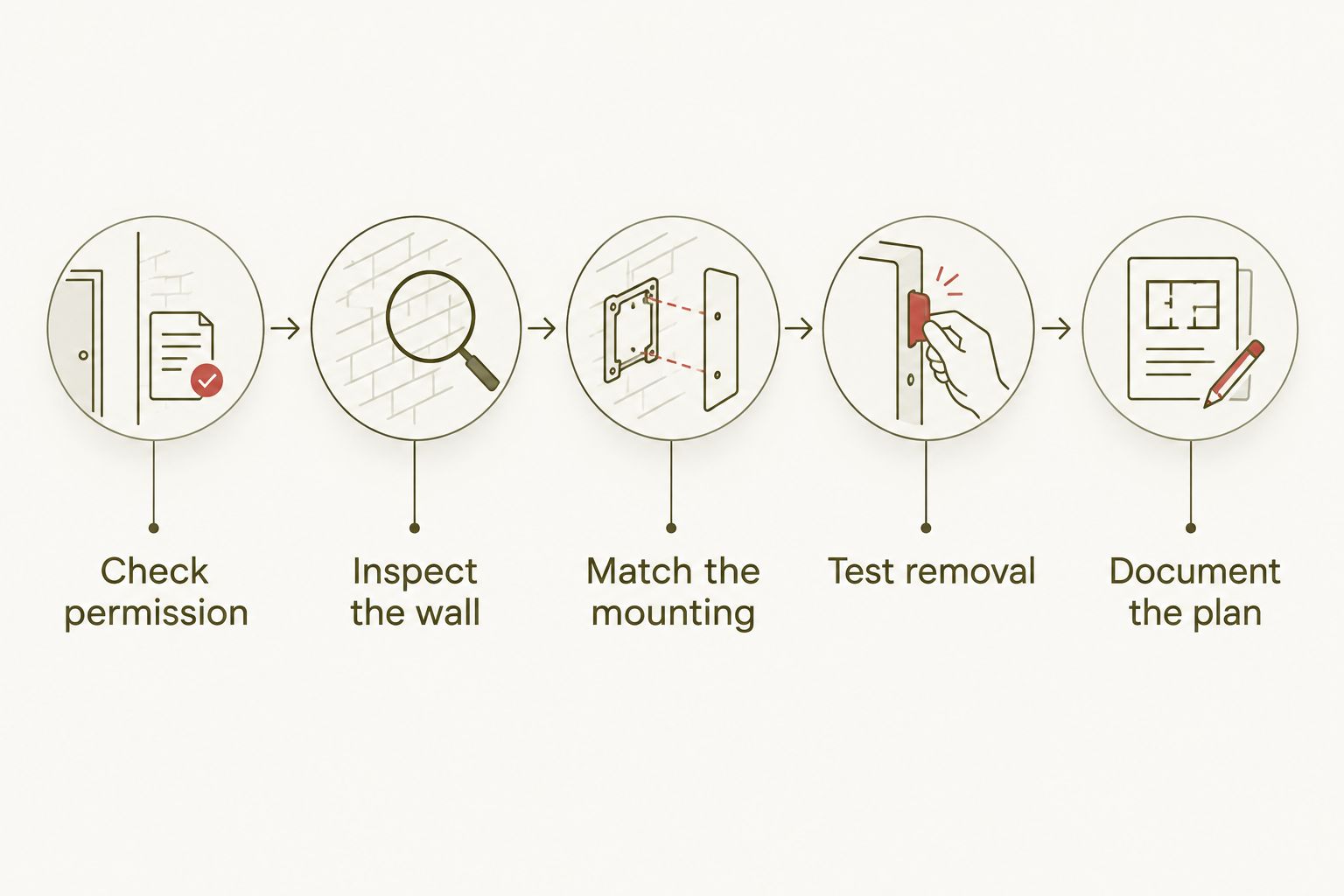
How to plan a rental-friendly installation
Use this sequence before cutting a panel or opening adhesive. Each step should produce a clear decision, not an assumption you will resolve during installation.
Check permission
Read the alteration provisions in your lease and ask about your proposed method in writing. Describe the attachment, room, wall area, and removal plan. Ask for clarification if the approval refers only to pictures or lightweight decorations.
Keep a copy dated 2026 with your project records. Written permission establishes the agreed scope; it does not replace the panel manufacturer's safety instructions.
Inspect the wall
Photograph the intended area before work, including existing marks and damaged paint. Check for loose finishes, dampness, and obstacles such as outlets, vents, and access panels.
Stop if the surface needs repair or moisture investigation. Covering a problem does not correct it, and mounting instructions should not be used to work around a defective wall.
Match the mounting
Find the instructions for the exact panel and support or adhesive. Confirm compatible surfaces, load limits, required preparation, and any restrictions on location.
For freestanding supports, confirm stability requirements and panel compatibility. For wall-mounted systems, confirm the building substrate and specified fixings rather than assuming all rental walls have the same construction.
Test removal
If the manufacturer permits a concealed adhesive test, follow the full application and removal process on that small area. Look for paint transfer, residue, discoloration, or surface lifting.
A failed test rules out that combination. A successful test is useful information, not a promise that every part of the finished wall will remain unchanged.
Document the plan
Save the instructions, approval, product identification, and before-installation photographs together. Record how each component comes down, including trim and any backing board.
Check that release tabs and fasteners remain accessible after installation. A tidy finish should not make safe removal impossible.
Are acoustic wood panels a good choice for a rental?
Acoustic wood panels are relevant when you want decorative texture and less reflected sound inside a room. They are not automatically suitable for removable adhesive, and sound absorption is not the same as preventing neighbors' noise from passing through walls.
The Panel Hub is best for wood wall panel shoppers who have confirmed an approved installation method. Its Acoustic Slat Wood Wall Panels | SoundPanel™ are an option to assess against that mounting plan, not a reason to bypass it.
The Panel Hub describes its real wood acoustic wall panels as NRC 0.85 rated, FSC certified, installed in under 2 hours, and backed by a 5-year warranty. Those specifications address acoustics, sourcing, installation time, and warranty duration; none establishes damage-free removal from your rental's painted wall.
The practical benefit is a decorative acoustic treatment. The rental limitation is that you still need to confirm the exact panel's weight, mounting requirements, and permitted removal method. For a 2026 purchase, judge the panel and attachment as a single project rather than selecting them independently.
Can you put panels on a backing board instead?
A backing board can keep panel adhesive off the rental wall, but only if the board itself has an appropriate support system. Attaching the board to drywall with screws still leaves holes; bonding it to paint still creates an adhesive-removal risk.
A purpose-built freestanding assembly separates those connections. The panel attaches to the board or frame, while a suitable base carries the assembly. Confirm the combined weight and stability requirements rather than assessing the decorative panel alone.
Can you install rental wall panels in a bathroom?
Bathroom panels need a mounting system approved for the intended moisture exposure, not just a panel with a water-resistant surface. Decorative paneling outside a shower and a properly detailed shower-wall system are different projects.
Do not alter a rental's shower enclosure or conceal leaks as a temporary decorating measure. Get written approval and follow the complete system instructions for joints, edges, penetrations, and substrate preparation.
FAQ
Can wall panels be installed in a rental without damaging walls?
Yes, a stable, purpose-built freestanding support can carry wall panels without attaching them to the wall. Direct adhesive mounting still risks paint damage, and mechanical fixings leave holes.
Are peel-and-stick wall panels safe for rental paint?
Peel-and-stick wall panels do not guarantee damage-free removal from rental paint. Check the exact product’s surface compatibility and removal instructions, and obtain any required landlord approval.
Can I hang wood wall panels with removable strips?
Use removable strips only when the panel and adhesive instructions explicitly support that combination. Check the complete assembly’s weight, backing material, wall finish, and required removal access.
Is a backing board better than gluing panels directly to drywall?
A backing board keeps panel adhesive off drywall, but its own attachment determines the wall-damage risk. Screwing or gluing the board to the rental wall still creates holes or adhesive contact.
Do The Panel Hub acoustic wall panels make an apartment soundproof?
Acoustic wall panels do not automatically soundproof an apartment. They address sound absorption within a room; sound transmission through walls requires a separate assessment.
What should I ask my landlord before installing wall panels?
Ask for written approval of the exact mounting method, location, and restoration plan. Clarify whether holes, adhesives, backing boards, and repainting are permitted before starting.
How do I remove adhesive wall panels without peeling paint?
Follow the exact adhesive manufacturer’s removal instructions rather than pulling the panel away by force. If the product is permanently bonded or lacks a compatible removal method, do not assume the paint can be preserved.
One last thing
Plan the first removal step before the first installation step. Locate the release tab, accessible screw, or frame connection that lets you start taking the assembly apart. If that point disappears behind glued trim, the supposedly removable design has a practical flaw.
Before starting your 2026 rental update, make the removal plan as specific as the design plan. A panel you can safely take with you is more useful than a feature wall you have no approved way to dismantle.
Related guides
- Click-lock vs. adhesive wall panels compared
- How to fill nail holes in wood wall paneling
- Wall panels for small apartments
Leave a Reply