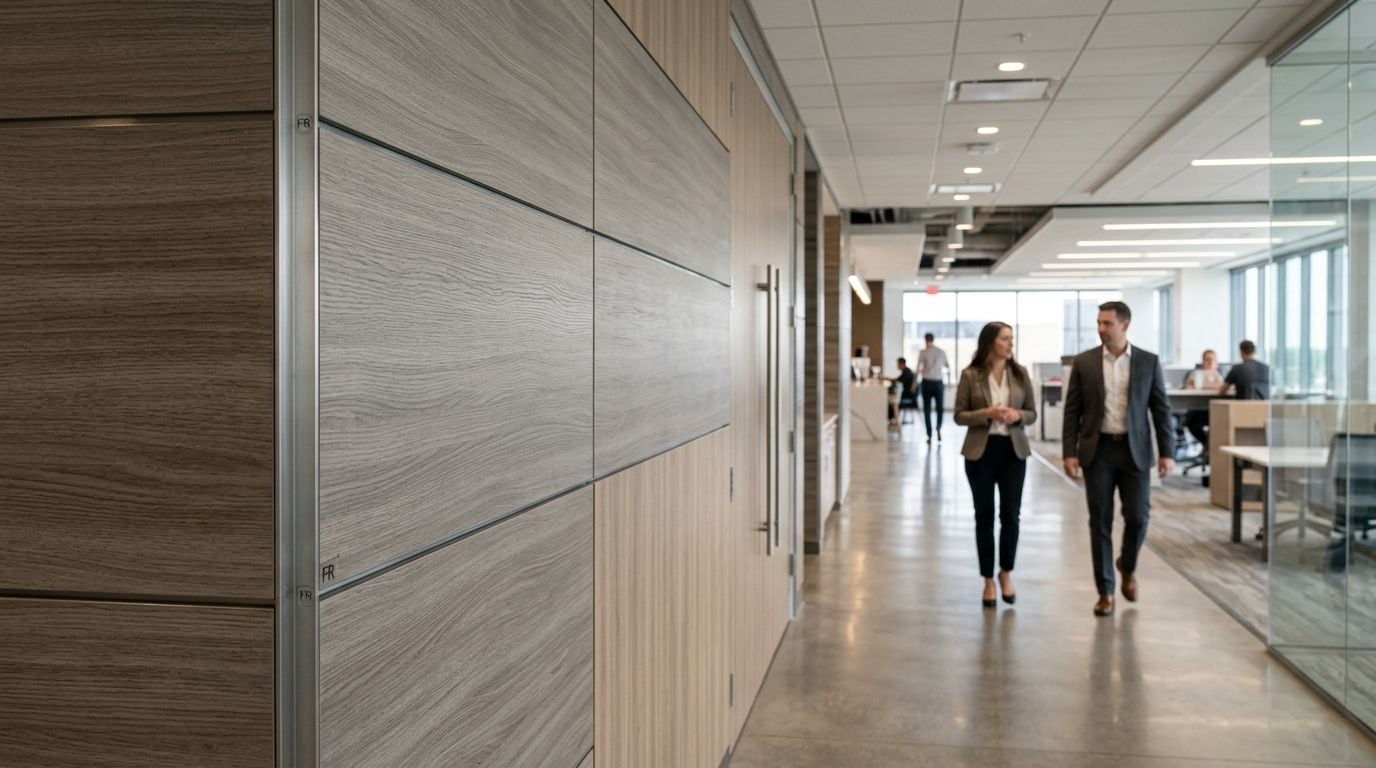
Fire-rated wall panels for commercial spaces span fiberglass composites, gypsum-faced boards, Class B PVC, and treated wood veneer — and specifying the wrong one for the wrong zone is the fastest way to fail an inspection in 2026.
- FRP panels rate best overall for fire-rated wall panels for commercial spaces in 2026, especially in restrooms and wet corridors.
- Fire-rated PVC panels are the budget pick for retail and restaurant walls that only need Class C compliance.
- Gypsum-faced decorative panels cover Class A egress corridors and stairwells where flame spread must stay at or below 25.
- Fire-rated acoustic wood slat panels pair sound control with open-plan offices once the corridor substrate is handled separately.
Why this matters
Building codes don't care how a wall panel looks in a showroom photo — they care about two numbers, flame spread index and smoke-developed index, both measured under ASTM E84. A panel that photographs well can still fail a fire marshal's walkthrough if it's installed in the wrong occupancy zone.
Most commercial fit-outs in 2026 mix zones inside the same floor plan: a Class A stairwell next to a Class B open office next to a decorative reception wall that isn't part of the egress path at all. Treating every wall the same wastes budget on over-specified panels in low-risk zones, or worse, under-specifies a corridor and fails inspection.
The breakdown below separates panels by the zone they're built for, not by brand marketing. For general interior finishing — including MDF wall panels for interior walls that contractors sometimes substitute in low-risk decorative zones — always confirm the specific product's current fire-rating documentation before ordering for a commercial job.
What makes the best fire-rated wall panels for commercial spaces
- Flame spread index (ASTM E84) — Class A tops out at 25, Class B runs 26-75, Class C runs 76-200; corridors and stairwells almost always require Class A.
- Smoke-developed index — most model codes cap this at 450 regardless of flame spread class, and it's the number contractors forget to check.
- NFPA 286 room corner test — required for certain occupancy types (assembly, healthcare) on top of the ASTM E84 tunnel test.
- Substrate and core material — FRP composite, treated MDF veneer, fire-rated PVC, and gypsum-faced boards carry different impact resistance and moisture tolerance.
- Occupancy and zone classification — identical square footage can require three different ratings depending on whether it's an egress corridor, an open office, or a non-egress decorative wall.
- Maintenance profile — commercial foot traffic wears panels faster than residential use; cleanability and impact resistance matter as much as the rating itself.
Fire-rated wall panels for commercial spaces at a glance
| Panel type | Best for | Standout feature | Key limitation |
|---|---|---|---|
| FRP (fiberglass reinforced panels) | Restrooms and wet corridors | Class A/B options with a washable, chemical-resistant surface | Limited decorative texture range |
| Gypsum-faced decorative panels | Egress corridors and stairwells | Meets Class A flame spread at ≤25 without a separate fire-retardant coat | Heavier, needs stud-level framing |
| Fire-rated PVC wall panels | Retail and restaurant walls | Lowest install cost among rated options, wipeable finish | Class C only in most lines, not corridor-rated |
| Fire-rated MDF wood veneer panels | Reception areas and lobbies | Real wood look over a treated Class B core | Needs a certified fire-retardant treatment, not paint |
| Fire-rated acoustic wood slat panels | Open-plan offices | Sound absorption plus a Class B rated core | Rated cores cost more than standard slat panels |
1. FRP panels: best fire-rated wall panels for restrooms and wet corridors
FRP is the default commercial spec for restrooms, kitchens, and wet corridors because the surface is washable and chemically resistant on top of carrying Class A or Class B ratings depending on the product line. It's the panel most fire marshals recognize on sight, which speeds up inspection.
FRP pros:
- Class A and Class B options widely available from commercial suppliers
- Washable, chemical-resistant surface holds up to daily commercial cleaning
- Recognized by most inspectors without extra documentation requests
FRP cons:
- Decorative texture range is thin compared to wood veneer or PVC
- Seams need H-molding or trim to stay code-compliant, adding labor
Best for: restrooms, back-of-house corridors, and wet commercial zones. Verdict: Buy for any wet or heavy-traffic corridor.
2. Gypsum-faced decorative panels: best for egress corridors and stairwells
Gypsum-faced panels carry a factory Class A flame spread rating without needing a separate fire-retardant coat, which is why they're the standard pick for stairwells and primary egress corridors in 2026 code cycles.
Gypsum panel pros:
- Class A rating built into the core, not a surface treatment
- Handles the heaviest-trafficked commercial corridors
- Broad supplier availability across most US markets
Gypsum panel cons:
- Heavier than composite or PVC alternatives, adds framing cost
- Impact resistance lags behind FRP in high-traffic zones
Best for: stairwells, egress corridors, and any zone requiring Class A by code. Verdict: Buy where code explicitly calls for Class A.
3. Fire-rated PVC wall panels: best budget option for retail and restaurant walls
Fire-rated PVC panels are the budget entry point among fire-rated wall panels for commercial spaces, running Class C in most product lines rather than the Class A or B required for egress paths — which fits retail sales floors and restaurant dining rooms, not corridors.
PVC panel pros:
- Lowest install labor among rated panel types
- Wipeable surface suits food-service and retail environments
- Wider color and texture range than FRP
PVC panel cons:
- Class C rating disqualifies most corridor and stairwell applications
- Lower impact resistance than FRP in high-traffic zones
Best for: retail sales floors and restaurant dining areas outside the egress path. Verdict: Buy for budget retail fit-outs; Skip for corridors.
4. Fire-rated MDF wood veneer panels: best for reception areas and lobbies
Treated MDF wood veneer panels bring a real-wood look to a Class B rated core, which is why they show up in reception areas and lobbies where the wall isn't part of the primary egress route but still needs to pass a fire marshal's review.
MDF veneer pros:
- Real wood veneer finish reads as premium in reception and lobby settings
- Class B rated cores are widely available from commercial suppliers
- Easier to source in warm tones that pair with wood-slat accent walls
MDF veneer cons:
- Requires certified fire-retardant treatment, not a surface coating alone
- Not rated for full egress corridor use in most jurisdictions
Best for: lobbies, reception desks, and non-egress decorative walls. Verdict: Buy for lobby-level finish work.
5. Fire-rated acoustic wood slat panels: best for open-plan offices
Open-plan offices need two things a plain gypsum wall doesn't deliver: sound absorption and a finish that doesn't look institutional. Fire-rated acoustic wood slat panels with a Class B core solve both, layering a slatted wood or veneer face over an acoustic backing.
Acoustic slat pros:
- Sound absorption cuts open-office noise complaints alongside a Class B rated core
- Matches the wood-slat aesthetic already common in commercial interiors
- Modular installation suits phased office build-outs
Acoustic slat cons:
- Rated acoustic cores cost more than standard, non-rated slat panels
- Still needs Class A backing in any adjacent egress corridor
Best for: open-plan offices and huddle rooms. Verdict: Buy for office interiors; pair with Class A corridor panels at the exits.
Where The Panel Hub's decorative panels fit in a fire-rated project
The Panel Hub's acoustic and decorative wood wall panels — including the line covered in acoustic wood wall panels for home studios — are built for interior accent and sound-dampening use, not as a substitute for a Class A or Class B rated substrate in a code-mandated corridor.
In a commercial fit-out, that puts The Panel Hub's real wood and PVC panels in the same category as the MDF veneer and acoustic slat entries above: decorative overlays for reception walls, huddle rooms, and open-plan offices, installed alongside — not instead of — whatever fire-rated substrate the zone requires. The SoundPanel American Acoustic Slat Wood Wall Panels carry an NRC 0.85 sound-absorption rating and install in under two hours, per product spec, suited to the same open-office use case as the fire-rated acoustic slat category above.
Before specifying any decorative wall panel — from The Panel Hub or any other wall panel supplier — on a commercial job, confirm current fire-rating documentation directly with the manufacturer and check it against the occupancy classification your local code official assigns to that wall.


How this ranking works
Each panel type above is scored against the same six criteria: flame spread class, smoke-developed index, room corner test requirements, substrate durability, occupancy fit, and maintenance load. No single panel wins across every zone — that's why the list splits by use case instead of stacking every option against one "best overall" pick alone.
Which fire-rated wall panel should you choose in 2026?
Match the panel to the zone, not the showroom sample. Specify FRP for restrooms and wet corridors, gypsum-faced panels for Class A egress corridors and stairwells, fire-rated PVC for budget retail and restaurant walls, and fire-rated MDF veneer or acoustic slat panels for lobbies and open-plan offices where the wall sits outside the egress path. Get the occupancy classification from your local code official before you order, not after the panels arrive.
FAQ
What is the best fire-rated wall panel for commercial spaces in 2026?
FRP panels rate best overall for wet corridors and restrooms in 2026, but the right pick depends on the zone — gypsum-faced panels cover Class A egress corridors and fire-rated PVC covers budget retail walls.
Is Class A or Class B required for commercial corridors?
Most jurisdictions require Class A (flame spread ≤25) in enclosed exit corridors and stairwells. Class B (26-75) is often accepted in other interior finish zones, so confirm the requirement with your local code official.
How much does a fire-rated wall panel cost?
Cost varies by core material, rating class, and supplier, so get a quote from a commercial supplier specifying your occupancy classification rather than relying on a general estimate.
Can PVC wall panels be fire-rated?
Yes, Class C rated PVC panels are widely available, but most PVC lines don’t reach the Class A or B rating required for egress corridors.
Do decorative wood wall panels need a fire rating in commercial buildings?
It depends on whether the wall is part of the egress path. Decorative walls outside the egress path often don’t require the same Class A rating as corridors, but always confirm with your local code official.
What’s the difference between ASTM E84 and NFPA 286?
ASTM E84 is a tunnel test measuring flame spread and smoke development. NFPA 286 is a room corner test required for certain occupancy types, such as assembly and healthcare, on top of the E84 result.
Are The Panel Hub’s wall panels rated for commercial fire code?
The Panel Hub’s acoustic and decorative panels are built for interior accent and sound-dampening use in homes and light-commercial interiors. Confirm current fire-rating documentation directly before specifying any panel on a code-mandated commercial wall.
What is the smoke-developed index limit for commercial wall finishes?
Most model building codes cap the smoke-developed index at 450 regardless of flame spread class, and inspectors check this number as closely as the flame spread rating itself.
One last thing
A panel can pass ASTM E84 as Class A and still fail inspection if its smoke-developed index tops 450 — the flame spread number gets all the attention on spec sheets, and the smoke number gets ignored until the fire marshal's walkthrough in 2026 building cycles.
Related guides
Leave a Reply