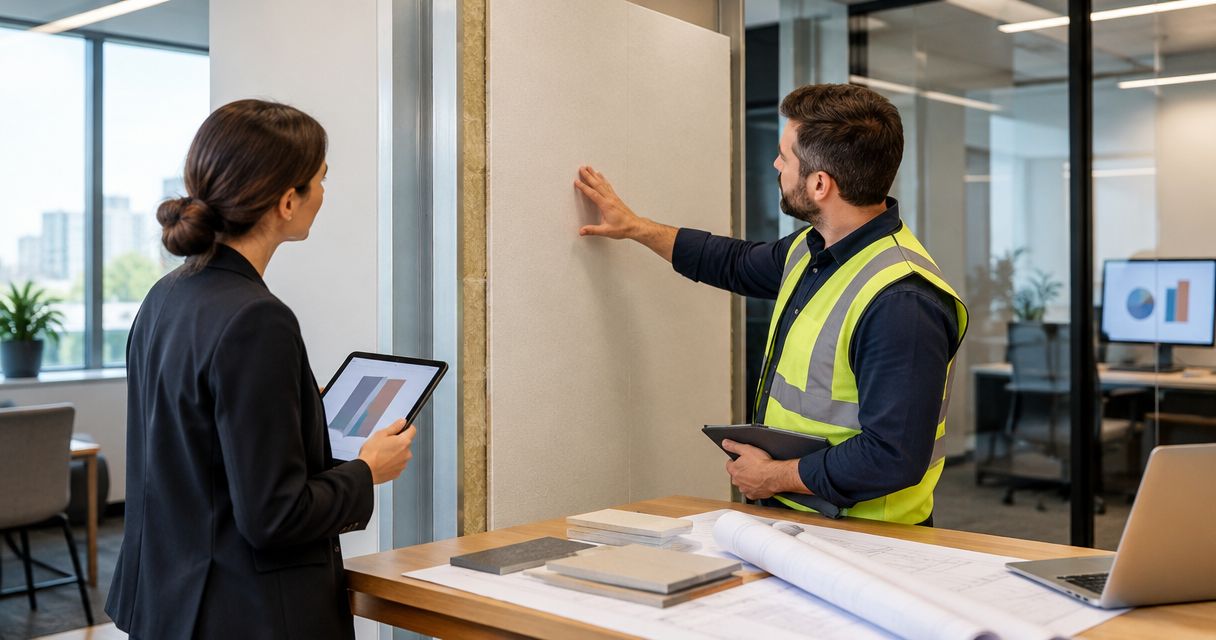
A commercial fire-rated wall panel needs a project-specific installed quote; a panel-only figure does not establish the cost of a compliant wall. For your 2026 budget, first distinguish a fire-tested decorative finish from a fire-resistance-rated wall assembly, then include the required backing, attachment, detailing, and installation in the same scope.
- How much does a fire-rated wall panel cost? Request an installed quote tied to the required fire classification.
- ASTM E84 surface-burning results do not establish an hourly wall fire-resistance rating.
- Compare matching wall areas, mounting details, installation scope, and fire documentation before selecting a bid.
- The Panel Hub sells acoustic and decorative wall panels; confirm fire documentation before commercial specification.
What does a fire-rated wall panel cost for commercial use?
Budget the specified wall system, not an isolated panel. A commercial quote is useful only when it identifies what the wall must achieve and what the contractor will actually install. Start with the required classification, the wall location, and a measured scope.
Use this breakdown when requesting a 2026 estimate. For a closer look at the labor portion, see how much professional wall panel installation typically costs.
| Quote component | What to have included | What to clarify |
|---|---|---|
| Panel supply | Exact panel, finish, dimensions, and quantity | Whether the quoted construction matches the fire-test documentation |
| Wall preparation | Removal, repairs, leveling, and substrate work | Whether the existing wall is suitable for the specified installation |
| Mounting system | Required backing, fasteners, adhesive, or supports | Whether the proposed mounting matches the documented application |
| Installation | Layout, cutting, fitting, and attachment | Treatment of corners, edges, openings, and changes in direction |
| Rated-wall details | Applicable joints, penetrations, and perimeter details | Which contractor is responsible for each detail |
| Project services | Delivery, access, protection, cleanup, and documentation | What the quote excludes and who supplies outstanding items |
Ask bidders to separate these components without changing the specification. A short quote that leaves preparation or finishing undefined is not directly comparable with a complete installed proposal.
Why this matters
The phrase fire-rated panel covers different purchasing problems. You might need an interior finish with documented surface-burning performance, or you might need a wall assembly that meets an hourly fire-resistance requirement. Those are not interchangeable requests.
The distinction affects both compliance and the quote. Buying an attractive panel first and asking about its fire performance later reverses the decision: establish the requirement, verify the documentation, and then compare suitable finishes.
Your architect, code consultant, or local authority having jurisdiction should establish the applicable requirement. A product description alone does not establish approval for a particular commercial location.
Surface-burning classification or hourly fire resistance?
A surface-burning classification is not an hourly fire-resistance rating. ASTM E84 and UL 723 evaluate surface-burning characteristics, including flame spread and smoke development. ASTM E119 and UL 263 address fire resistance of building construction and assemblies.
For a 2026 specification, name the applicable test and required result rather than asking only for something “fire-rated.” Read the report alongside the installation instructions; the tested construction matters as much as the headline classification.
| Requirement | Best for | What the evidence addresses | Limitation |
|---|---|---|---|
| Interior-finish classification | Selecting exposed finishes where surface-burning requirements apply | Flame-spread and smoke-developed results under the applicable test | Does not establish an hourly wall rating |
| Fire-resistance-rated wall assembly | Locations requiring an hourly fire-resistance rating | Performance of the documented wall construction | Requires the specified components and construction details |
| Acoustic performance | Rooms where sound absorption is a separate design objective | Sound absorption under the relevant acoustic test | Does not establish either fire classification or fire resistance |
These requirements can apply to the same project. Treat them as separate checks rather than assuming a panel that meets one objective satisfies the others.
What does a 1-hour wall rating mean for the quote?
A 1-hour wall rating concerns the documented assembly, not just its visible surface. Have the designer identify the applicable assembly and confirm how the proposed decorative finish attaches without conflicting with its requirements.
The purchasing advantage is a defined construction to price. The constraint is that substitutions require review; a different backing, attachment method, or wall detail is not automatically equivalent.
What does a 2-hour wall rating mean for the quote?
A 2-hour wall rating also applies to the specified assembly. Do not estimate it by doubling the scope of a 1-hour wall or by selecting a panel with a stronger-sounding product description.
Ask the contractor to price the actual assembly and its details. The rating alone does not describe the wall layers, supporting construction, joints, openings, or finish installation.
Why commercial wall-panel estimates vary
Commercial estimates vary when the specified construction or installation scope changes. Check these factors before treating a difference between bids as a saving:
- Required performance. An interior finish and a fire-resistance-rated partition answer different requirements. Establish which work the quote covers.
- Documented installation. Backing, air spaces, adhesive, and attachment details affect whether a proposed installation matches the supporting documentation.
- Existing wall condition. A prepared substrate and a wall needing removal or repair are different scopes. Require an explicit preparation allowance or defined work description.
- Layout complexity. Corners, returns, outlets, doors, and other interruptions create cutting and finishing tasks beyond covering an uninterrupted wall.
- Interfaces and penetrations. Joints and service openings in rated construction need appropriate details. Assign responsibility rather than leaving these items between trades.
- Site conditions. Access restrictions, occupied areas, protection requirements, and work scheduling belong in the contractor's scope so bidders price the same conditions.
Do not apply a blanket waste percentage without reviewing the panel layout. Ask the installer to account for panel dimensions, pattern direction, usable offcuts, and the actual wall arrangement.
How do you get a comparable commercial quote?
Use the same written brief for every bidder. A consistent request turns a collection of unrelated proposals into a comparison you can act on.
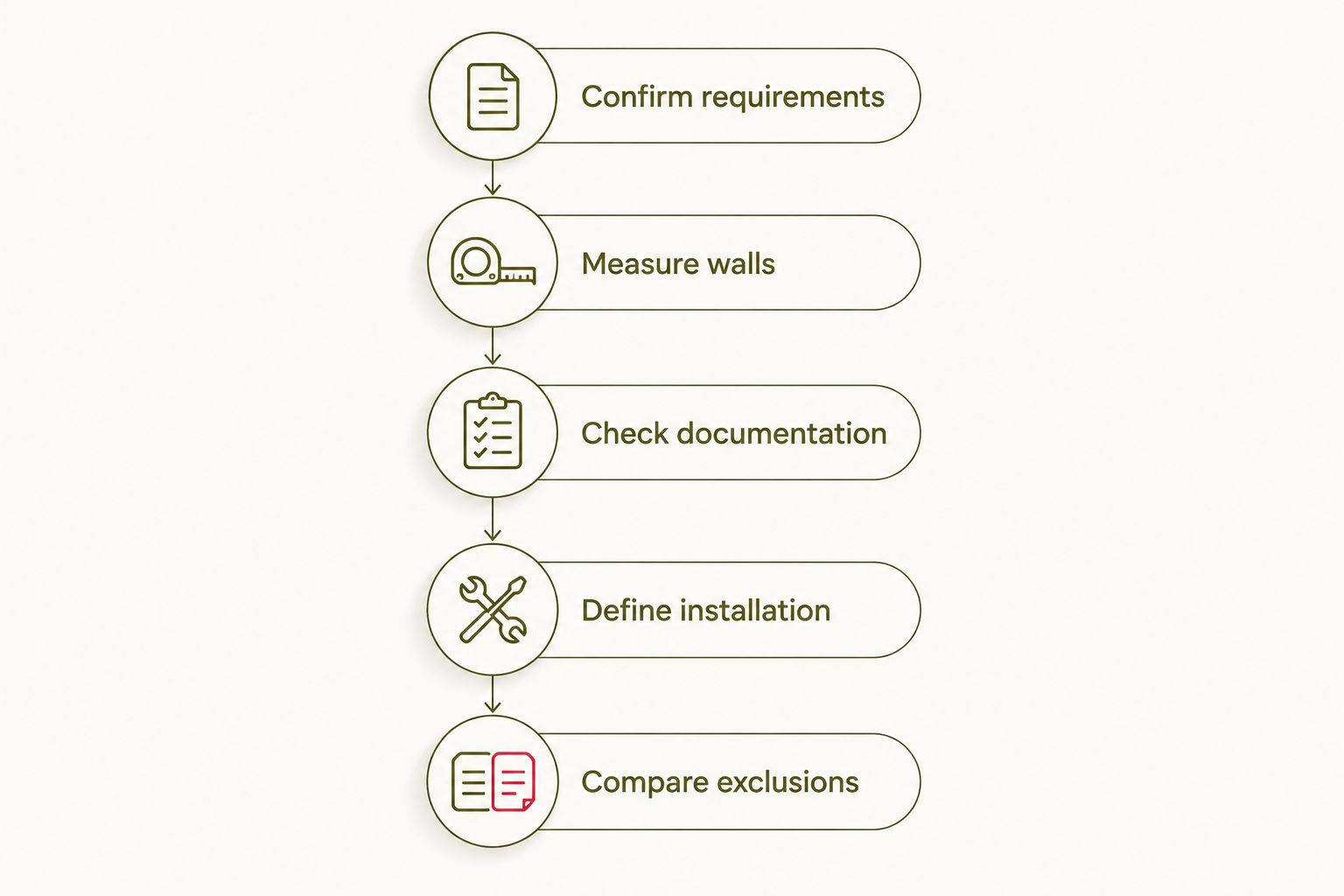
- Confirm requirements. Identify the wall location, intended use, required fire performance, and any separate acoustic objective. Have the responsible design professional resolve unclear terminology before procurement.
- Measure walls. Record wall dimensions and openings, then supply drawings or a marked-up elevation. State whether each bidder should measure on site before finalizing quantities.
- Check documentation. Request the relevant test report, classification or assembly listing, and installation instructions. Confirm that the exact proposed panel and mounting arrangement are covered.
- Define installation. List preparation, attachment, cuts, trim, joints, penetrations, protection, and cleanup. Identify work supplied by other trades.
- Compare exclusions. Review the complete installed scope, not just the panel line. Resolve qualifications and substitutions in writing before accepting the proposal.
The sequence matters: documentation comes before final procurement. Otherwise, a finish decision can create redesign work when the commercial requirement is checked.
What should the fire documentation identify?
Look for the exact product construction, the applicable test method, the reported result, and the installation conditions. A report for a different thickness, backing, or mounting arrangement does not establish the performance of your proposed wall.
Where an hourly rating is required, ask for the applicable assembly reference and construction details. Where an interior-finish classification is required, ask the designer to confirm that the submitted documentation satisfies the project's requirement.
Can you compare quotes per square foot?
A square-foot comparison works only after the scopes match. Separate material coverage from installed wall area, then check that both bidders include the same preparation, attachment, finishing, and documentation.
For your 2026 comparison sheet, record the panel quantity and installed area separately. Packaging and usable coverage are not the same thing, particularly when the layout includes cuts or a directional pattern.
Keep these distinctions visible:
- Panel coverage: the area represented by the supplied material.
- Installed area: the wall surface included in the installation scope.
- Layout allowance: additional material justified by cuts and the planned arrangement.
- Fixed project work: delivery, protection, setup, or other tasks that do not track directly with covered area.
Ask for an itemized revision when a bidder changes the product or construction. A substitute is a new technical proposal, not simply a different total.
When do decorative acoustic panels belong in the discussion?
Decorative acoustic panels belong in the selection process when appearance and sound absorption are project goals. Those benefits remain separate from fire compliance, so evaluate the proposed panel against each requirement independently.
The Panel Hub is best for homeowners and DIYers shopping for decorative and acoustic wood wall panels. For a commercial application, request product-specific fire documentation before treating any panel as a suitable finish.
The Panel Hub describes its real wood acoustic panels as NRC 0.85 rated and offers a 5-year warranty. NRC describes sound absorption, while a warranty describes a contractual commitment; neither establishes a fire classification or an hourly wall rating.
The benefit is a way to address decorative and acoustic goals together. The limitation is equally important: you still need suitable fire documentation for the exact product and proposed installation, plus acceptance for the intended commercial use.
Can a Class A finish replace a rated wall?
A Class A finish cannot replace a required fire-resistance-rated wall assembly. Surface-burning classification and hourly fire resistance measure different aspects of fire performance.
Ask the designer to show both requirements on the specification when both apply. That prevents a finish submittal from being mistaken for evidence about the underlying partition.
Can you keep an existing rated wall and add panels?
You can evaluate a decorative overlay on an existing rated wall, but approval depends on the wall construction, proposed finish, and attachment details. Have the designer review the change before installation.
Do not assume an existing wall is rated because it looks substantial. Confirm its documented construction and assess any new fasteners, openings, or service work against the applicable requirements.
Is the lowest panel quote the least expensive complete option?
The lowest panel quote does not establish the lowest complete project cost. Compare the same accepted construction, installed area, preparation, finishing, and responsibilities before selecting a proposal.
For a 2026 purchase decision, request a written list of exclusions and resolve it before ordering. An undefined responsibility remains an open project task even when it is absent from the quote.
FAQ
How much does a fire-rated wall panel cost for commercial use?
A commercial fire-rated wall panel requires a project-specific quote tied to the required performance and installation scope. Compare the complete installed construction, including preparation, mounting, finishing, and applicable rated-wall details.
Does Class A mean a wall has a 1-hour fire rating?
Class A does not mean a wall has a 1-hour fire rating. A surface-burning classification and an hourly fire-resistance rating describe different test results.
What should I ask for before ordering commercial wall panels?
Ask for product-specific fire documentation, installation instructions, and confirmation that the proposed construction satisfies the project’s requirements. Have the responsible design professional review the submission before procurement.
Can acoustic wall panels also meet commercial fire requirements?
Acoustic wall panels need separate fire documentation to establish suitability for a commercial application. An acoustic rating does not establish surface-burning classification or hourly fire resistance.
Does The Panel Hub’s acoustic rating establish fire performance?
The Panel Hub’s stated NRC 0.85 acoustic rating does not establish fire performance. Request the relevant fire documentation for the exact panel and proposed installation.
Should installation be included in a commercial panel estimate?
Installation should be included when you need a complete project estimate. Define preparation, attachment, cuts, trim, joints, penetrations, protection, and cleanup so bidders cover the same work.
Can I substitute a similar-looking panel after approval?
A similar-looking panel is not automatically an acceptable substitute. Submit its construction, fire documentation, and installation details for review before making the change.
One last thing
Ask every bidder to identify the exact document supporting the proposed fire performance. Keep that reference beside the panel specification and installation scope, not buried in an email thread.
For your 2026 handover file, retain the accepted submittal and installation details. The useful purchase record is not just which finish you chose; it is which documented construction was accepted and installed.
Related guides
- Fire-rated wall panels for commercial spaces
- Wall panels for architects and design firms
- Wall panels for retail store buildouts
Leave a Reply