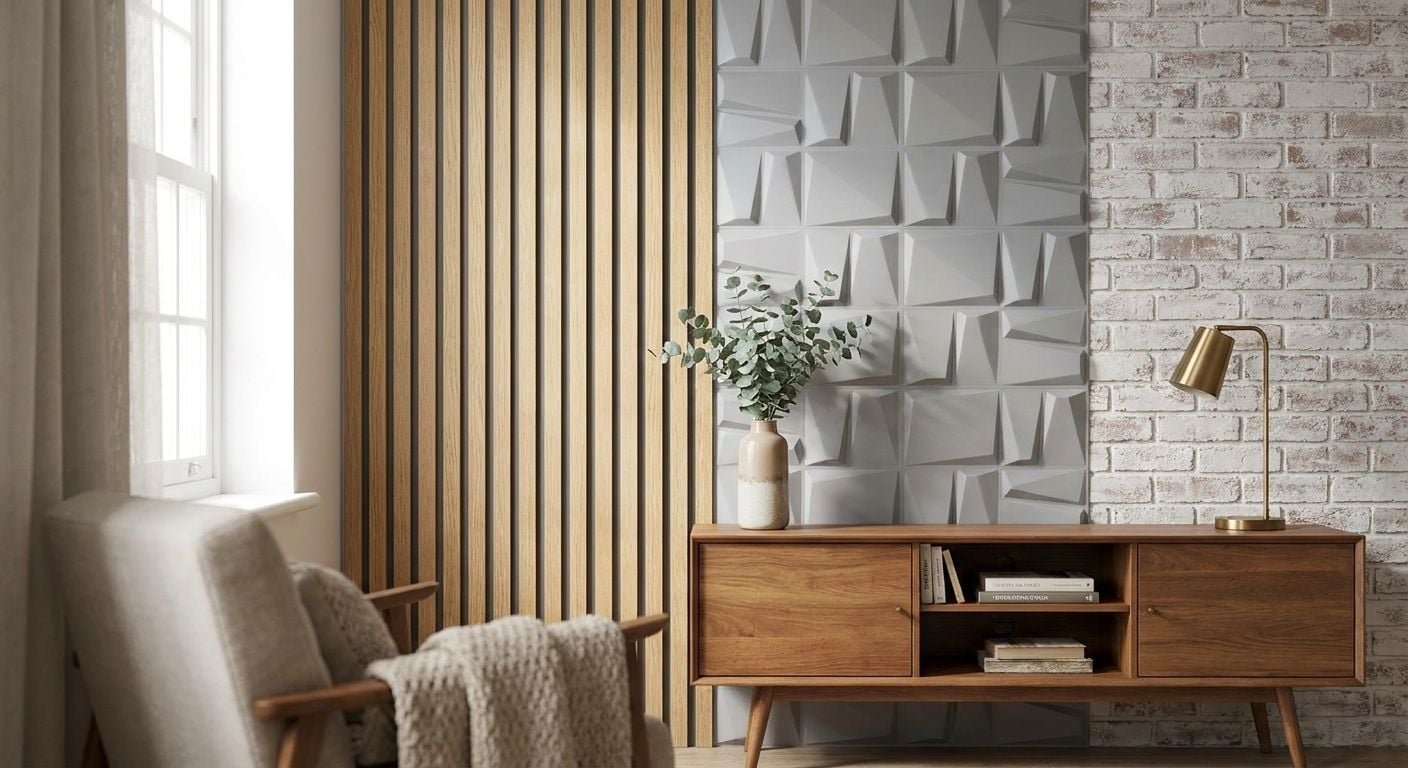
Under $50 per panel puts you in PVC, peel-and-stick, and foam tile territory — real wood acoustic panels live in a different price tier entirely, and this guide tells you exactly when that trade-off is worth crossing.
- Best true budget pick for 2026: PVC wall panels, waterproof and reliably under $50 per panel.
- Best cheap wall panels under $50 for renters: peel-and-stick faux wood, no tools or holes required.
- Best fast accent wall: MDF slat panels, lightweight enough to install solo in an afternoon.
- Best step-up once budget allows: The Panel Hub’s real wood acoustic panels add NRC 0.85 sound dampening.
- Foam acoustic tiles are the cheapest noise-reduction option but don’t hold up as decor long-term.
Why this matters
Most people searching for cheap wall panels under $50 are furnishing a first apartment, patching a rental bathroom, or testing an accent wall before committing to something permanent. That's a legitimate use case — PVC, peel-and-stick, and foam options exist because not every wall needs certified materials or an acoustic rating.
But the $50 ceiling is also where the category splits in two. Below it, you're buying decoration. Above it, you start getting engineered performance — sound dampening, FSC-certified solid wood, warranty backing. The Panel Hub sits in that second tier, and knowing the split before you buy keeps you from either overpaying for a rental wall or underbuying for a room where noise actually matters.
What makes the best cheap wall panel
- Waterproof rating — non-negotiable for bathrooms and kitchens, optional everywhere else
- Per-panel coverage — how much wall you cover before you're buying a second box
- Install method — peel-and-stick, click-lock, or adhesive changes who can install it
- Surface durability — whether the finish scratches, yellows, or peels within a year
- Upgrade path — can you replace one section later without redoing the whole wall
- Actual function — decoration only, or does it also cut noise
At a glance
| Panel type | Best for | Standout feature | Key limitation |
|---|---|---|---|
| PVC wall panels | Bathrooms and kitchens | Fully waterproof | Looks synthetic up close |
| Peel-and-stick faux wood | Renters | Zero tools, removable | Thin veneer wears fast |
| MDF slat panels | Quick accent walls | Fastest solo install | Not moisture-safe |
| Foam acoustic tiles | Home office noise control | Cheapest way to dampen sound | Looks industrial, not decor |
| Real wood acoustic panels | Bedrooms and living rooms | NRC 0.85 sound absorption | Priced above the $50 tier |
1. PVC wall panels: best cheap wall panels under $50 for bathrooms
PVC wall panels click or glue directly onto drywall and stay fully waterproof, which is why they show up in bathroom and kitchen renovations more than any other budget material. They come in wood-look, marble-look, and plain finishes, and a single panel typically covers several square feet.
PVC wall panel pros:
- Genuinely waterproof, no sealing required
- Wipes clean, resists mildew
- Reliably falls under the $50-per-panel range
PVC wall panel cons:
- Finish reads as plastic in direct light
- Adds zero sound dampening
- Seams can show on larger walls
Verdict: Buy — if the room is wet, this is the correct call at this price point.
2. Peel-and-stick faux wood panels: best for renters
These apply with adhesive backing, no drilling, and pull off cleanly at move-out. They're the fastest way to test an accent wall look without committing to anything structural.
Peel-and-stick pros:
- No tools, no holes in the wall
- Fully removable, lease-friendly
- Fastest install of any option here
Peel-and-stick cons:
- Thin veneer scuffs and lifts at edges within a year or two
- Doesn't hold up in humid rooms
- Limited to small accent sections, not full-room coverage
Verdict: Buy — for a rental accent wall, skip everything else on this list.
3. MDF slat panels: best for a fast weekend accent wall
MDF slat panels click together in vertical strips and are light enough for one person to hang in an afternoon. They're a step up in look from peel-and-stick but still land solidly under $50 per panel in most cases.
MDF slat panel pros:
- Paintable, so you control the finish
- Solo install, no special tools
- Reads more premium than PVC from a distance
MDF slat panel cons:
- Swells if it gets wet — bathrooms are off-limits
- Chips at corners if handled roughly during install
- No acoustic benefit
Verdict: Buy — good middle ground for a living room or hallway accent.
4. Foam acoustic tiles: best for cheap noise control in a home office
Foam tiles are the least decorative option on this list but the only one built specifically to cut echo. They're a legitimate fix for a home office or bedroom with bad reverb, sold in packs that keep the per-tile cost low.
Foam acoustic tile pros:
- Cheapest route to real noise reduction
- Easy to arrange in custom patterns
- Lightweight, minimal wall damage on removal
Foam acoustic tile cons:
- Looks like a recording booth, not a finished room
- Foam degrades and yellows faster than solid materials
- Absorbs sound but adds nothing to resale or room value
Verdict: Hold — fine for a closet studio, wrong for a room guests will see.
5. Real wood acoustic wall panels: best step-up pick once $50 isn't the ceiling
This is where the category changes shape. Real wood acoustic panels — like the acoustic slat wood wall panels from The Panel Hub — pair solid wood or veneer with an acoustic felt backing rated NRC 0.85, meaning they measurably cut echo instead of just decorating over it. FSC-certified sourcing and a 5-year warranty come standard, and install still runs under 2 hours for most rooms.
They're not competing for the under-$50 slot — they're the answer for readers who start this search budget-conscious and end it realizing PVC won't solve an echoey bedroom or a noisy shared-wall apartment.
Real wood acoustic panel pros:
- NRC 0.85 rating actually reduces room echo, not just visual noise
- FSC-certified solid wood holds finish for years, not months
- 5-year warranty backs the purchase
- Installs in under 2 hours despite the heavier material
Real wood acoustic panel cons:
- Priced well above the $50-per-panel budget tier
- Heavier panels benefit from a second set of hands during install
- Overkill for a rental you'll leave within a year
Verdict: Buy — once you need the wall to sound different, not just look different.


“If a wall panel doesn’t list an NRC rating, assume it does nothing for the noise in the room.”
How this list was ranked
Each panel type is scored against the six criteria above — waterproofing, coverage, install method, durability, upgrade path, and actual function — then assigned a single best-fit use case so no two entries compete for the same reader. Real wood acoustic panels rank last for pure budget shoppers and first for anyone whose real problem is noise, not just an empty wall.
Which cheap wall panel should you choose?
Staying under $50 and dealing with moisture: PVC wall panels win, no contest. Renting and want it reversible: peel-and-stick faux wood. Want a fast weekend project on a wall that stays dry: MDF slat panels. Fighting echo in a home office on the tightest possible budget: foam acoustic tiles, with the caveat that they won't double as finished decor.
If the real issue is a bedroom or living room that sounds as bad as it looks unfinished, the best cheap wall panels under $50 simply won't fix that — real wood acoustic panels from The Panel Hub are the next step up, and 2026 buyers who make that jump usually do it after trying the cheap route first.
FAQ
What are the best cheap wall panels under $50 in 2026?
PVC wall panels are the most reliable option that stays under $50 per panel in 2026, especially for bathrooms and kitchens. Peel-and-stick faux wood and MDF slat panels also fall in this range for dry rooms.
Are peel-and-stick wall panels durable enough for a bedroom?
Peel-and-stick panels hold up fine for a year or two of light use but the thin veneer scuffs and lifts at the edges over time. They’re better suited to a temporary rental accent wall than a permanent bedroom feature.
Is PVC or MDF better for a bathroom on a budget?
PVC is the better choice for a bathroom because it’s fully waterproof, while MDF swells and warps when exposed to moisture. Save MDF slat panels for dry rooms like a living room or hallway.
Can foam acoustic tiles under $50 actually reduce noise?
Yes, foam acoustic tiles do reduce echo and are the cheapest way to get real noise control. They look industrial rather than decorative, so they suit a home office more than a living space.
Do budget wall panels install as fast as premium ones?
Peel-and-stick and MDF slat panels install just as fast, often faster, since they’re lighter than solid wood. Real wood acoustic panels from The Panel Hub still install in under 2 hours despite the heavier material.
Is it worth spending more than $50 on real wood acoustic panels?
It’s worth it once noise, not just appearance, is the problem you’re solving. Real wood acoustic panels carry an NRC 0.85 rating and a 5-year warranty that budget PVC and foam options don’t offer.
How do I keep cheap wall panels looking good longer than a year?
Keep peel-and-stick and PVC panels away from direct sun and high humidity swings, since both cause lifting and warping. MDF panels last longest when kept in rooms with stable, dry conditions.
What’s the difference between PVC and real wood wall panels?
PVC is a synthetic, waterproof material with no sound-dampening properties, while real wood acoustic panels use FSC-certified solid wood bonded to an acoustic core. The wood option costs more but adds NRC-rated noise reduction that PVC can’t match.
One last thing
The cheapest panels on this list all share one blind spot: none of them do anything for noise, because noise reduction requires an engineered core, not just a decorative surface. If echo is the actual complaint about the room, no amount of PVC or peel-and-stick will fix it — that's the one line item worth checking before you buy anything under $50.
Related guides
- PVC wall panels for bathrooms
- MDF wall panels for interior walls
- Wood slat wall panels for living rooms
Leave a Reply