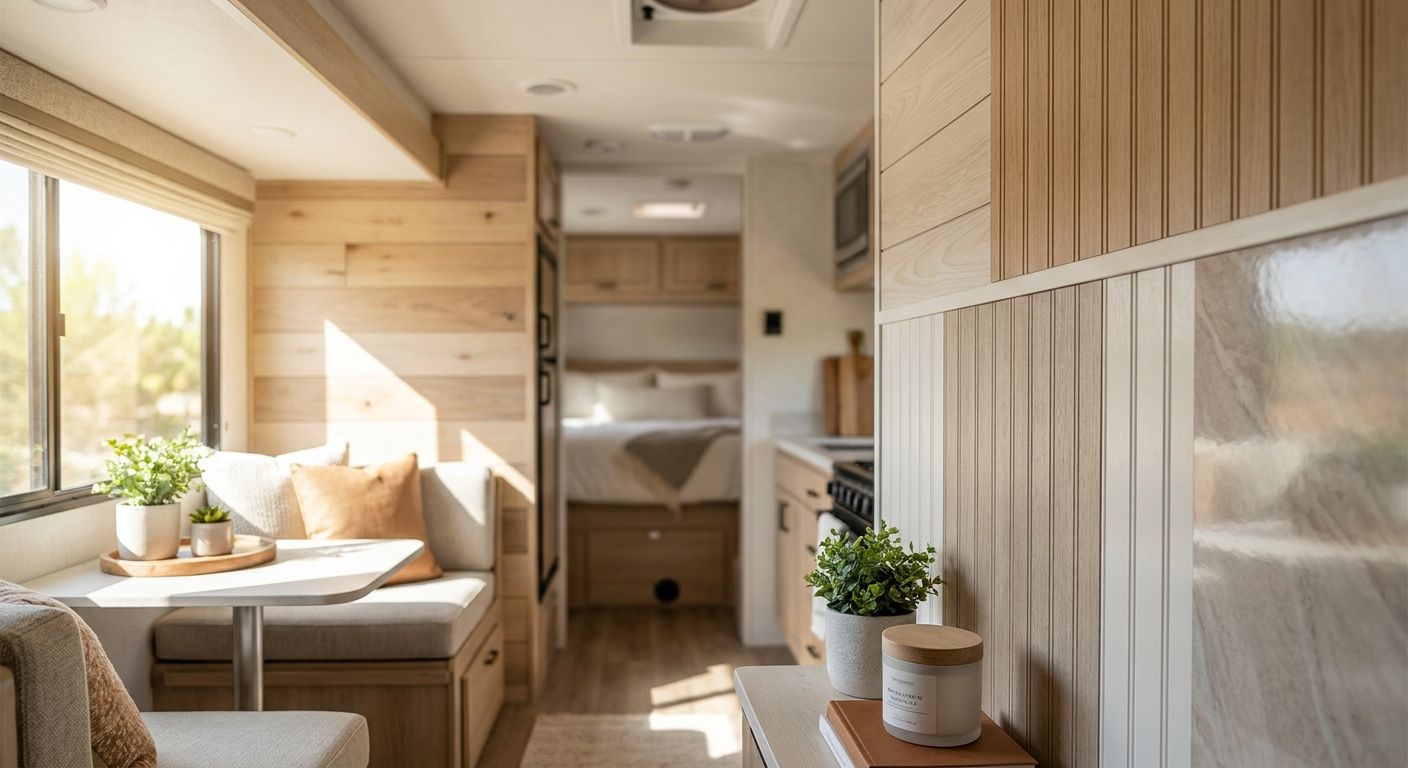
RV and camper walls are thin, curved, and moving down the highway at 65 mph — a wall panel that behaves fine in a house bedroom can crack, peel, or add weight a small rig can't spare. This guide ranks six wall panel options against the problems that actually matter in a camper: vibration, humidity, curb weight, and installing without gutting the wall.
- SoundPanel American Acoustic Slat Wood Wall Panels is the best overall pick for RV interiors, combining real wood with an NRC 0.85 rating.
- RockSurface Highland Rock Wall Panel is the best choice for galley and wet-zone walls that flex and get splashed.
- RockSurface Canyon Rock Wall Panel is the budget option among the six panels ranked here.
- Every panel in this guide from The Panel Hub installs in under 2 hours, a real factor in a camper’s tight footprint.
- The best wall panels for RV interiors in 2026 balance weight and moisture tolerance, not just looks.
Why this matters
A camper wall isn't a stud wall. It's a thin composite skin over aluminum or wood framing, and it moves every time you drive over a pothole. Panels that rely on heavy mechanical fasteners or thick MDF backers add weight you're already fighting against axle ratings and fuel economy.
Road noise is the other problem nobody budgets for. A generator running outside, tires on gravel, and rain on a fiberglass roof all bounce around a hard-surfaced interior. The SoundPanel American Acoustic Slat Wood Wall Panels carry an NRC 0.85 rating specifically to cut that kind of reflected noise, which matters more in a 200-square-foot box than it does in a living room.
Humidity is the third variable. Galley walls and shower nooks in a camper see condensation swings a house wall never sees, so panel choice near water needs to resist warping, not just look good on day one.
What makes the best wall panels for RV interiors
- Low weight per panel — every pound matters against a trailer's GVWR.
- Moisture tolerance — galley and bathroom-adjacent walls need panels that won't cup or swell.
- Install time under 2 hours per section — you're working in a cramped space, often solo.
- Acoustic performance (NRC rating) — reduces road noise and generator hum inside the cabin.
- Real wood vs. faux options — real wood adds warmth; faux stone or acoustic composites add durability in high-touch zones.
- FSC certification — matters if the panel is going into a build meant to last as long as the rig.
RV wall panels at a glance
| Panel | Best for | Standout feature | Key limitation |
|---|---|---|---|
| SoundPanel American Acoustic Slat Wood Wall Panels | Overall / road-noise dampening | NRC 0.85 rating on real wood veneer | Adds more visual weight than a flat panel |
| RockSurface Highland Rock Wall Panel | Galley and wet-zone accent walls | Faux stone surface, moisture-tolerant | Not an acoustic product — no NRC rating |
| RockSurface Canyon Rock Wall Panel | Budget-conscious builds | Lowest-cost option in this lineup | Same texture family as Highland — less variety if paired |
| Acoustic Slat White Felt Wood Wall Panels | Lightweight ceiling or bunk overhead | Felt-backed acoustic core, lighter feel | Lighter shade shows road grime faster than darker finishes |
| Crossing Lines Solid Wood Wall Panels | Real-wood living-area accent | Solid wood crossing-line pattern | No acoustic backing — decorative only |
| Hexagon Acoustic Wood Wall Panels | Dinette or small nook | Geometric hexagon shape breaks up small walls | Cutting hexagons around curved RV corners takes more planning |
1. SoundPanel American Acoustic Slat Wood Wall Panels: best overall for RV interiors
This is a real-wood-veneer slat panel bonded to an acoustic core rated NRC 0.85, built for walls that need to look finished and quiet down the cabin at the same time. It's the panel to reach for on the main living wall of a camper or Class B van build, where road noise and a flat interior surface are both problems.
SoundPanel American Acoustic Slat Wood Wall Panels pros:
- NRC 0.85 rating cuts reflected road and generator noise
- Real wood veneer, not a printed laminate
- Installs in under 2 hours per section per The Panel Hub's standard install guidance
SoundPanel American Acoustic Slat Wood Wall Panels cons:
- Heavier than a flat MDF or PVC panel, worth checking against your rig's weight margin
- Slat texture collects dust in a way a flat panel doesn't
Best for: the main living wall or headboard wall in a camper or van build.
Verdict: Buy.
2. RockSurface Highland Rock Wall Panel: best for galley and wet-zone walls
RockSurface Highland Rock Wall Panel is a faux stone surface panel, built to bring a natural rock look into a space without the weight or installation complexity of real stone veneer. In a camper it works well behind a galley stove or in a bathroom nook where condensation and splashing are routine.
RockSurface Highland Rock Wall Panel pros:
- Faux stone texture handles moisture better than raw wood veneer
- Lighter than actual stone or tile, a real advantage on a towed rig
- Distinct look from the wood panels elsewhere in the cabin, useful for a galley accent
RockSurface Highland Rock Wall Panel cons:
- No acoustic rating — this is a visual and moisture play, not a noise-reduction one
- Faux stone reads differently up close than real wood grain, which some buyers don't want next to a wood-paneled living area
Best for: galley backsplash walls and bathroom-adjacent accent walls.
Verdict: Buy.
3. RockSurface Canyon Rock Wall Panel: best budget option
RockSurface Canyon Rock Wall Panel shares the same faux stone construction as the Highland version but in a different finish, and it's the lowest-cost panel in this ranking. For a first-time camper renovation where the budget has to stretch across flooring, cabinetry, and walls, this is where the wall line item gets smaller without dropping durability.
RockSurface Canyon Rock Wall Panel pros:
- Lowest price point among the six panels ranked here
- Same moisture tolerance as the Highland finish
- Works as a small accent instead of covering a full wall, which keeps material cost down further
RockSurface Canyon Rock Wall Panel cons:
- Texture is close enough to Highland Rock that pairing both in one small space can look repetitive
- Not an acoustic panel
Best for: budget renovations and small accent sections rather than full walls.
Verdict: Buy.
4. Acoustic Slat White Felt Wood Wall Panels: best for ceilings and bunk overheads
This SoundPanel variant uses a white felt backing instead of the standard acoustic core, which keeps the finished weight lower — a meaningful detail when the panel is going overhead in a bunk area or ceiling section rather than a vertical wall.
Acoustic Slat White Felt Wood Wall Panels pros:
- Lighter overall build than the standard SoundPanel slat, better suited to ceiling mounting
- Still carries an acoustic core, so it dampens sound from a roof-mounted AC unit or rain
- Lighter finish brightens a low-ceiling bunk space
Acoustic Slat White Felt Wood Wall Panels cons:
- Light finish shows road dust and handprints faster than a darker oak tone
- Overhead installation in a curved RV ceiling takes more careful measuring than a flat wall
Best for: bunk ceilings and low-headroom overhead sections.
Verdict: Buy.
5. Crossing Lines Solid Wood Wall Panels: best real-wood accent for the living area
Crossing Lines Solid Wood Wall Panels is a purely decorative solid wood panel with a crossing-line pattern, no acoustic core attached. In a camper it's the panel for a slide-out wall or dinette accent where you want real wood grain but don't need noise dampening on that particular surface.
Crossing Lines Solid Wood Wall Panels pros:
- Solid wood construction, not veneer over composite
- Distinct pattern breaks up a flat interior wall
- Lighter than the acoustic-core panels since there's no backing layer
Crossing Lines Solid Wood Wall Panels cons:
- No sound dampening, so it does nothing for road noise
- Solid wood needs the same humidity awareness as any wood product near a galley or shower
Best for: slide-out walls or dinette accents where noise isn't the concern.
Verdict: Hold — pick this only after the acoustic walls are covered.
6. Hexagon Acoustic Wood Wall Panels: best for dinette nooks and small walls
Hexagon Acoustic Wood Wall Panels use a real-wood-veneer hexagon shape bonded to an acoustic core, which makes them a good fit for breaking up a small, awkward wall — the kind of nook you get next to a dinette bench or a narrow hallway wall in a travel trailer.
Hexagon Acoustic Wood Wall Panels pros:
- Geometric shape works on small wall sections where a full slat panel would look oversized
- Still carries acoustic backing, unlike Crossing Lines
- Real-wood-veneer surface, not printed
Hexagon Acoustic Wood Wall Panels cons:
- Cutting hexagons around a curved RV corner or window cutout takes more layout planning than a flat slat panel
- Higher piece count per square foot means more cut edges to seal against moisture
Best for: dinette nooks and narrow hallway walls.
Verdict: Buy.


How we ranked
Each panel above is scored against the criteria listed earlier: weight, moisture tolerance, install time, NRC rating where applicable, and material — real wood vs. faux stone. The acoustic panels rank higher for main living walls because road and generator noise is a daily problem in a small cabin; the faux stone panels rank higher for wet zones because that's where wood veneer struggles. Nothing here is scored on looks alone.
Which wall panel should you choose?
For a full living-area wall in a camper or van, SoundPanel American Acoustic Slat Wood Wall Panels is the default pick in 2026 — real wood, NRC 0.85, and a sub-2-hour install per section. If you're covering a galley or shower-adjacent wall, switch to RockSurface Highland Rock Wall Panel or the lower-cost Canyon Rock Wall Panel instead, since neither wood veneer option is built for constant moisture exposure. Ceilings and bunk overheads get the White Felt acoustic slat for the weight savings, and small nooks get the Hexagon Acoustic panel to avoid an oversized pattern on a small wall.
FAQ
What are the best wall panels for RV interiors in 2026?
SoundPanel American Acoustic Slat Wood Wall Panels is the best overall choice for RV interiors in 2026, rated NRC 0.85 for sound dampening on real wood veneer. Galley and wet-zone walls do better with a faux stone panel like RockSurface Highland Rock Wall Panel.
Are wood wall panels safe to use in a camper or RV?
Yes, real wood veneer wall panels work in a camper as long as they’re kept away from constant direct moisture, such as inside a shower stall. Galley backsplashes and bathroom-adjacent walls do better with a faux stone or moisture-tolerant panel instead.
Do acoustic wall panels actually reduce road noise in an RV?
Panels rated for sound absorption, like the SoundPanel line at NRC 0.85, reduce reflected noise inside a hard-surfaced cabin, which includes road hum and generator sound. A purely decorative panel with no acoustic core, like Crossing Lines Solid Wood Wall Panels, does nothing for noise.
How long does it take to install wall panels in an RV?
Panels from The Panel Hub are built to install in under 2 hours per section, though a curved RV wall or ceiling section takes longer than a flat house wall due to extra cutting and fitting.
What’s the cheapest wall panel option for a camper renovation?
RockSurface Canyon Rock Wall Panel is the lowest-cost option among panels commonly used in camper builds, and it still carries the same moisture tolerance as the higher-priced Highland Rock finish.
Can you put wall panels on RV ceilings?
Yes, but choose a lighter panel for overhead use — Acoustic Slat White Felt Wood Wall Panels uses a felt-backed core that reduces overall weight compared to the standard acoustic slat, making it better suited to bunk ceilings.
Do wall panels add too much weight to a travel trailer?
Weight varies by panel type; acoustic-core panels are heavier than flat decorative panels, so check your rig’s weight margin before covering multiple walls with the heavier options.
Is real wood or faux stone better for an RV bathroom wall?
Faux stone performs better in an RV bathroom because it resists the humidity swings that can warp real wood veneer over repeated exposure. RockSurface Highland Rock Wall Panel is built specifically for that kind of wet-zone use.
One last thing
The detail most camper renovators miss: pair the acoustic panel on the wall closest to the wheel wells, not the wall you'll see first walking in. Road noise transmits through the floor and side walls near the axles, so an NRC 0.85 panel does more work there than it does on a rear accent wall that only ever sees ambient cabin noise.
Related guides
Leave a Reply